Fatal Path by Fanning Ronan
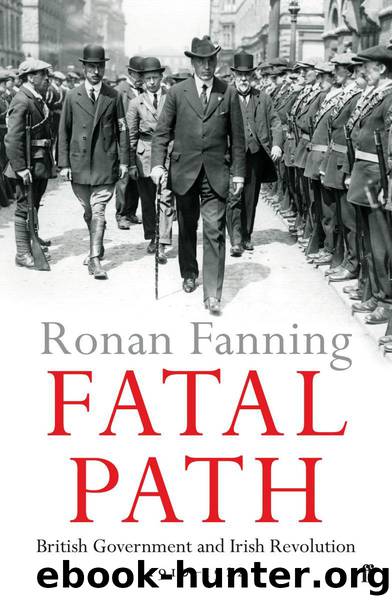
Author:Fanning, Ronan [Fanning, Ronan]
Language: eng
Format: mobi
ISBN: 9780571297412
Publisher: Faber & Faber
Published: 2013-04-29T16:00:00+00:00
Although the war cabinet continued to meet in London, policy-making on Ireland, as on everything else, was paralysed in Lloyd George’s absence. ‘Everything gets hung up while you are away,’ complained the king to his prime minister when he was about to return to Paris. ‘No one seems capable of taking any decision.’9 The cabinet secretary, Maurice Hankey, writing on Christmas Day 1918, brooded that Lloyd George was trying to ‘absorb too much into his hands. He seems to have a sort of lust for power: ignores his colleagues or tolerates them in an almost disdainful way’.10 Edward Shortt, when moving from the Irish office to the home office in January 1919, correctly predicted ‘that while the Peace Conference is sitting, it will be impossible to get Lloyd George to appreciate the situation and what should and can so easily be done’.11 ‘Lloyd George means to take a bold line on the Irish question the moment he is able to give the matter his personal attention, and appear before the world as the man who succeeded where Gladstone failed.’ But, as Horace Plunkett remarked, ‘the trouble is that while he is waiting for his opportunity England and Ireland are losing theirs’.12
Sinn Féin had meanwhile seized the opportunity to capitalise on its stunning victory in the general election. On 21 January 1919, the 37 of the 73 Sinn Féin MPs who were not in prison assembled in Dublin’s Mansion House and unanimously adopted a provisional constitution of their unilaterally established Irish parliament (Dáil Éireann), which proclaimed the establishment of an independent Irish republic. On that same day the first shots were fired in the guerrilla war of independence when the Irish Volunteers (shortly to be renamed the Irish Republican Army) killed two RIC constables escorting a cart of gelignite at Soloheadbeg in County Tipperary. On 3 February, Michael Collins, the effective leader of the IRA, engineered Éamon de Valera’s escape from Lincoln gaol; the remaining Sinn Féin internees were released between 6 and 10 March. On 1 April de Valera was elected president of Dáil Éireann but the Sinn Féin delegation sent by the Dáil to Paris to seek recognition of the Irish Republic and to lobby for admission to the peace conference failed to achieve either objective. On 4 April, Collins, now also the Dáil’s minister of finance, launched the first national loan to bankroll a revolutionary war, and on 1 June, de Valera left Ireland for the United States where he spent the next eighteen months garnering financial and political support.
The IRA’s initial focus in what is known either as the ‘War of Independence’ or the ‘Anglo-Irish War’ of 1919–21 was the ostracisation of the police. This soon became a campaign of attacking and burning RIC and coastguard stations, especially in remote rural areas, and then of killing soldiers as well as policemen. ‘Favourite targets of the IRA,’ in Tom Bartlett’s words, ‘apart from soldiers and policemen, were informers or “touts”, a catch-all category that appears to have included the likes of tinkers, tramps, ex-servicemen and Protestants.
Download
This site does not store any files on its server. We only index and link to content provided by other sites. Please contact the content providers to delete copyright contents if any and email us, we'll remove relevant links or contents immediately.
| Africa | Americas |
| Arctic & Antarctica | Asia |
| Australia & Oceania | Europe |
| Middle East | Russia |
| United States | World |
| Ancient Civilizations | Military |
| Historical Study & Educational Resources |
Cecilia; Or, Memoirs of an Heiress — Volume 1 by Fanny Burney(32550)
Cecilia; Or, Memoirs of an Heiress — Volume 2 by Fanny Burney(31950)
Cecilia; Or, Memoirs of an Heiress — Volume 3 by Fanny Burney(31934)
The Secret History by Donna Tartt(19065)
Sapiens: A Brief History of Humankind by Yuval Noah Harari(14375)
Leonardo da Vinci by Walter Isaacson(13321)
The Radium Girls by Kate Moore(12021)
Sapiens by Yuval Noah Harari(5366)
How Democracies Die by Steven Levitsky & Daniel Ziblatt(5217)
The Wind in My Hair by Masih Alinejad(5092)
Homo Deus: A Brief History of Tomorrow by Yuval Noah Harari(4910)
Endurance: Shackleton's Incredible Voyage by Alfred Lansing(4773)
Man's Search for Meaning by Viktor Frankl(4587)
The Silk Roads by Peter Frankopan(4527)
Millionaire: The Philanderer, Gambler, and Duelist Who Invented Modern Finance by Janet Gleeson(4472)
The Rape of Nanking by Iris Chang(4206)
Joan of Arc by Mary Gordon(4104)
The Motorcycle Diaries by Ernesto Che Guevara(4092)
Stalin by Stephen Kotkin(3960)
