Faith Comes by Hearing: A Response to Inclusivism by Christopher W. Morgan;Robert A. Peterson
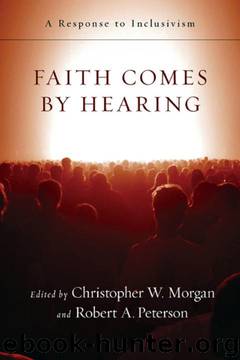
Author:Christopher W. Morgan;Robert A. Peterson
Language: eng
Format: epub
Published: 2012-12-10T01:13:00+00:00
When Paul speaks of the God-sent Holy Spirit, his perspective is always eschatological, looking forward to the end, of which our present experience of redemption and life in the Spirit is the beginning. The Spirit is the gift of the new age, the guarantee and foretaste, the pledge and first installment of what is to come when the fullness of salvation is revealed at Christ's return (Eph 1:13-14; Rom 8:23). It is this teaching on the relation between the old and the new, the flesh and the Spirit, the historical and the eschatological that forms the whole context within which Paul expounds his doctrines of the church and of salvation. It is in this context that he elaborates on his doctrine of the Spirit .116
What, then, are we to conclude from this redemptive-historical look at Scripture in terms of the Son-Spirit relation? Does it yield the same conclusions as the pneumatological approach? Does it give biblical grounds to think that the Spirit is salvifically at work in the world, bringing people to salvation apart from explicit faith in Christ? My answer is "no." In fact, as we examine the Son-Spirit relation progressively across redemptive history, what we discover is the opposite of the pneumatological approach. In the canon, the work of the Spirit, as it is progressively disclosed, is never divorced from the work of the Son and bringing people to faith in him. In other words, the Spirit's work is always tied to gospel realities.117 Thus, in light of the coming of Christ, it is the Spirit's role to bear witness of him; to convict the world of sin, righteousness and judgment so that they may believe in him (Jn 16:7-11).118 In truth, the Spirit's work, now in redemptive history, is to apply the work of Christ to us so that we may be brought to saving faith in Christ and increasingly conformed to his image. There is no indication in the Bible that the Spirit ever operates in a saving way apart from the gospel. Even though the Spirit's work as the third person of the Godhead is not fully disclosed in the OT, we are never led to think that God is salvifically at work in people's lives apart from bringing people into a covenantally defined relationship centered in the promises of God, now fulfilled in Christ.
What, then, is the main problem with the pneumatological approach? It is simply this: The work of the Spirit is stripped of its redemptive-historical connections, and then made to buttress the theological underpinning of the inclusivist's understanding of the "universality axiom." Or, as Daniel Strange rightly contends, "Rather than being Christocentric in his inclusivism, which I believe he would claim to be, Pinnock's position is pneumatocentric and as a result the particularity of Christ is compromised.... Pinnock's desire to universalize the particular has meant a separation of the epistemological from the ontological.""' And I would add: Pinnock's desire to universalize the particular has further compromised the whole plot line of Scripture and its presentation of the Son-Spirit relation in redemptive history.
Download
This site does not store any files on its server. We only index and link to content provided by other sites. Please contact the content providers to delete copyright contents if any and email us, we'll remove relevant links or contents immediately.
The Secret Power of Speaking God's Word by Joyce Meyer(3172)
Signature in the Cell: DNA and the Evidence for Intelligent Design by Stephen C. Meyer(3125)
Real Sex by Lauren F. Winner(3013)
The Holy Spirit by Billy Graham(2943)
The Gnostic Gospels by Pagels Elaine(2527)
Jesus by Paul Johnson(2352)
Devil, The by Almond Philip C(2324)
23:27 by H. L. Roberts(2245)
The Nativity by Geza Vermes(2226)
Chosen by God by R. C. Sproul(2160)
All Things New by John Eldredge(2157)
Angels of God: The Bible, the Church and the Heavenly Hosts by Mike Aquilina(1954)
The Return of the Gods by Erich von Daniken(1929)
Angels by Billy Graham(1921)
Knowing God by J.I. Packer(1852)
Jesus of Nazareth by Joseph Ratzinger(1808)
Evidence of the Afterlife by Jeffrey Long(1783)
The Gnostic Gospel of St. Thomas by Tau Malachi(1782)
How To Be Born Again by Billy Graham(1775)
