Christianity's Most Dangerous Idea by Kenneth Richard Samples
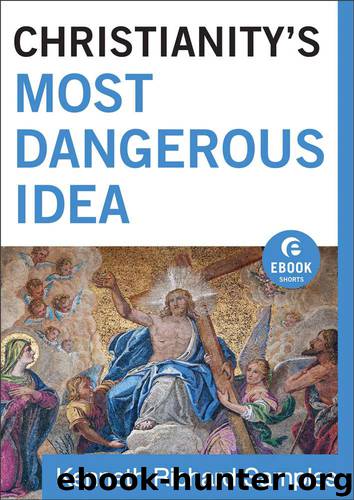
Author:Kenneth Richard Samples [Samples, Kenneth Richard]
Language: eng
Format: epub, mobi
Tags: Theology, Apologetics, Christian, Christian Books & Bibles, Religion & Spirituality, 90 Minutes (44-64 Pages)
ISBN: 9781441241436
Amazon: B00CA0VTHQ
Goodreads: 17869169
Publisher: Baker Books
Published: 2013-05-01T00:00:00+00:00
This reasoning clearly begs the question—that is, the premises illegitimately depend on the assumed conclusion—and it exposes an antisupernatural bias. This reasoning reveals a problem of having a basis on presuppositions rather than actual history.
Because good evidence supports the conclusion that the Gospels reflect early sources about the life and death of Jesus, one can assume that if the Gospel writers had departed from the historical facts (either by exaggeration or outright invention), hostile witnesses conversant with the events of Jesus’s life could have and would have exposed the untruths. As textual scholar F. F. Bruce writes, it could not have been easy “to invent words and deeds of Jesus in those early years, when so many of His disciples were about, who could remember what had and had not happened.”[28] The apostles, confident in their testimony, appealed to the firsthand knowledge of unbelievers who were conversant with the facts of Jesus’s life (see Acts 2:22; 26:25–27).
Viewing the resurrection of Jesus Christ as a legend or myth ignores the solid historical support (oral and written) behind the event, seems rooted in unsupported antisupernatural presuppositions, and fails to recognize the short interval of time between the emergence of the Gospel writings and the events they describe. Accordingly, this must be considered a highly implausible and inadequate explanatory theory.
2. Fraud Theory: Someone Stole the Body
According to the Gospel records, after hearing about the empty tomb some of the Jewish religious leaders bribed the guards to say that they had fallen asleep on their watch and that Jesus’s apostles had come in the night and stolen the body (Matt. 28:11–15). Regardless of how this story started, it became (in effect) the first alternative explanation of the resurrection scenario. On that basis it deserves analysis.
This theory disregards the fact that the apostles themselves at first did not believe that Jesus had risen. It also fails to account for the dramatic conversion of James, who was opposed to Jesus’s ministry and was turned around only through seeing the risen Jesus (see Mark 6:1–5; 1 Cor. 15:7; Gal. 2:9). The same is also true of Paul, who earlier had persecuted the early believers and was converted only through a direct encounter with the resurrected Christ. These factors also contradict the claim that someone other than the disciples stole Jesus’s body.
Now let’s examine further the idea that the disciples stole the body and pulled off a fraud. One must ask whether the apostles were even capable of stealing the body. In order to steal it, they would have had to bypass the guards and move the large, sealed stone (weighing possibly between one and a half and two tons) in front of the tomb. This makes a theft highly unlikely, especially since the apostles acted cowardly after Jesus’s initial arrest. Moreover, if the guards were asleep, then how did they know the identity of whoever stole the body?
What possible motivation would the apostles have for stealing the body anyway? They had nothing to gain and virtually everything to lose.
Download
Christianity's Most Dangerous Idea by Kenneth Richard Samples.mobi
This site does not store any files on its server. We only index and link to content provided by other sites. Please contact the content providers to delete copyright contents if any and email us, we'll remove relevant links or contents immediately.
The Secret Power of Speaking God's Word by Joyce Meyer(3165)
Signature in the Cell: DNA and the Evidence for Intelligent Design by Stephen C. Meyer(3124)
Real Sex by Lauren F. Winner(3006)
The Holy Spirit by Billy Graham(2942)
The Gnostic Gospels by Pagels Elaine(2522)
Jesus by Paul Johnson(2351)
Devil, The by Almond Philip C(2324)
23:27 by H. L. Roberts(2245)
The Nativity by Geza Vermes(2226)
Chosen by God by R. C. Sproul(2159)
All Things New by John Eldredge(2157)
Angels of God: The Bible, the Church and the Heavenly Hosts by Mike Aquilina(1952)
The Return of the Gods by Erich von Daniken(1927)
Angels by Billy Graham(1920)
Knowing God by J.I. Packer(1850)
Jesus of Nazareth by Joseph Ratzinger(1802)
The Gnostic Gospel of St. Thomas by Tau Malachi(1781)
Evidence of the Afterlife by Jeffrey Long(1776)
How To Be Born Again by Billy Graham(1775)
