Biblical Theology of the Holy Spirit by Burke Trevor J.; Warrington Keith;
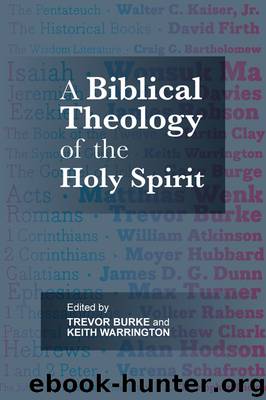
Author:Burke, Trevor J.; Warrington, Keith;
Language: eng
Format: epub
Publisher: SPCK
12
1 Corinthians
WILLIAM P. ATKINSON
Introduction
Paul generally used the term pneuma in 1 Corinthians to refer either to God’s Spirit or to the human spirit, distinguishing between them in a way that leaves no room for Fee’s suggested term ‘S/spirit’. God’s Spirit is illustrated by analogy with a human’s spirit as representing the inner recesses of God’s being and yet, as distinguishable from God, is sent out into God’s world and people. Similarly, the Spirit is linked to – though not identified with – Christ, and always honours him. The working of the Spirit is a demonstration of God’s power, possibly raising Christ and in turn believers from death. The Spirit is linked inextricably with divine wisdom. The Spirit is no mere inspirer of the exciting, spectacular and inexplicable. Rather, the Spirit is concerned with the content of Christian belief. The Spirit is holy and grants holiness to others. In receipt of the Spirit of holiness, believers are valuable to God. It is clear that God gives and believers receive the Spirit, but the Spirit is also understood as a giver. This process is not without risk of pride and division, and some of the Corinthians saw their spirituality in exclusive and elitist ways, and so Paul called for unity and mutual respect in their diverse giftedness.
This chapter aims to explore the Spirit in 1 Corinthians in ways that do justice to the wider context of Paul’s relationship with Corinth, and that focus where possible on the ontological as well as the functional, despite the intensely pragmatic outlook of the letter. In writing to Corinth, Paul was not answering dispassionate questions that called for enlightenment on matters of cool objective debate. This church was deeply divided and questions asked were appeals for Paul’s intervention to halt mounting confusion, disruption and possible destruction of its life (3.17,1 etc.). Among the several fractious parties in the church was a Paul party (1.12–16; 3.21–22; 4.6, 15) and this group, it can be assumed, communicated with Paul directly (1.11; 7.1; 11.18; 16.15–18).2 They may well have been reporting their consternation and bewilderment regarding the beliefs and behaviour of others in the church who were reluctant to turn to Paul – the other ‘parties’. These observations will emerge as particularly useful in the final section of this chapter, on the ‘spirituals’.
Earlier sections of this chapter seek to gaze behind the Corinthians’ – and therefore Paul’s – immediate pragmatic concerns to the theology and pneumatology that governed Paul’s replies. Some of this theology may have been operating at a fairly subconscious level in Paul; it is theology and pneumatology that ‘leaked out’ as Paul raced3 to answer the perplexing problems and intense grievances harboured by a divided and confused congregation.
Spirits divine, human and worldly
It is entirely clear that in 1 Corinthians Paul used the word pneuma in different ways. Most commonly, he used the term to refer sometimes to human spirits and sometimes to the divine Spirit.4 The clearest example of this distinction is in 2.11, where we read both of to pneuma tou anthrōpou to en autō and of to pneuma tou theou.
Download
This site does not store any files on its server. We only index and link to content provided by other sites. Please contact the content providers to delete copyright contents if any and email us, we'll remove relevant links or contents immediately.
The Five People You Meet in Heaven by Mitch Albom(3561)
The Secret Power of Speaking God's Word by Joyce Meyer(3182)
Real Sex by Lauren F. Winner(3014)
Name Book, The: Over 10,000 Names--Their Meanings, Origins, and Spiritual Significance by Astoria Dorothy(2979)
The Holy Spirit by Billy Graham(2944)
0041152001443424520 .pdf by Unknown(2843)
How The Mind Works by Steven Pinker(2813)
ESV Study Bible by Crossway(2774)
Ancient Worlds by Michael Scott(2682)
Churchill by Paul Johnson(2578)
The Meaning of the Library by unknow(2565)
The ESV Study Bible by Crossway Bibles(2550)
The Gnostic Gospels by Pagels Elaine(2527)
MOSES THE EGYPTIAN by Jan Assmann(2412)
Jesus by Paul Johnson(2352)
City of Stairs by Robert Jackson Bennett(2347)
The Complete Dead Sea Scrolls in English (7th Edition) (Penguin Classics) by Geza Vermes(2277)
The Nativity by Geza Vermes(2227)
Ancient Near Eastern Thought and the Old Testament by John H. Walton(2223)
