Belgium in the Great War by Jean-Michel Veranneman
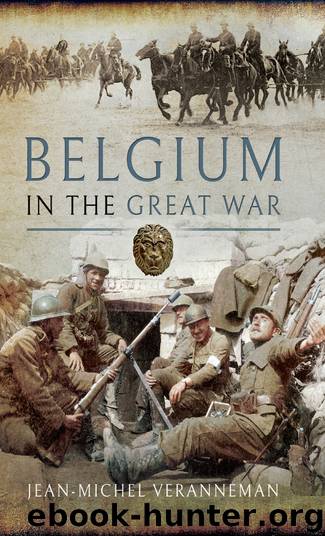
Author:Jean-Michel Veranneman
Language: eng
Format: epub
Tags: HISTORY / Military / Korean War
ISBN: 9781526716620
Publisher: Pen and Sword
Published: 2018-11-29T16:00:00+00:00
4.2 The Frontbeweging, the Flemish Movement at the Belgian Front
War has been described as long periods of boredom and waiting interspersed with intense terror and action. The long boredom was certainly there at the Yser front, held by the Belgian army after stabilization – that is between November 1914 and the last summer of the war in 1918. Most Belgian soldiers tried to keep themselves busy as we have seen, but for the Flemings among them having lots of time on their hands was particularly propitious for reflecting on who they were and what they were doing there. Most officers were French speakers from Wallonia and Brussels or French-speaking Flemings, the latter usually bilingual. Those who only spoke French rarely bothered to learn Dutch, even when encouraged to do so by the hierarchy. Only a few Flemish intellectuals had gone through the reserve officers training (some were later organized in Dutch). A number of the educated Flemish were NCOs or were even in the ranks. Others were teachers, priests, monks or seminarians, who usually acted as stretcher bearers or male nurses. Since the level of education was lower in mainly rural Flanders than in the (then) more developed industrial and urbanized Wallonia, a larger proportion of Flemings were serving in infantry units, while the proportion was inverted in the engineers, artillery and so on. With the advent of trench warfare the distinction between cavalry and infantry had disappeared in practice and Lanciers, Guides and Chasseurs à Cheval were now fighting dismounted.
A lot has been written about the respective proportions of Flemish and Walloon soldiers in infantry and the other arms, of the losses incurred and so forth. A few facts are thus in order here – as so often, political expediency has spawned myths. The proportion of Flemish soldiers in the infantry units was indeed higher than that of Walloons (about 60 per cent versus 37 per cent, the balance being difficult to classify) but it was not overwhelmingly so (not 80 per cent Flemish infantrymen as has been written by some). And according to some, 90 per cent of the Belgian soldiers killed in action were Flemish and many had died because they could not understand the orders given them in French! Serious Belgian (including Flemish) historians have taken a closer look at all this and worked on official army archives documenting the cases of KIAs, their unit, place of birth, circumstances of demise and so on11 and have reported facts, not hearsay. First, the population of Flanders was (and still is) larger than that of Wallonia. Next, the German invasion having come from the east there had been no time to mobilize many of the young Walloons, whereas the hostilities had moved gradually back into Flanders allowing more time to organize a complete call-up. Also, fewer Flemings than Walloons having the benefit of basic education there was a tendency to assign them to the infantry, where basic training was simpler for rankers than the engineers or artillery units, where greater skills were needed.
Download
This site does not store any files on its server. We only index and link to content provided by other sites. Please contact the content providers to delete copyright contents if any and email us, we'll remove relevant links or contents immediately.
Waking Up in Heaven: A True Story of Brokenness, Heaven, and Life Again by McVea Crystal & Tresniowski Alex(37812)
Empire of the Sikhs by Patwant Singh(23086)
We're Going to Need More Wine by Gabrielle Union(19046)
Hans Sturm: A Soldier's Odyssey on the Eastern Front by Gordon Williamson(18592)
Leonardo da Vinci by Walter Isaacson(13337)
The Radium Girls by Kate Moore(12030)
Tools of Titans by Timothy Ferriss(8398)
Educated by Tara Westover(8054)
How to Be a Bawse: A Guide to Conquering Life by Lilly Singh(7486)
Permanent Record by Edward Snowden(5848)
The Last Black Unicorn by Tiffany Haddish(5639)
The Rise and Fall of Senator Joe McCarthy by James Cross Giblin(5281)
Promise Me, Dad by Joe Biden(5154)
The Wind in My Hair by Masih Alinejad(5095)
A Higher Loyalty: Truth, Lies, and Leadership by James Comey(4964)
The Crown by Robert Lacey(4817)
The Iron Duke by The Iron Duke(4358)
Joan of Arc by Mary Gordon(4115)
Stalin by Stephen Kotkin(3969)
