After Tamerlane: The Rise and Fall of Global Empires, 1400-2000 by John Darwin
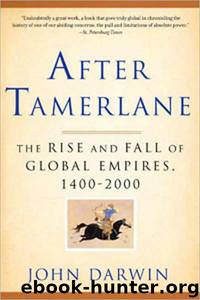
Author:John Darwin
Language: eng
Format: mobi, epub
Tags: Non-Fiction, Eurasian History, Geopolitics, 21st Century, v.5, Political Science, Amazon.com, World History, Retail, Military History, History
ISBN: 9781596916029
Publisher: Bloomsbury Press
Published: 2009-08-17T15:00:00+00:00
in the Islamic world) disliked the ruler’s embrace of foreign infidel practices, his web of corruption, and his extravagant lifestyle. In the army and bureaucracy, the Arabic-educated class loathed the continued domination of the Turko-Circassian elite, restored to favour by Ismail after Said’s flirtation with a more ‘Arabic’ policy. All these unresolved conflicts were charged with a sense of social malaise: fear and suspicion of European carpetbaggers; moral unease at the gross exploitation of the fellahin (rural cultivators) class, the principal victims of agrarian change.116 The mood of revolt now had a new voice in the journalists and newspapers that began to appear. Thus the external crisis over foreign debts (and Europe’s demand for effective control over Egypt’s finances) quickly turned into a crisis at home over who would bear the real burden of the foreign demands. The Suez Canal – the booster rocket towards full independence – became the Trojan Horse of foreign control, and (quite literally) the invasion route for alien rule.
Iran was more fortunate, and its rulers less bold. They had anyway much less room for manoeuvre. Mehemet Ali had founded his state on the power of his army and the wealth to be gained by the export of cotton. The Qajar rulers, who entrenched their power at much the same time, lacked these resources. Creating an army that would deter external aggressors and internal dissent was far more difficult: indeed, they had to make do with an imperial bodyguard of 4,000 men.117 The shahs faced the antipathy of the clerical elite – the Shi’a ulama – whose social power was much greater than that of the ulama in Egypt.118 They had to base their authority to a crucial degree on an alliance of tribes, since pastoral nomads made up more than a third (and perhapseven half) of thewhole population, and formeda massof armies in being. They had no bank of ‘new’ land with which to reward a compliant elite or finance a larger bureaucracy. And, although the Iranian economy staged a major recovery from the chaos and disorder of the late eighteenth century, there was no bonanza from cotton to draw in foreign investment or pay for a programme of public improvements in irrigation, railways or roads. The country remained in a stage of acute localization, in which tribe and sub-tribe, village community, artisan guild, urban quarter or ward, sect, religion or language remained the main source of identity and the main cause of division. In short, the means to build a strong dynastic state upon the Egyptian model were almost entirely lacking.
Yet the Qajars were threatened by external dangers at least as acute as those that confronted the Ottoman Empire. Russia’s expansion into the Caucasus had cost them dearly. By the treaties of Gulistan (1813) and Turkmanchai (1828) they had been forced to give up their claim on Georgia and Armenia and surrender much of Azerbaijan. The growth of Britain’s sea power in the Persian Gulf was bound to make them uneasy. It encouraged the
Download
After Tamerlane: The Rise and Fall of Global Empires, 1400-2000 by John Darwin.epub
This site does not store any files on its server. We only index and link to content provided by other sites. Please contact the content providers to delete copyright contents if any and email us, we'll remove relevant links or contents immediately.
| Africa | Americas |
| Arctic & Antarctica | Asia |
| Australia & Oceania | Europe |
| Middle East | Russia |
| United States | World |
| Ancient Civilizations | Military |
| Historical Study & Educational Resources |
Cecilia; Or, Memoirs of an Heiress — Volume 1 by Fanny Burney(32670)
Cecilia; Or, Memoirs of an Heiress — Volume 2 by Fanny Burney(32035)
Cecilia; Or, Memoirs of an Heiress — Volume 3 by Fanny Burney(32014)
The Secret History by Donna Tartt(19377)
Sapiens: A Brief History of Humankind by Yuval Noah Harari(14493)
Leonardo da Vinci by Walter Isaacson(13436)
The Radium Girls by Kate Moore(12126)
Sapiens by Yuval Noah Harari(5425)
How Democracies Die by Steven Levitsky & Daniel Ziblatt(5295)
The Wind in My Hair by Masih Alinejad(5162)
Homo Deus: A Brief History of Tomorrow by Yuval Noah Harari(4980)
Endurance: Shackleton's Incredible Voyage by Alfred Lansing(4872)
Man's Search for Meaning by Viktor Frankl(4687)
The Silk Roads by Peter Frankopan(4628)
Millionaire: The Philanderer, Gambler, and Duelist Who Invented Modern Finance by Janet Gleeson(4556)
The Rape of Nanking by Iris Chang(4286)
The Motorcycle Diaries by Ernesto Che Guevara(4183)
Joan of Arc by Mary Gordon(4181)
Stalin by Stephen Kotkin(4030)
