Acts 1-12 For You by R. Albert Mohler Jr
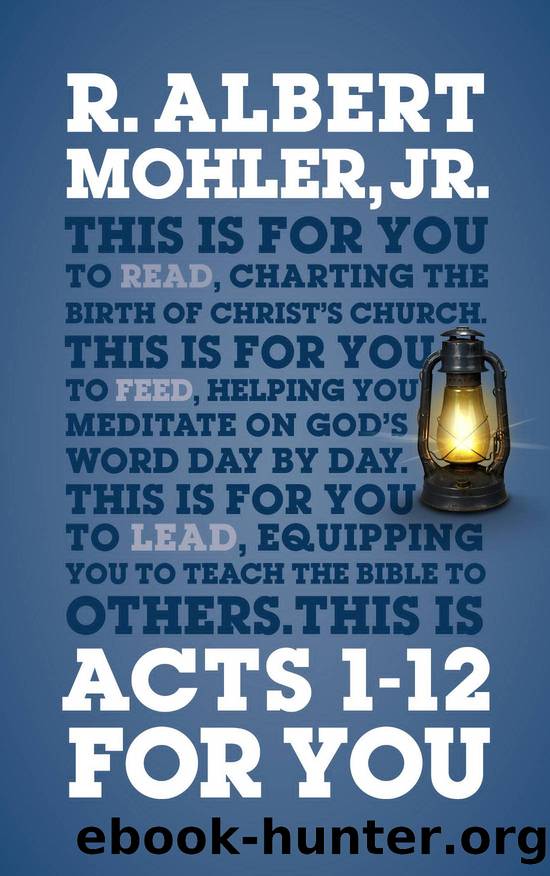
Author:R. Albert Mohler, Jr.
Language: eng
Format: epub
ISBN: 9781909919938
Publisher: The Good Book Company
Published: 2017-10-04T16:00:00+00:00
Christianity and the Temple
Stephen also makes a similar argument with regard to the temple. Just as the law was not an end unto itself, so too the temple ultimately pointed beyond itself. The temple, the bulwark of Judaism in the time of Jesus, was passing away. Everything the temple represented was perfectly fulfilled in Christ. For those Jews who regarded the temple as the very center of their religious life, Stephen’s claim would have been near blasphemous. Yet as he reflected on the scope of redemptive history, Stephen recognized that the physical temple had heralded the day in which Christ, the great High Priest, went behind the curtain of the temple “not made with hands” and made final atonement for the sins of his covenant people (Hebrews 9:11-14; 6:19-20).
Stephen makes this argument by showing that God’s presence in the Old Testament was never confined to the temple or even to the land of Israel. Instead, God appeared to Abraham in Mesopotamia (Acts 7:2). As Stephen goes on to explain, God continued to appear to Abraham and even cut a covenant with him all while Abraham did not even own a “foot’s length” in the promised land (v 3-8). God was “with” Joseph in Egypt (v 9). God even visited Moses in the wilderness outside the promised land (v 30-33). Then God dwelt in the tabernacle outside of Israel during the time of promise (v 44-45). It was not until the days of Solomon that God’s dwelling had a fixed location in the temple (v 45-47). Yet even Solomon recognized that the temple could never truly serve as God’s ultimate dwelling place. This evidence leads to Stephen’s conclusion in verse 48: “The Most High does not dwell in houses made by hands.”
Stephen also quotes from Isaiah 66:1-2, showing that even the prophets recognized that God’s presence could never be restricted to one location (Acts 7:49-50). The fact that God was never confined to the temple, and the fact that the story of God’s presence develops across the pages of the Old Testament, demonstrate that the story of the temple was incomplete under the old covenant. True believers would have recognized that there would come a day when God would be with his people in a way that was even greater than under the old covenant.
Stephen thus turns the tables on his listeners. He, not they, has remained faithful to Scripture’s teaching on Moses, the law, and the temple. Stephen becomes the prosecutor in this court scene and charges his audience with the ultimate crime: “You stiff-necked people, uncircumcised in heart and ears, you always resist the Holy Spirit. As your fathers did, so do you” (v 51).
Stephen’s scathing indictment has the ring of an Old Testament prophet. This, of course, is intentional. Stephen is saying that just as the brothers of Joseph rejected Joseph (v 9-16), and just as the people of Israel rejected Moses (v 35), so too the people of Israel are now rejecting Jesus, through rejecting his messenger Stephen.
Download
This site does not store any files on its server. We only index and link to content provided by other sites. Please contact the content providers to delete copyright contents if any and email us, we'll remove relevant links or contents immediately.
The Five People You Meet in Heaven by Mitch Albom(3581)
The Secret Power of Speaking God's Word by Joyce Meyer(3246)
Real Sex by Lauren F. Winner(3029)
Name Book, The: Over 10,000 Names--Their Meanings, Origins, and Spiritual Significance by Astoria Dorothy(2992)
The Holy Spirit by Billy Graham(2963)
0041152001443424520 .pdf by Unknown(2853)
How The Mind Works by Steven Pinker(2823)
ESV Study Bible by Crossway(2784)
Ancient Worlds by Michael Scott(2694)
Churchill by Paul Johnson(2593)
The Meaning of the Library by unknow(2582)
The ESV Study Bible by Crossway Bibles(2555)
The Gnostic Gospels by Pagels Elaine(2538)
MOSES THE EGYPTIAN by Jan Assmann(2424)
Jesus by Paul Johnson(2368)
City of Stairs by Robert Jackson Bennett(2363)
The Complete Dead Sea Scrolls in English (7th Edition) (Penguin Classics) by Geza Vermes(2294)
The Nativity by Geza Vermes(2235)
Ancient Near Eastern Thought and the Old Testament by John H. Walton(2230)
