A Practical Method for Taus, Dilruba, and Esraj by Michael Wheeler
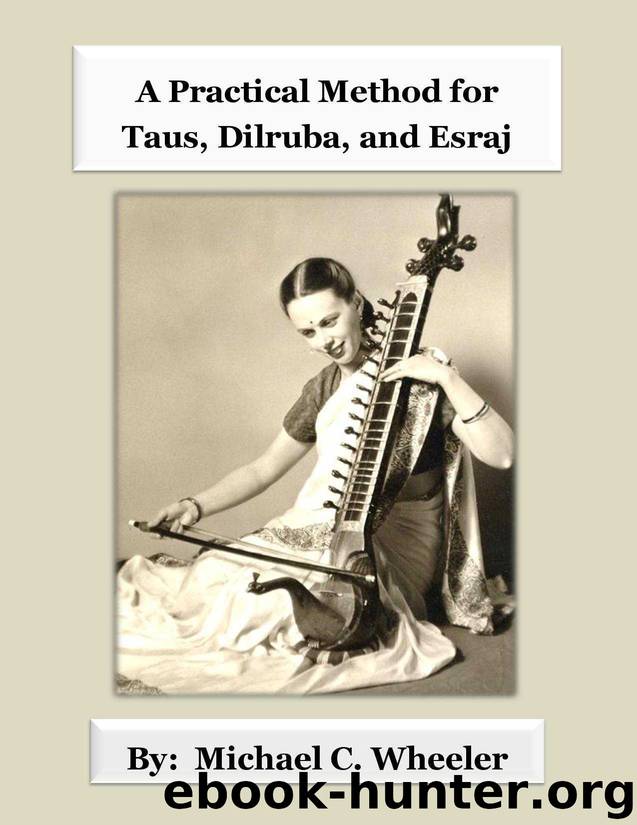
Author:Michael Wheeler [Wheeler, Michael]
Language: eng
Format: azw3
Published: 2012-09-12T04:00:00+00:00
References:
Bagchee, Sandeep. Nād: Understanding Rāga Music. Mumbai: Eeshwar, 1998. Print.
Bakshi, Haresh. 101 Raga-s for the 21st Century and Beyond: A Music Lover's Guide to Hindustani Music. Victoria, B.C.: Trafford, 2005. Print.
Raga Unveiled: India's Voice. Dir. Gita Desai. Prod. Mukesh Desai. Perf. Subhash Kak, Ashok Ranade, and Zakir Hussain. Self, 2009. DVD.
Vir, Ram Avtar. Theory of Indian Music. New Delhi: Pankaj, 1980. Print.
Chapter 5: Technique (Part I)
For our purposes, the word “technique” really means “skill.” When we think of someone playing an instrument with good technique, we usually think of someone who is performing beautifully with very little effort. Using the right sitting position and good fingering are just two ingredients that will help us play well. For Taus, Dilruba, and Esraj the best way we achieve good technique will be through forming good habits early on, and then moving on to the playing of various exercises called “Palta” or “Alankar.”
A Word on “Universal Technique:” It would be grossly incorrect to say that there is only one way to play these instruments. All over India, Pakistan, and Afghanistan there are slightly different bow-holds, fingering, sitting positions and fret-layouts. It is very important not to confuse the suggested approach in this text with an endorsement as “the best” way to play. Rather, these suggestions simply represent one way these instruments are learned. Your instructor may have a way that suits you (and your learning) better.
Taus Sitting Position:
Although the Taus can be played using any position below, there has been an effort to make special mention of the pictured position. Because Taus is such a large instrument, it is recommended that the player adopt the posture seen to the left. In this position, the Taus is rested between crossed legs and braced against the left shoulder.
Download
This site does not store any files on its server. We only index and link to content provided by other sites. Please contact the content providers to delete copyright contents if any and email us, we'll remove relevant links or contents immediately.
The Goal (Off-Campus #4) by Elle Kennedy(13817)
Kathy Andrews Collection by Kathy Andrews(12003)
Diary of a Player by Brad Paisley(7668)
Assassin’s Fate by Robin Hobb(6311)
What Does This Button Do? by Bruce Dickinson(6275)
Big Little Lies by Liane Moriarty(5894)
Altered Sensations by David Pantalony(5176)
Pale Blue Dot by Carl Sagan(5096)
Sticky Fingers by Joe Hagan(4268)
The Death of the Heart by Elizabeth Bowen(3688)
The Heroin Diaries by Nikki Sixx(3619)
Confessions of a Video Vixen by Karrine Steffans(3363)
Beneath These Shadows by Meghan March(3354)
How Music Works by David Byrne(3337)
Computational Linguistics and Intelligent Text Processing: 20th International Conference, CICLing 2019 La Rochelle, France, April 7â13, 2019 Revised Selected Papers, Part I by Alexander Gelbukh(3252)
The Help by Kathryn Stockett(3201)
Jam by Jam (epub)(3163)
Harry Potter 4 - Harry Potter and The Goblet of Fire by J.K.Rowling(3148)
Strange Fascination: David Bowie: The Definitive Story by David Buckley(2919)
