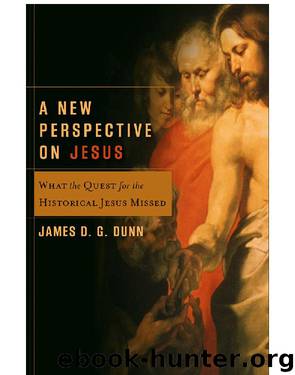
A New Perspective on Jesus by James D. G. Dunn
Author:James D. G. Dunn
Language: eng
Format: epub
Tags: REL006100, Jesus Christ—Historicity—History of doctrines—20th century, Jesus Christ—History of doctrines—20th century
ISBN: 9781585585595
Publisher: Baker Publishing Group
Published: 2012-11-19T16:00:00+00:00
The gospels are books made out of books; none of them is a document which simply transcribes the oral teaching of an apostle or of apostles. Their agreements and differences cannot be explained except on the hypothesis of a more or less close literary relationship, and while oral tradition is a vera causa, it is only a subordinate factor in the evolution of our canonical Greek gospels.[9]
It should occasion no surprise, then, that the hypothesis that emerged in the late-nineteenth and early-twentieth centuries as the most plausible resolution of the Synoptic Problem is still known simply as the two-document hypothesis.[10] And even when some variations are offered in explanation of some of the complexities of the data, like Ur-Markus or Proto-Luke, what is envisaged are still written documents.[11] The literary paradigm continues to determine the way the problem and its solution are conceptualized. B. H. Streeter certainly recognized the importance of “a living oral tradition” behind the Gospels and cautioned against studying the Synoptic Problem “merely as a problem of literary criticism,” but, ironically, he went on to develop “a four document hypothesis.”[12]
The main development from and challenge to source criticism was, of course, form criticism, which began as a deliberate attempt to break away from the literary paradigm and to conceptualize the transmission process in oral terms. The character of the challenge was already signaled by Wellhausen’s observation: “Die letzte Quelle der Evangelien ist mündliche Überlieferung, aber diese enthält nur den zerstreuten Stoff.”[13] In effect, Wellhausen was combining the hypotheses of Herder and Schleiermacher—Jesus tradition as oral tradition but in small units. Bultmann took up the challenge when he defined the purpose of form criticism thus: “to study the history of the oral tradition behind the gospels.”[14] His analysis of The History of the Synoptic Tradition, I need hardly remind you, became the single most influential exposition of Formgeschichte.[15]
Unfortunately, however, Bultmann could not escape from the literary default setting; he could not conceive of the process of transmission except in literary terms. This becomes most evident in his conceptualization of the whole tradition about Jesus as “composed of a series of layers.”[16] The imagined process is one where each layer is laid or builds upon another. Bultmann made such play with it because, apart from anything else, he was confident that he could strip off later (Hellenistic) layers to expose the earlier (Palestinian) layers.[17] The image itself, however, is drawn from the literary process of editing, where each successive edition (layer) is an edited version (for Bultmann, an elaborated and expanded version) of the previous edition (layer). But is such a conceptualization really appropriate to a process of oral retellings of traditional material? Bultmann never really addressed the question, despite its obvious relevance.
Similarly, Kümmel in his classic Introduction recognizes the importance of oral tradition, both in “fixing” the gospel material in written form and in the reworking of the earliest sources into the canonical Gospels; but his discussion focuses mainly on the two-source hypothesis, and his references to form-critical
Download
This site does not store any files on its server. We only index and link to content provided by other sites. Please contact the content providers to delete copyright contents if any and email us, we'll remove relevant links or contents immediately.
| Guides | New Testament |
| Old Testament |
The Five People You Meet in Heaven by Mitch Albom(3550)
The Secret Power of Speaking God's Word by Joyce Meyer(3161)
Real Sex by Lauren F. Winner(3005)
Name Book, The: Over 10,000 Names--Their Meanings, Origins, and Spiritual Significance by Astoria Dorothy(2969)
The Holy Spirit by Billy Graham(2938)
0041152001443424520 .pdf by Unknown(2842)
How The Mind Works by Steven Pinker(2811)
ESV Study Bible by Crossway(2772)
Ancient Worlds by Michael Scott(2677)
Churchill by Paul Johnson(2576)
The Meaning of the Library by unknow(2563)
The ESV Study Bible by Crossway Bibles(2546)
The Gnostic Gospels by Pagels Elaine(2517)
MOSES THE EGYPTIAN by Jan Assmann(2411)
Jesus by Paul Johnson(2349)
City of Stairs by Robert Jackson Bennett(2337)
The Complete Dead Sea Scrolls in English (7th Edition) (Penguin Classics) by Geza Vermes(2269)
The Nativity by Geza Vermes(2224)
Ancient Near Eastern Thought and the Old Testament by John H. Walton(2219)
