When Painkillers Become Dangerous by Drew Pinsky
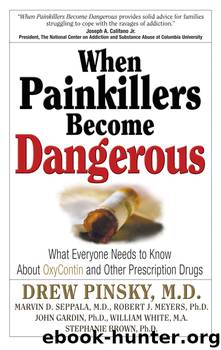
Author:Drew Pinsky
Language: eng
Format: epub
Publisher: Hazelden Publishing
Published: 2004-09-22T04:00:00+00:00
OxyContin Addiction
A New Drug, but an Old Problem
William White, M.A.
The recent media attention generated by OxyContin is only the latest chapter in America’s long history of addiction to medically prescribed narcotics and non-narcotic painkillers. In this chapter, we will explore drugs (from alcohol and tobacco to narcotics and cocaine), both patent and prescription, that were used for legitimate medical purposes but had unexpected consequences, including addiction. My intent is neither to castigate all drugs whose excessive or prolonged use can produce substance use disorders, nor indict the drug companies that manufacture them, the physicians who prescribe them, and the pharmacists who distribute them. Many of the drugs discussed here have provided a needed balm to millions. My intent is rather to underscore the shadow side of the long history of the use of psychoactive drugs within American medicine. The goal is to sit at history’s feet and see what lessons are offered us on this problem.
OxyContin was introduced into American medicine as a Schedule II prescribed narcotic in December 1995. Its primary active ingredient, oxycodone, has been an ingredient of more than fifty prescribed pain medications (Percodan and Percocet, for example) since the 1960s. OxyContin is distinguished by a high dosage of oxycodone that is time-released. It is this quality that made it an ideal drug in the management of severe pain related to conditions ranging from back injury to cancer. For many patients suffering from severe chronic pain, OxyContin seemed God-sent. Its effectiveness as a painkiller contributed to its rapid popularity.
Reports of OxyContin misuse and addiction increased dramatically in 2002 and 2003. Obtained through forged prescriptions, unscrupulous physicians and pharmacists, theft, and a growing black market, the pills were crushed and snorted or injected to obtain a heroin-like effect. The drug became known as “hillbilly heroin” due to its popularity in economically depressed rural communities such as those found in Appalachia.1 Alarm over OxyContin addiction was triggered by increased reports of OxyContin-related deaths, emergency room admissions, and addiction treatment admissions.
Complicating the increase in OxyContin use was a parallel increase in the misuse of other narcotic medications, particularly those containing hydrocodone and acetaminophen (Vicodin, Lortab), hydrocodone and aspirin (Lortab ASA), and hydrocodone and ibuprofen (Vicoprofen). Media attention related to celebrity use of drugs containing oxycodone and hydrocodone peaked in 2003, but this was only the tip of the iceberg; this trend is indicated by the fact that the number of people admitted to treatment in the United States for dependence on prescription painkillers doubled between 1992 and 2002.2
While this book focuses on a particular category of drugs— prescription narcotics—and a particular drug—OxyContin—that are generating considerable alarm in many communities, this book might also serve as a case study of drugs whose great benefit is stained by their unforeseen potential for misuse and dependence. Preventing and managing this potential in existing and new drugs will require informed leaders and an informed citizenry.
This chapter explores the fascinating history of such drugs, and tries to extract principles for predicting, preventing, and managing what today is referred to as “prescription drug dependence.
Download
This site does not store any files on its server. We only index and link to content provided by other sites. Please contact the content providers to delete copyright contents if any and email us, we'll remove relevant links or contents immediately.
Unwinding Anxiety by Judson Brewer(73440)
The Art of Coaching by Elena Aguilar(53672)
The Fast Metabolism Diet Cookbook by Haylie Pomroy(21263)
Rewire Your Anxious Brain by Catherine M. Pittman(18805)
Healthy Aging For Dummies by Brent Agin & Sharon Perkins RN(17126)
Talking to Strangers by Malcolm Gladwell(13559)
The Art of Thinking Clearly by Rolf Dobelli(10721)
Mindhunter: Inside the FBI's Elite Serial Crime Unit by John E. Douglas & Mark Olshaker(9532)
Crazy Rich Asians by Kevin Kwan(9422)
The Compound Effect by Darren Hardy(9169)
Tools of Titans by Timothy Ferriss(8602)
Periodization Training for Sports by Tudor Bompa(8421)
Becoming Supernatural by Dr. Joe Dispenza(8376)
Wonder by R. J. Palacio(8245)
Bodyweight Strength Training by Jay Cardiello(8040)
Crystal Healing for Women by Mariah K. Lyons(8011)
Change Your Questions, Change Your Life by Marilee Adams(7938)
Nudge - Improving Decisions about Health, Wealth, and Happiness by Thaler Sunstein(7862)
Should I Stay or Should I Go? by Ramani Durvasula(7782)
