1001 Great Ideas for Teaching & Raising Children With Autism or Asperger's by Ellen Notbohm & Veronica Zysk & Temple Grandin
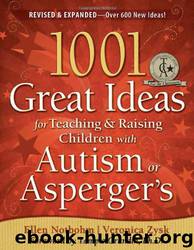
Author:Ellen Notbohm & Veronica Zysk & Temple Grandin [Notbohm, Ellen & Zysk, Veronica & Grandin, Temple]
Language: eng
Format: epub
Tags: Family & Relationships, Psychology, Children With Special Needs, Psychopathology, Autism Spectrum Disorders
ISBN: 9781935274063
Google: GnAh6JmCE0EC
Amazon: 1935274066
Publisher: Future Horizons
Published: 2010-02-27T00:00:00+00:00
First, be honest about whether your
child is ready to attend such an event.
If he truly can’t keep all four legs of
his chair on the floor, gets easily
overloaded in a room full of people
and noise, still thinks a fork is for
combing hair, and eats applesauce
with his fingers, it may be kinder to
all to leave him with a sitter this
time.
Visit the venue—restaurant, house of
worship—with
your
child
beforehand to give her a visual
image.
Explain what the event is (wedding,
bar mitzvah, grandparent’s birthday,
family reunion) and what will happen
at the event. What will she be
expected to do? Sit quietly during the
service, sign a guest book, get food
from a buffet?
If possible, arrange seating where
she will be able to see the event.
However, if you think she may not
make it through the entire event, sit
where you can take her out
unobtrusively.
Preview the menu and, if it is not
appropriate for your child, ask the
hotel or restaurant for a special meal.
Most are glad to do it. Offer to pay
separately. If special arrangements
are not possible, bring something for
your child as inconspicuously as
possible, or feed her beforehand so
she is not sitting around ravenously
watching everyone else eat. When
you’ve done what you can, don’t
sweat it further. Holidays and events
are so exciting for many children they
don’t eat much anyway.
Teach him a simple introduction and,
if he can tolerate it, a handshake.
Let him know there will be lots of
people there, but he doesn’t have to
hug or kiss anyone he doesn’t want
to, especially strangers. Then stay
close to support him in this. “Josh
prefers not to hug,” delivered in a
pleasant, unapologetic tone of voice
is perfectly acceptable.
Give appropriate fifteen-, ten- and
five-minute warnings, then leave
while he’s still having fun and the
memories will be good. In other
words, before the too-much-party
meltdown.
Having him tell the host “thank you
for inviting me” before leaving puts
nice closure on the event.
QUICK IDEA
A few months
before a holiday, ask
your child’s speech
language pathologist
to begin teaching
holiday vocabulary,
and incorporate topic
boards and
conversation related
to the event.
Never forget that autism has given your
child the gifts of rote memory, imitative
speech and literal interpretation. Refrain
from wondering aloud in the car on the
way to the party if Uncle Joe will over-
imbibe as usual, unless you want to hear
little Hannah check in later with “I want to
sit with Uncle Joe so I can see if he really
does drink like a fish!”
To hug or not to hug
Nowadays we teach all children, under
the banner of “stranger danger” and child-
abuse prevention, to protest any touch that
makes them uncomfortable. Children with
autism experience this tenfold. Many have
an aversion to hugs and kisses, even from
well-meaning relatives whom they may or
may not know well. The reasons are
many: the contact comes without warning,
the person hugging him smells funny, the
touch is too light or too harsh, it disturbs
his
vestibular
or
proprioceptive
equilibrium.
Download
This site does not store any files on its server. We only index and link to content provided by other sites. Please contact the content providers to delete copyright contents if any and email us, we'll remove relevant links or contents immediately.
Unwinding Anxiety by Judson Brewer(72995)
The Art of Coaching by Elena Aguilar(53195)
The Fast Metabolism Diet Cookbook by Haylie Pomroy(21131)
Rewire Your Anxious Brain by Catherine M. Pittman(18644)
Healthy Aging For Dummies by Brent Agin & Sharon Perkins RN(17038)
Talking to Strangers by Malcolm Gladwell(13350)
The Art of Thinking Clearly by Rolf Dobelli(10455)
Mindhunter: Inside the FBI's Elite Serial Crime Unit by John E. Douglas & Mark Olshaker(9324)
Crazy Rich Asians by Kevin Kwan(9279)
The Compound Effect by Darren Hardy(8949)
Tools of Titans by Timothy Ferriss(8369)
Periodization Training for Sports by Tudor Bompa(8254)
Becoming Supernatural by Dr. Joe Dispenza(8204)
Wonder by R. J. Palacio(8098)
Crystal Healing for Women by Mariah K. Lyons(7928)
Bodyweight Strength Training by Jay Cardiello(7909)
Change Your Questions, Change Your Life by Marilee Adams(7761)
Therapeutic Modalities for Musculoskeletal Injuries, 4E by Craig R. Denegar & Ethan Saliba & Susan Saliba(7715)
Nudge - Improving Decisions about Health, Wealth, and Happiness by Thaler Sunstein(7693)
