Your Foundation in Christ (Victory Series Book #3): Live By the Power of the Spirit by Neil T. Anderson
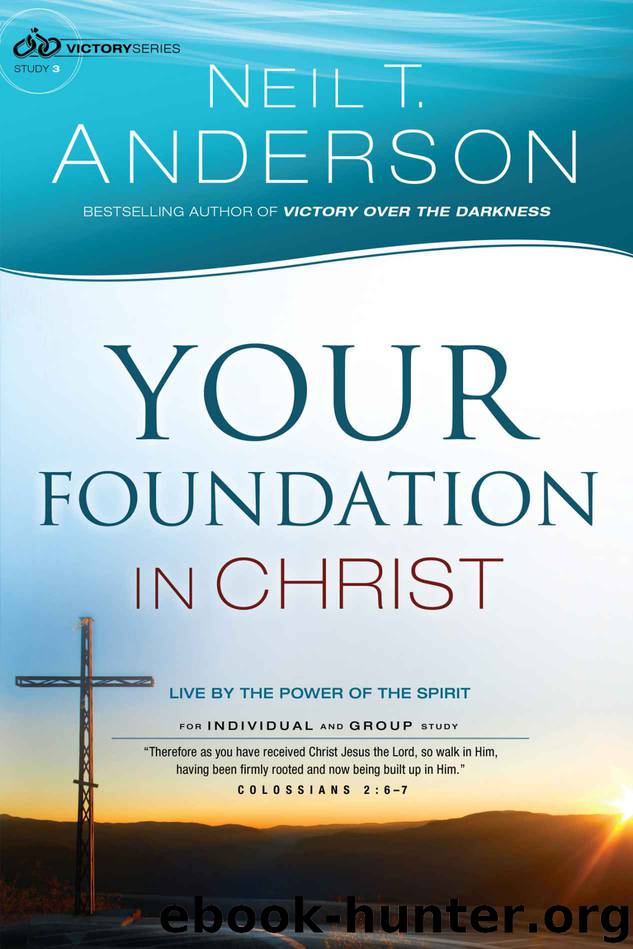
Author:Neil T. Anderson [Anderson, Neil T.]
Language: eng
Format: epub
Tags: REL012120
ISBN: 9781441265678
Publisher: Baker Publishing Group
Published: 2014-09-02T00:00:00+00:00
2
Discipline and Judgment
Zechariah 8:14–17
Key Point
Judgment is related to character, which we are not to judge; while discipline is related to behavior, which should be carried out in love.
Key Verse
God disciplines us for our good, in order that we may share in his holiness.
Hebrews 12:10
Judicial and civil decisions are made in the courts of our land when people commit crimes or fail to work out their differences with one another. Judges are to “render true and sound judgment” (Zechariah 8:16) based on evidence brought by witnesses. They aren’t judging people when they settle differences and determine guilt or innocence. They are determining guilt or innocence based on the law of the land and by the testimony of witnesses. Only God can righteously judge us.
God commands us not to judge one another, but He instructs us to discipline those caught in sin for the purpose of restoring fellowship. Knowing the difference between the two has profound implications for how we relate to others. Judgment is related to a person’s character, while discipline is related to a person’s behavior. Suppose you catch your son telling a lie and you say to him, “Son, what you just said right now isn’t true.” You are not judging him. You are confronting him for the purpose of discipline. If you said, “Son, you are a liar,” that would be judging him.
Some attempts at discipline are nothing more than character assassination. If you called someone dumb, stupid, or arrogant, how could he resolve that? He couldn’t instantly change his character. We are losing ground when we shovel dirt at one another. However, if you pointed out a behavior problem, he could own up to his sin, confess it, repent, and seek forgiveness from those he had offended. He may have to live with the consequences of the sin and make restitution, if warranted, but he could be reconciled with God and others.
Character is what we build up in one another, and we are not to tear it down. Many of the problems in our churches and families would disappear if we memorized Ephesians 4:29 and never violated it: “Do not let any unwholesome talk come out of your mouths, but only what is helpful for building others up according to their needs, that it may benefit those who listen.” When we tear each other down, we grieve the Holy Spirit (see verse 30). Let us do no evil to our neighbor. Let us speak the truth in love. In civil matters, let the judges in our courts decide our guilt or innocence based on witnesses, and let God be the judge of our character.
Discipline has to be based on observed behavior. We have to personally see or hear what others have said or done before we can rightfully confront them. The Mosaic Law required two or three witnesses in order to carry out a capital punishment (see Deuteronomy 19:15). Christians are likewise instructed to have two or three witnesses before bringing a sinning believer before the Church (see Matthew 18:15–20).
Download
This site does not store any files on its server. We only index and link to content provided by other sites. Please contact the content providers to delete copyright contents if any and email us, we'll remove relevant links or contents immediately.
The 5 Love Languages: The Secret to Love That Lasts by Gary Chapman(9792)
The Space Between by Michelle L. Teichman(6932)
Assassin’s Fate by Robin Hobb(6200)
Wiseguy by Nicholas Pileggi(5771)
Everything Happens for a Reason by Kate Bowler(4734)
Gerald's Game by Stephen King(4642)
Pillow Thoughts by Courtney Peppernell(4272)
A Simplified Life by Emily Ley(4158)
The Power of Positive Thinking by Norman Vincent Peale(4062)
Harry Potter and the Prisoner of Azkaban (Book 3) by J. K. Rowling(3355)
Resisting Happiness by Matthew Kelly(3337)
Girl, Wash Your Face by Rachel Hollis(3282)
Being Aware of Being Aware by Rupert Spira(3272)
The Secret Power of Speaking God's Word by Joyce Meyer(3184)
The Code Book by Simon Singh(3181)
More Language of Letting Go: 366 New Daily Meditations by Melody Beattie(3024)
Real Sex by Lauren F. Winner(3016)
Name Book, The: Over 10,000 Names--Their Meanings, Origins, and Spiritual Significance by Astoria Dorothy(2982)
The Holy Spirit by Billy Graham(2944)
