You Can't Say That! by Berstein David E
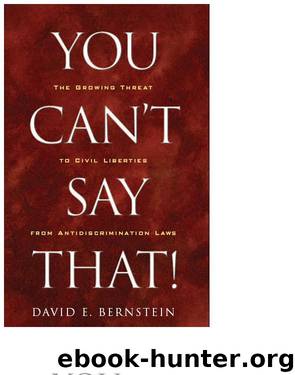
Author:Berstein, David E.
Language: eng
Format: epub
ISBN: 1-930865-53-8
Publisher: Cato Institute
Dale leaves many questions unresolved. For example, can for-profit businesses ever claim the right to expressive association in defiance of antidiscrimination laws, or, as Justice O’Connor suggested in her concurrence in Jaycees , can the right only be asserted by ‘‘primarily expressive’’ associations? If the latter, how does one determine whether a nonprofit organization is ‘‘primarily commercial,’’ as O’Connor thought the Jaycees to be, or primarily expressive? Under what circumstances must courts apply Jaycees’ compelling interest test, and when, if ever, does the government have an interest sufficient to overcome the First Amendment’s protection of expressive association? Despite these loose ends, the Court’s decision in Dale is the greatest victory yet won by civil liberties partisans in the conflict between antidiscrimination laws and civil liberties.
The reaction to Dale , however, has largely divided along ideological lines. ‘‘Conservatives’’ generally support Dale , because in their eyes it prevents government from taking sides in the culture wars. ‘‘Progressives,’’ including many liberals who otherwise have strong civil libertarian instincts, oppose Dale because it seems to deal a blow to gay rights. Progressives also fear that organizations that wish to discriminate against other groups will rely on Dale for constitutional exemptions from antidiscrimination laws.
As a legal matter, however, Dale was not about the conflict between gay rights activists and their opponents, nor was it about a general right to discriminate. Rather, the underlying issue in Dale was whether a private, nonprofit expressive association has a First Amendment right to discriminate when needed to prevent dilution of its message. Although the right of expressive association can benefit people on either side of the political spectrum, for the past two decades the right has been primarily raised as a defense to antidiscrimination claims by African Americans, women, and especially homosexuals. As a result, left-leaning organizations have typically sought to limit the scope of the constitutional right, while conservatives have been more supportive of the autonomy of private associations. As discussed below, however, the left may soon find that the constitutional right to expressive association has its uses. It may save one of the left’s favorite causes—affirmative action preferences at private universities—from interference by the government.
* * *
Download
This site does not store any files on its server. We only index and link to content provided by other sites. Please contact the content providers to delete copyright contents if any and email us, we'll remove relevant links or contents immediately.
The Thirst by Nesbo Jo(6952)
Permanent Record by Edward Snowden(5852)
The Myth of the Strong Leader by Archie Brown(5513)
Spare by Prince Harry The Duke of Sussex(5202)
A Higher Loyalty: Truth, Lies, and Leadership by James Comey(4967)
Secrecy World by Jake Bernstein(4756)
Adulting by Kelly Williams Brown(4582)
The Borden Murders by Sarah Miller(4330)
Machine Learning at Scale with H2O by Gregory Keys | David Whiting(4317)
Killers of the Flower Moon by David Grann(4062)
American Kingpin by Nick Bilton(3894)
The Secret Barrister by The Secret Barrister(3715)
Fear by Bob Woodward(3705)
Future Crimes by Marc Goodman(3603)
The Last Girl by Nadia Murad(3518)
The House on Mango Street by Sandra Cisneros(3476)
Liar's Poker by Michael Lewis(3455)
Oathbringer (The Stormlight Archive, Book 3) by Brandon Sanderson(3225)
The Social Psychology of Inequality by Unknown(3039)
