With Masses and Arms by La Serna Miguel;
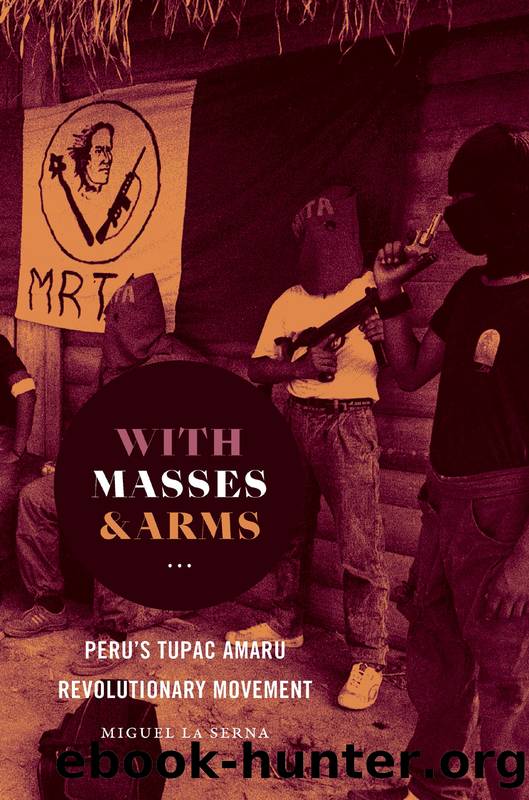
Author:La Serna, Miguel;
Language: eng
Format: epub
Publisher: University of North Carolina Press
Published: 2020-11-15T00:00:00+00:00
Part 3
13
Fujishock
The Canto Grande prison escape was a public relations coup for the Tupac Amaru Revolutionary Movement. Not even the stronger, more lethal Shining Path had achieved something so epic. To do so without the loss of a single life added a touch of romanticism to the narrative. âIt generated an enormous sympathy and respect within the population,â wrote Polay, âand many identified with the action, which punished and mocked a government that had allowed for all the plagues of Egypt to fall on its people. ⦠It also gave us an image of an MRTA that broke its shackles and chains and re-created itself resurging victoriously over its enemies.â1 As the remaining days of the GarcÃa administration dwindled, so did its hold on the media narrative. Officials accused prison authorities of assisting the prisoners, while critics accused the president of colluding with the rebels. GarcÃa and Polay had been close once, after all. Had the president, with one foot out the door, given his old roommate a final parting gift? The timing and circumstances of the escape only fueled the conspiracy theory.2
The fact that no one knew Polayâs whereabouts thickened the plot. âIs Polay Back in the Jungle?â asked La República three days after his escape.3 No one knew for sure. A lightning assault on the jungle town of Yurimaguas less than three weeks after his flight added to the speculation.4 When asked if Polay had spearheaded the attack, Interior Minister AgustÃn Mantilla gave an unreassuring answer: âI canât say whether Polay or any of the Canto Grande escapees were there, as the information I have at the moment is very sketchy.â5
This proved to be a turning point for the rebels. In one fell swoop, the MRTA had replenished most of its army and support base, exposed the incompetence of the state, and captured the attention of the media and the public. Never before had the group held such political leverage. Some in the rebel leadership, including VÃctor Polay and Alberto Gálvez, believed this to be their best opportunity to negotiate an end to the armed conflict and a dignified entry into the legal political sphere. They hoped that president-elect Alberto Fujimori, a political neophyte, would welcome the opportunity to disarm one of the countryâs fiercest guerrilla organizations. Fujimori had been a long-shot candidate. The former La Molina University rector had run against acclaimed writer and neoliberal Mario Vargas Llosa. Vargas Llosa had been favored to win until the run-off elections, at which point the diminutive Fujimori began gaining momentum in the polls. Popularly known as El Chino, the Chinaman, despite his purely Japanese heritage, Fujimori tapped into popular dissatisfaction with the status quo. His campaign slogan, Un presidente como tú, âA president like you,â hit home on this populist message. In electing Fujimori, the Peruvians had doubled down on democratic populism after a disappointing experiment with Aprismo. âVÃctor and I had reached the conclusion that the time had come to enter negotiationsâ with the incoming administration, Alberto Gálvez recalled.
Download
This site does not store any files on its server. We only index and link to content provided by other sites. Please contact the content providers to delete copyright contents if any and email us, we'll remove relevant links or contents immediately.
| Africa | Americas |
| Arctic & Antarctica | Asia |
| Australia & Oceania | Europe |
| Middle East | Russia |
| United States | World |
| Ancient Civilizations | Military |
| Historical Study & Educational Resources |
The Dawn of Everything by David Graeber & David Wengrow(1711)
The Bomber Mafia by Malcolm Gladwell(1629)
Facing the Mountain by Daniel James Brown(1557)
Submerged Prehistory by Benjamin Jonathan; & Clive Bonsall & Catriona Pickard & Anders Fischer(1459)
Wandering in Strange Lands by Morgan Jerkins(1432)
Tip Top by Bill James(1418)
Driving While Brown: Sheriff Joe Arpaio Versus the Latino Resistance by Terry Greene Sterling & Jude Joffe-Block(1378)
Red Roulette : An Insider's Story of Wealth, Power, Corruption, and Vengeance in Today's China (9781982156176) by Shum Desmond(1362)
Evil Geniuses: The Unmaking of America: A Recent History by Kurt Andersen(1357)
The Way of Fire and Ice: The Living Tradition of Norse Paganism by Ryan Smith(1341)
American Kompromat by Craig Unger(1321)
F*cking History by The Captain(1308)
It Was All a Lie by Stuart Stevens;(1302)
American Dreams by Unknown(1289)
Treasure Islands: Tax Havens and the Men who Stole the World by Nicholas Shaxson(1275)
Evil Geniuses by Kurt Andersen(1259)
White House Inc. by Dan Alexander(1216)
The First Conspiracy by Brad Meltzer & Josh Mensch(1175)
The Fifteen Biggest Lies about the Economy: And Everything Else the Right Doesn't Want You to Know about Taxes, Jobs, and Corporate America by Joshua Holland(1127)
