US Patrol Torpedo Boats by Gordon Rottman
Author:Gordon Rottman
Language: eng
Format: epub
Tags: US Patrol Torpedo Boats: World War II
ISBN: 9781780962085
Publisher: Osprey Publishing
Published: 2011-11-25T16:00:00+00:00
Propulsion
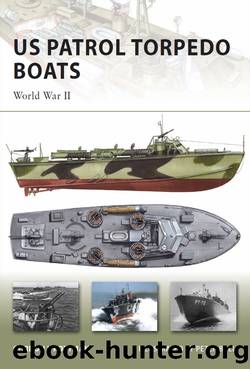
Besides firepower PT boats were built for speed. Three Packard 1,200 brake horsepower (bhp) 4-M2500 marine petrol engines were fitted with Holley aircraft carburetors. This same engine was used in all boats regardless of manufacturer. It has been rumored that it was a licensed copy of the British Rolls Royce-Marlin, but it is based on the Packard 1925 Liberty aircraft engine. This was a V12, four-stroke, saltwater-cooled, supercharged engine weighing 3,000lb. Engines developed 1,200bhp in 1940. Improvements raised it to 1,350bhp in 1943 and then 1,500bhp in 1945; these were necessary because of armament weight increases. The typical cruising engine speed was 2,400rpm. At their top speed of 41knots the engines reached 3,000rpm, but this could only be maintained for a short time. They used 100-octane aviation gasoline, which they could mooch off of seaplane tenders or cruisers (which had catapult aircraft). On the stern transom of Elco boats were six exhaust vents and mufflers. The exhaust could be directed through the mufflers with their outlets either underwater or bypassed to increase power. On Higgins boats there were three below-waterline exhaust vents and mufflers, one per side from each engine. The helmsman had throttles to control speed, but an annunciator on each signaled the engine room when the engine went from neutral (idle) to ahead so that they would know when to manually change gears. A speaking tube also connected the cockpit and engine room. One engine was forward of the other two on the centerline. Each had its own clockwise-rotating 28-in. three-bladed prop and rudder. The boat could run on any one engine in event the others were damaged or broke down. When running slow and quiet at night the center engine would be used. Its prop was deeper beneath the water and created less wake. At night the phosphorescent wake was easily detectable by aircraft and ships’ lookouts stationed in the tops. In daylight distant aircraft might detect the wake before the boat was seen.
Download
This site does not store any files on its server. We only index and link to content provided by other sites. Please contact the content providers to delete copyright contents if any and email us, we'll remove relevant links or contents immediately.
| Africa | Americas |
| Arctic & Antarctica | Asia |
| Australia & Oceania | Europe |
| Middle East | Russia |
| United States | World |
| Ancient Civilizations | Military |
| Historical Study & Educational Resources |
The Radium Girls by Kate Moore(12029)
100 Deadly Skills by Clint Emerson(4926)
Rise and Kill First by Ronen Bergman(4790)
The Templars by Dan Jones(4689)
The Doomsday Machine by Daniel Ellsberg(4490)
The Rape of Nanking by Iris Chang(4213)
Killing England by Bill O'Reilly(4004)
Stalin by Stephen Kotkin(3969)
Hitler in Los Angeles by Steven J. Ross(3946)
12 Strong by Doug Stanton(3550)
Hitler's Monsters by Eric Kurlander(3343)
Blood and Sand by Alex Von Tunzelmann(3205)
The Code Book by Simon Singh(3189)
Darkest Hour by Anthony McCarten(3133)
The Art of War Visualized by Jessica Hagy(3008)
Hitler's Flying Saucers: A Guide to German Flying Discs of the Second World War by Stevens Henry(2754)
Babylon's Ark by Lawrence Anthony(2679)
The Second World Wars by Victor Davis Hanson(2526)
Tobruk by Peter Fitzsimons(2518)
