Understanding World War I: A Concise History by Micallef Joseph
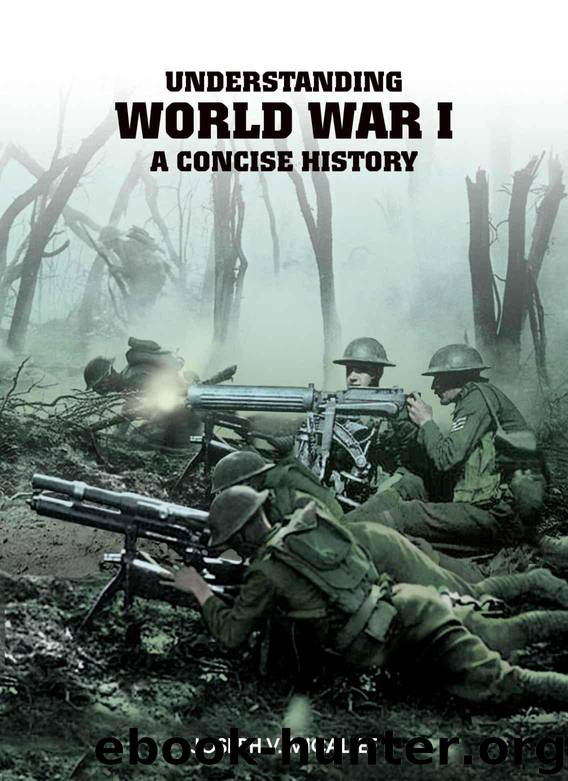
Author:Micallef, Joseph [Micallef, Joseph]
Language: eng
Format: epub
Publisher: Antioch Downs Press
Published: 2014-06-15T21:00:00+00:00
Battle of the Somme July - Nov 1916
What Haig’s planning failed to take into account was that the artillery’s shells—more than 12,000 tons of explosives—would prove unequal to the task of destroying the enemy’s frontline barbed wire or robustly built concrete bunkers. Many shells failed to explode. The German troops, safely dug into the chalk hills, simply took shelter in their bunkers until the bombardment stopped, and then emerged unscathed to man their machine guns.
Trench network Hawthorne Ridge Redoubt
The assault on July 1 began with the detonation of a 40,000-pound mine. It had been laid, after seven months of tunneling by Royal Engineers, beneath the German frontlines on Hawthorn Ridge Redoubt. That huge explosion was followed ten minutes later, at 0730 hours, by with the detonation of sixteen more mines and the first wave of troops going over the top with bayonets fixed. Not surprisingly, given the amount of warning the Germans had been given by the bombardment, and the failure of the artillery to break the defenses, those troops met with little success.
They met, instead, deadly machine gun and rifle fire that killed them, wounded them, or forced them back into their trenches. Many of the soldiers, weighed down by heavy supplies and expecting an easy passage to the German lines, took no more than a few steps before being struck down by the defenders. Further south French forces, whose offensive had been preceded by a much smaller bombardment, were more successful, but even they could do little more than consolidate their small gains rather than exploit them. Nevertheless, despite appalling losses, Haig persisted with his approach, believing as the battle raged on, that the Germans would eventually succumb to exhaustion and that victory was imminent. Small advances were sometimes made, but they were short-lived and never followed up. German commanders took the opportunity to transfer troops from Verdun, doubling the number of defenders, and reorganizing their lines.
Download
This site does not store any files on its server. We only index and link to content provided by other sites. Please contact the content providers to delete copyright contents if any and email us, we'll remove relevant links or contents immediately.
| Africa | Americas |
| Arctic & Antarctica | Asia |
| Australia & Oceania | Europe |
| Middle East | Russia |
| United States | World |
| Ancient Civilizations | Military |
| Historical Study & Educational Resources |
The Radium Girls by Kate Moore(12112)
100 Deadly Skills by Clint Emerson(4983)
Rise and Kill First by Ronen Bergman(4857)
The Templars by Dan Jones(4751)
The Doomsday Machine by Daniel Ellsberg(4576)
The Rape of Nanking by Iris Chang(4276)
Killing England by Bill O'Reilly(4064)
Stalin by Stephen Kotkin(4023)
Hitler in Los Angeles by Steven J. Ross(3993)
12 Strong by Doug Stanton(3590)
Hitler's Monsters by Eric Kurlander(3411)
The Code Book by Simon Singh(3269)
Blood and Sand by Alex Von Tunzelmann(3256)
Darkest Hour by Anthony McCarten(3184)
The Art of War Visualized by Jessica Hagy(3058)
Hitler's Flying Saucers: A Guide to German Flying Discs of the Second World War by Stevens Henry(2785)
Babylon's Ark by Lawrence Anthony(2744)
Tobruk by Peter Fitzsimons(2575)
The Second World Wars by Victor Davis Hanson(2559)
