Ultimate Security: Finding a Refuge in Difficult Times by Derek Prince
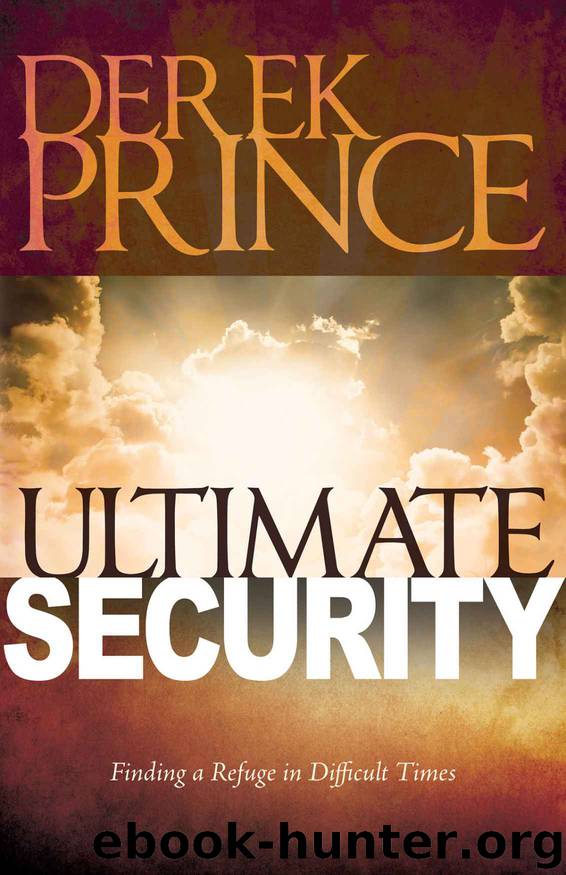
Author:Derek Prince [Prince, Derek]
Language: eng
Format: epub
Publisher: Whitaker House
Published: 2014-07-14T00:00:00+00:00
13
SEVENTH STAGE: GLORIFIED
In God’s plan for us, He did not stop at saving us, nor did He stop at justifying us. Rather, He went on to glorify us. It is very important to see that all these stages are in the past tense. If you can believe, on the basis of Scripture, that God saved you, then you can also believe, on the basis of the Word of God, that God justified you. Accordingly, on the basis of Scripture, you can believe that God glorified you.
Glorification Is for Now
You cannot put off glorification to the future as something wonderful to look forward to. Being glorified is for us now—here, in time, during this life. Salvation leads to justification, and justification leads to glorification.
To be glorified, or to enter glorification, means to share Christ’s glory with Him. Before Jesus went to the cross, when He was praying prophetically to the Father, He said of His disciples, “The glory which You have given Me I have given to them” (John 17:22 nasb). Notice that it was not going to happen; it had happened. The glory that the Father had given Jesus was made available to His disciples—and to us—through His sacrificial death and triumphant resurrection.
Let me repeat: If you enter into the fullness of God’s plan, you can make these three declarations: “God saved me,” “God justified me,” and “God glorified me.” You can use the same tense for all aspects—not the future tense but the past tense. These blessings have already happened. They are yours now.
In Romans 4, Paul explained that we are justified through the resurrection of Jesus. Paul spoke about the patriarch Abraham’s faith in God and referred to the Old Testament Scripture that says, “Abram [Abraham] believed the Lord, and he credited [“reckoned” nasb] it to him as righteousness” (Genesis 15:6; see also Romans 4:20–22). Then, Paul went on to say:
Now not for his sake only was it written that it was credited to [Abraham], but for our sake also, to whom it will be credited, as those who believe in Him who raised Jesus our Lord from the dead, He who was delivered over because of our transgressions, and was raised [resurrected] because of our justification. (Romans 4:23–25 nasb)
Jesus died to pay the penalty for our sins. But when He rose again from the dead, it was to bring us justification. When God resurrected Jesus, He reversed the verdicts of two human courts—a secular Roman court and a religious Jewish court. Both courts had declared Jesus worthy of death and had seen that He was executed. But on the third day, when the stone was rolled away—when God brought Jesus back from the dead—God overturned those two human verdicts. He declared, in effect, “This is indeed My Son. This is indeed the promised Messiah. There is no sin in Him. He is totally righteous. He cannot be held by the chains of death.”
The resurrection vindicated the righteousness of Jesus. But His resurrection vindicates our righteousness, also. Our guilt was imputed to Jesus, and He died because of our guilt.
Download
This site does not store any files on its server. We only index and link to content provided by other sites. Please contact the content providers to delete copyright contents if any and email us, we'll remove relevant links or contents immediately.
The 5 Love Languages: The Secret to Love That Lasts by Gary Chapman(9784)
The Space Between by Michelle L. Teichman(6929)
Assassin’s Fate by Robin Hobb(6199)
Wiseguy by Nicholas Pileggi(5769)
Everything Happens for a Reason by Kate Bowler(4733)
Gerald's Game by Stephen King(4641)
Pillow Thoughts by Courtney Peppernell(4271)
A Simplified Life by Emily Ley(4157)
The Power of Positive Thinking by Norman Vincent Peale(4061)
Harry Potter and the Prisoner of Azkaban (Book 3) by J. K. Rowling(3347)
Resisting Happiness by Matthew Kelly(3337)
Girl, Wash Your Face by Rachel Hollis(3282)
Being Aware of Being Aware by Rupert Spira(3272)
The Secret Power of Speaking God's Word by Joyce Meyer(3178)
The Code Book by Simon Singh(3177)
More Language of Letting Go: 366 New Daily Meditations by Melody Beattie(3020)
Real Sex by Lauren F. Winner(3014)
Name Book, The: Over 10,000 Names--Their Meanings, Origins, and Spiritual Significance by Astoria Dorothy(2978)
The Holy Spirit by Billy Graham(2944)
