The War Path by David Irving
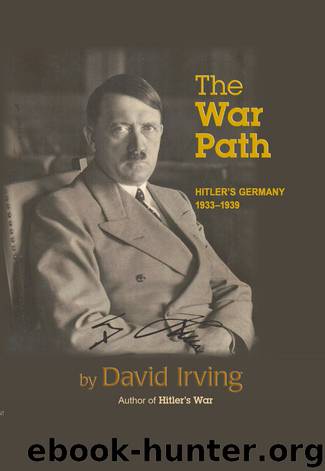
Author:David Irving [Irving, David]
Language: eng
Format: epub
Publisher: Focal Point Publications
Before Munich, significantly, Hitler had scarcely bothered about Slovakia. As recently as April 1938 he had assured the Hungarian envoy that Bratislava, the Slovak capital, would be Hungary's. He was to admit to Voytech Tuka, the radical Slovak leader, in February 1939: ‘I always thought the Slovaks’ one desire was to return to Hungary.’ There is no reason to disbelieve this disarming confession of ignorance. He added that it was not until he met the Hungarian premier Imrédy on September 20 that he realized his error. By mid-October he could tell Darányi, ‘The Slovak leaders of every political shade have been besieging us for days, clamouring that they don't want to join Hungary.’
This was also true. On September 25 there was to be seen at Carinhall, Göring's forest mansion, the Slovak engineer Franz Karmasin – leader of the Carpathian German Party. He was now cast to play the ‘Henlein’ role in Slovakia, where there were useful, tightly-knit communities totalling about 150,000 ethnic Germans. The Slovak government had to regard the Reich as their sole protector against Hungary's exorbitant demands, and it was easy for Karmasin to mediate. He arranged for the Slovak deputy prime minister, Dr Ferdinand Ďurčanský, to see Göring on October 12. Ďurčanský assured him his people never wanted to join Hungary – only the Jews there opted for Hungary. ‘Slovaks want complete autonomy with strong political, economic and military dependence on Germany.’ He assured Göring that Slovakia would ban all Communists and deal with the Jewish problem on similar lines to Germany. Göring afterward noted for the record, ‘Slovak aspirations to autonomy are to be suitably supported. A Czecho-without the Slovakia will be thrown even more cruelly on to our mercy. Slovakia will be very important to us as an airfield base for operations to the east [i.e., into Russia].’
The Czechs too turned to Hitler for protection. Beneš fled to the United States and moderates replaced his ministers, anxious to salvage what they could of their independence and to curry Hitler's favour. Hitler dismantled ‘Green’ only reluctantly. When armed Czech Communists caused incidents in the German-language enclaves of Iglau and Minn on October 9, Hitler had put his troops on immediate standby to occupy the towns if German life and limb were threatened; and he seems briefly to have envisaged even wider operations, for although the Wehrmacht's costly mobilization was just ending he raised with his adjutants the possibility of launching ‘Green’ after all. Keitel's adjutant, Captain Eberhard, recorded the subsequent telephone call thus: ‘Apparently “Green” is still not settled! – Schmundt inquires how soon “Green” could be ready for launching again, and how long for “Red’?’ (‘Red’ was the build-up against France.)
Czechoslovakia's armed forces were still a matter of concern to the OKW; she could still engage up to twenty-five German divisions. But politically she was not the risk she had once been. On October 12 the Czech envoy, Vojtĕch Mastný, assured Göring privately that his country had done a ‘complete about-turn’: Czechoslovakia would realign her
Download
This site does not store any files on its server. We only index and link to content provided by other sites. Please contact the content providers to delete copyright contents if any and email us, we'll remove relevant links or contents immediately.
| Africa | Americas |
| Arctic & Antarctica | Asia |
| Australia & Oceania | Europe |
| Middle East | Russia |
| United States | World |
| Ancient Civilizations | Military |
| Historical Study & Educational Resources |
The Radium Girls by Kate Moore(12093)
100 Deadly Skills by Clint Emerson(4972)
Rise and Kill First by Ronen Bergman(4838)
The Templars by Dan Jones(4733)
The Doomsday Machine by Daniel Ellsberg(4545)
The Rape of Nanking by Iris Chang(4255)
Killing England by Bill O'Reilly(4042)
Stalin by Stephen Kotkin(4004)
Hitler in Los Angeles by Steven J. Ross(3978)
12 Strong by Doug Stanton(3575)
Hitler's Monsters by Eric Kurlander(3384)
The Code Book by Simon Singh(3250)
Blood and Sand by Alex Von Tunzelmann(3240)
Darkest Hour by Anthony McCarten(3161)
The Art of War Visualized by Jessica Hagy(3043)
Hitler's Flying Saucers: A Guide to German Flying Discs of the Second World War by Stevens Henry(2777)
Babylon's Ark by Lawrence Anthony(2718)
Tobruk by Peter Fitzsimons(2559)
The Second World Wars by Victor Davis Hanson(2554)
