The U.S. Coast Guard in World War II by Malcolm F. Willoughby
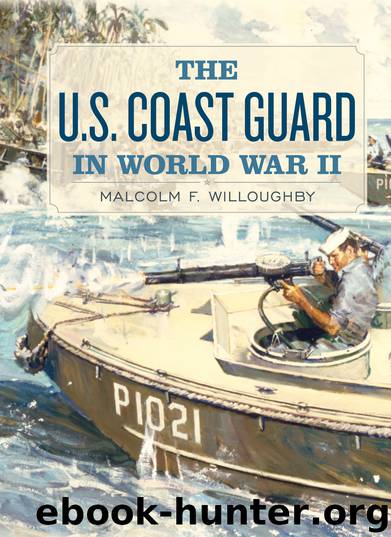
Author:Malcolm F. Willoughby
Language: eng
Format: epub
ISBN: 9781612519937
Publisher: Naval Institute Press
Published: 2016-03-10T05:00:00+00:00
LOCATIONS OF FIRST PACIFIC LORAN STATIONS
The Hawaiian chain was made up of:
The many new Loran stations required increasing numbers of trained men. By July 1944, the Loran School at Groton, Connecticut, was turning out 20 rated “radiomen Loran” every 5 weeks in its 10-week course, to man the four new stations being built every 10 weeks. Loran was growing up.
Headquarters recognized the need for the supervision of construction work from a point much closer to activities than Washington, D.C. As a consequence Command Unit # 203, headed by Lieutenant Commander John F. Martin, was established in April 1944, to take charge of all Loran construction in the Pacific. A fixed base was required for administrative work, as a receiving and shipping point for construction personnel and materials, and for storage of materials and equipment. Accordingly, a base was established at Sand Island, in Honolulu Harbor, adjacent to the Coast Guard aids to navigation depot. The base was designed to house 350 men, and to store materials for three Loran chains. After finishing the Hawaiian stations, Construction Detachment C (Unit 80) built the Loran portion of the base before going to the Marianas. The Sand Island Base became the depot from which all construction materials were procured.
Working in conjunction with this base were the Advanced Base Section of Coast Guard Headquarters Civil Engineering Division; the construction detachment supply officers at the Coast Guard Supply Depot, Alameda, California; and the District Supply personnel at Seattle. Coast Guard planes were assigned to this unit for survey, transportation, and signal check purposes. A Liberty-type cargo vessel was acquired by the Coast Guard to handle material and equipment for Loran work. This vessel, USS Menkar (AK-123), 445 feet long, was transferred from the Navy to the Coast Guard in October, 1944, and placed in command of Lieutenant Commander Niels P. Thomsen, USCG, with a full Coast Guard crew. Three days after its first arrival at Sand Island, Menkar was headed for the Marianas with Loran materials.
Later on, progress in the Pacific was such that in January 1945, a similar advanced base was established at Guam, near the scene of later Loran construction, and Command Unit #203 departed for that base.
The Armed Forces of the United States were gradually pushing their way through the South Pacific and securing first one and then another of the several large island groups. Loran had proven so valuable that it became an established policy to go into these areas with Loran chains at the earliest possible moment. The new aid to navigation would be vitally important in the ensuing operations nearer the Philippines and Japan. United States planes had bombed Wake Island and the Japanese mandated Marshall Islands, and the Army and Marine forces had landed at Roi and Kwajalein. A chain in the Phoenix Islands, midway between Hawaii and Australia, would serve naval and air operations over a wide and important area in which the Army Air Transport Command was operating planes.
This chain was authorized on 5 February 1944.
Download
This site does not store any files on its server. We only index and link to content provided by other sites. Please contact the content providers to delete copyright contents if any and email us, we'll remove relevant links or contents immediately.
| Africa | Americas |
| Arctic & Antarctica | Asia |
| Australia & Oceania | Europe |
| Middle East | Russia |
| United States | World |
| Ancient Civilizations | Military |
| Historical Study & Educational Resources |
The Radium Girls by Kate Moore(12124)
100 Deadly Skills by Clint Emerson(4992)
Rise and Kill First by Ronen Bergman(4862)
The Templars by Dan Jones(4754)
The Doomsday Machine by Daniel Ellsberg(4583)
The Rape of Nanking by Iris Chang(4283)
Killing England by Bill O'Reilly(4069)
Stalin by Stephen Kotkin(4029)
Hitler in Los Angeles by Steven J. Ross(3996)
12 Strong by Doug Stanton(3592)
Hitler's Monsters by Eric Kurlander(3415)
The Code Book by Simon Singh(3275)
Blood and Sand by Alex Von Tunzelmann(3261)
Darkest Hour by Anthony McCarten(3190)
The Art of War Visualized by Jessica Hagy(3062)
Hitler's Flying Saucers: A Guide to German Flying Discs of the Second World War by Stevens Henry(2787)
Babylon's Ark by Lawrence Anthony(2749)
Tobruk by Peter Fitzsimons(2577)
The Second World Wars by Victor Davis Hanson(2561)
