The Tango War: The Struggle for the Hearts, Minds and Riches of Latin America During World War II by Mary Jo McConahay
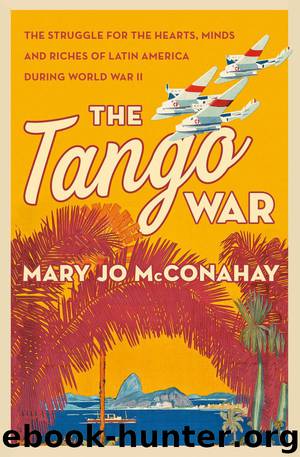
Author:Mary Jo McConahay [McConahay, Mary Jo]
Language: eng
Format: epub
Tags: 20th Century, History, Latin America, Military, World War II
ISBN: 9781250091246
Google: MHtJDwAAQBAJ
Amazon: B079DW1N2M
Publisher: St. Martin's Press
Published: 2018-09-18T03:00:00+00:00
—ORSON WELLES, SCRIPT, The Brass Ring
The propaganda mandate of the CIAA was to contrast the Allies’ democracies with the totalitarianism exemplified by the Reich. In recruiting Orson Welles, Rockefeller’s original idea was to use the radio star’s deep baritone voice and significant oratorical skills to give speeches about individual freedom—radio reached wide in Latin America, even to the illiterate who were beyond the draw of the written press. The host of the Mercury Theatre on the Air seemed a perfect choice.
Orson Welles had taken to the stage at age nineteen, a strapping six-footer with jet-black hair and a talent for miming accents and dialects. At barely twenty, he was playing the mysterious radio serial hero “The Shadow,” who possessed the “power to cloud men’s minds so they could not see him.”
To maintain the show’s mystery, Welles played The Shadow anonymously, but he became a household name when he produced the radio series called The Mercury Theatre on the Air. He chose dramas for their effectiveness on the airwaves—the first was Bram Stoker’s Dracula—and in 1938 he ran the most notorious Halloween radio program in history, his adaptation of the 1897 novel War of the Worlds by H. G. Wells. The show drew so much attention that the program attracted the commercial sponsorship of the Campbell’s Soup Company, and Welles brought in stars whose names read like a who’s who of the era’s most celebrated performers: Katharine Hepburn, Laurence Olivier, Helen Hayes, Margaret Sullivan, Burgess Meredith, Joan Bennett, Lionel Barrymore.
President Roosevelt and Rockefeller wanted the propaganda of the CIAA to flow north and south, underscoring the concept of common ideals throughout the Americas. In Orson Welles, Rockefeller saw an orator who would give not only public lectures but also radio addresses heard in Latin America and the United States. His words would carry far, and they would be irresistible.
By the time Welles was packing to board the Pan Am Clipper to South America in early 1942, however, something had changed in his public profile. He was still the most recognizable voice on radio, but now he was also a famous, innovative cinema director. His first major film, Citizen Kane, was being hailed as the greatest ever made. Kane’s central character, a barely disguised version of yellow-journalism mogul William Randolph Hearst, played by Welles, was unforgettable. Welles’s treatment of the Hearst character was unremittingly scathing; Hearst tried to have the film’s negative destroyed, forbade his chain of newspapers from giving it reviews or ad space, threatened blackmail. Meanwhile, word of mouth celebrated Citizen Kane all the way to Latin America.
After the film opened in New York in May 1941, Jock Whitney met among the warm breezes of Rio de Janeiro with Lourival Fontes, the powerful and Machiavellian chief of Brazil’s Department of Press and Propaganda. The wily Fontes saw a way to get some propaganda of his own from the CIAA’s operation. Yes, the speeches and radio performances of Mr. Orson Welles would be welcome. But why not have the famous director
Download
This site does not store any files on its server. We only index and link to content provided by other sites. Please contact the content providers to delete copyright contents if any and email us, we'll remove relevant links or contents immediately.
| Africa | Americas |
| Arctic & Antarctica | Asia |
| Australia & Oceania | Europe |
| Middle East | Russia |
| United States | World |
| Ancient Civilizations | Military |
| Historical Study & Educational Resources |
The Radium Girls by Kate Moore(12036)
100 Deadly Skills by Clint Emerson(4932)
Rise and Kill First by Ronen Bergman(4797)
The Templars by Dan Jones(4695)
The Doomsday Machine by Daniel Ellsberg(4493)
The Rape of Nanking by Iris Chang(4224)
Killing England by Bill O'Reilly(4008)
Stalin by Stephen Kotkin(3973)
Hitler in Los Angeles by Steven J. Ross(3949)
12 Strong by Doug Stanton(3554)
Hitler's Monsters by Eric Kurlander(3349)
Blood and Sand by Alex Von Tunzelmann(3207)
The Code Book by Simon Singh(3197)
Darkest Hour by Anthony McCarten(3136)
The Art of War Visualized by Jessica Hagy(3014)
Hitler's Flying Saucers: A Guide to German Flying Discs of the Second World War by Stevens Henry(2759)
Babylon's Ark by Lawrence Anthony(2686)
The Second World Wars by Victor Davis Hanson(2529)
Tobruk by Peter Fitzsimons(2521)
