The Suicide Battalion (The History of World War One) by J.L. McWilliams & R. James Steel
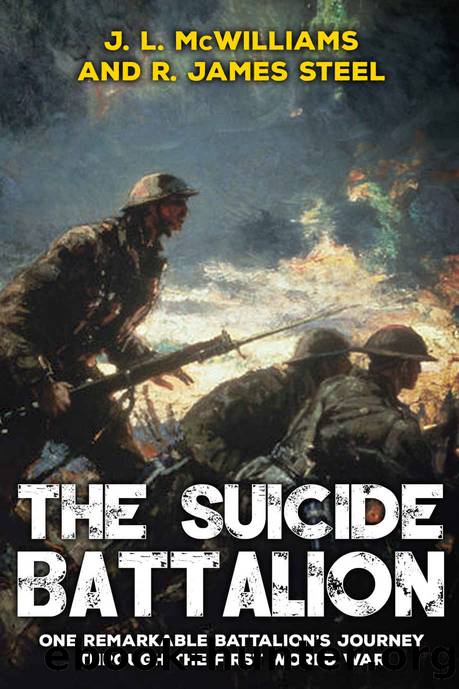
Author:J.L. McWilliams & R. James Steel [McWilliams, J.L.]
Language: eng
Format: azw3
Publisher: Sapere Books
Published: 2020-05-23T16:00:00+00:00
Before the Canadians had been thrown into Passchendaele there had been three possible alternatives as to their employment. Firstly, they could have been used as expected â to capture Sallaumines Hill flanking Lens. This would have necessitated a German withdrawal from Lens. The second alternative would have been to commit the corps to the spectacular breakthrough at Cambrai. The attack there was to take place on 20 November with dramatic results. Unfortunately, Byngâs follow-up action was hampered by a shortage of reserves, and it ended in near-disaster. The Canadians might well have made the difference here.
The third alternative was Passchendaele, but weather conditions alone made it most impractical. Nevertheless, it had been chosen for the âdecisive blow.â General âFighting Frankâ Worthington, the founder of the Royal Canadian Armoured Corps, served there as a private with the Canadian Machine Gun Corps, and his verdict on Haigâs choice was clear: âI can forgive the Somme, but I cannot forgive Passchendaele, because the same mistakes were made over again, in a more exaggerated form, and Passchendaele had no value strategically in the overall picture of the war. None whatsoever. They laid the blame on the French, who demanded that they attack there to relieve Verdun. Well now, I donât think that that holds water, because when you are going to commit an army you fight where you are going to win. You donât fight where you are not going to win. And that was not a place to win.â[21]
Haig had as yet not visited any of his troops at the front. Nor had any of his staff. Now, after three years of warfare, one of his staff officers came to view the scenes of victory. For Lieutenant-General Sir Launcelot Kiggel, 17 November 1917 was to be a day of triumph: he was about to visit Passchendaele, the long sought-after prize of Sir Douglas Haig and his staff. âAs his staff car lurched through the swampland and neared the battleground he became more and more agitated. Finally he burst into tears and muttered, âGood God, did we really send men to fight in that?ââ[22]
Download
This site does not store any files on its server. We only index and link to content provided by other sites. Please contact the content providers to delete copyright contents if any and email us, we'll remove relevant links or contents immediately.
| Africa | Americas |
| Arctic & Antarctica | Asia |
| Australia & Oceania | Europe |
| Middle East | Russia |
| United States | World |
| Ancient Civilizations | Military |
| Historical Study & Educational Resources |
The Dawn of Everything by David Graeber & David Wengrow(1693)
The Bomber Mafia by Malcolm Gladwell(1620)
Facing the Mountain by Daniel James Brown(1546)
Submerged Prehistory by Benjamin Jonathan; & Clive Bonsall & Catriona Pickard & Anders Fischer(1452)
Wandering in Strange Lands by Morgan Jerkins(1419)
Tip Top by Bill James(1409)
Driving While Brown: Sheriff Joe Arpaio Versus the Latino Resistance by Terry Greene Sterling & Jude Joffe-Block(1370)
Red Roulette : An Insider's Story of Wealth, Power, Corruption, and Vengeance in Today's China (9781982156176) by Shum Desmond(1351)
Evil Geniuses: The Unmaking of America: A Recent History by Kurt Andersen(1346)
The Way of Fire and Ice: The Living Tradition of Norse Paganism by Ryan Smith(1329)
American Kompromat by Craig Unger(1307)
It Was All a Lie by Stuart Stevens;(1296)
F*cking History by The Captain(1289)
American Dreams by Unknown(1277)
Treasure Islands: Tax Havens and the Men who Stole the World by Nicholas Shaxson(1267)
Evil Geniuses by Kurt Andersen(1249)
White House Inc. by Dan Alexander(1207)
The First Conspiracy by Brad Meltzer & Josh Mensch(1167)
The Fifteen Biggest Lies about the Economy: And Everything Else the Right Doesn't Want You to Know about Taxes, Jobs, and Corporate America by Joshua Holland(1115)
