The Smaller Dragon; A Political History of Vietnam by Joseph Buttinger
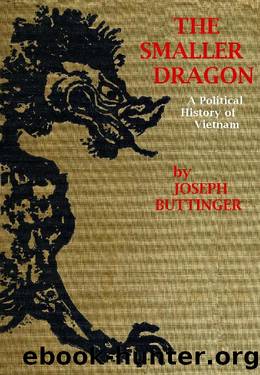
Author:Joseph Buttinger [Buttinger, Joseph]
Language: eng
Format: epub
Tags: Vietnam, History, Politics, France, Colonialism & Post-Colonialism, Indochina
Publisher: Praeger
Published: 1958-09-12T23:00:00+00:00
1913
The Resident Superior of Annam at Hué broke into the tomb of Tu Duc to rob it of its treasures for the benefit of the colonial administration. Several terrorist attacks occurred at Hanoi and Thai Binh; an insurrection in the South, organized by Gilbert Chieu, was put down before it had a chance to develop.
1914
The main features in the economic and social development of Vietnam under the colonial regime were clearly perceptible before the outbreak of the First World War, and remained unchanged until the eve of the Second World War:
1) Capital came chiefly from abroad—until 1914 primarily from the French state, after 1920 largely from French private investors. “So successfully did the French resist the investment of non-French European capital in their close preserve that in 1938 they owned 95 per cent of the European capital invested in business enterprises and all the capital invested in government securities.” (D. G. E. Hall, A History of South-East Asia, p. 657.) The goal of all investments was not a systematic development of the country but immediate high returns. Only a small fraction of the high profits made in Vietnam by private companies was reinvested locally. The chief investors were large banks.
2) Economic policy was directed toward the exploitation of natural resources for direct export. The main exports were rice, coal, rubber, rare minerals, and other unfabricated goods. The development of indigenous industries was kept within narrow bounds. Apart from rice mills and cement works, they were restricted to the production of goods for immediate mass consumption—breweries, distilleries, match factories, sugar refineries, paper mills, and a few textile and glass factories. But all these industries employed only a total of about 90,000 workers in 1929. The aim of this restrictive economic policy was to preserve the colony as a market for overpriced, tariff-protected products of French industry. Between 1921 and 1938, Indochina’s imports from France averaged 57.1 per cent of the total (Hall, op. cit., p. 657).
3) The development of Indochina as a market for French goods was obstructed by the brutal fiscal policy of the colonial regime, which took from the peasant the money he would need to purchase imported products. The exceptionally exploitive character of French colonialism, as K. Mitchel has pointed out in his Industrialization of the Western Pacific, thus contributed to the survival of many old village industries in Indochina. All public works—canals, railroads, harbors, and later highways—were paid for, either directly or indirectly, by the indigenous taxpayer, or as Pierre Courou put it, “each piaster expended by the state has, directly or indirectly, been taken from the minute incomes of the peasants.” (Op. cit., p. 224). The great foreign concerns paid either no taxes or very little, and some were even subsidized by public funds.
4) Public works were not primarily undertaken for economic reasons, and although paid for by the Vietnamese, they were of benefit chiefly to the colonial regime and the French speculator, investor, and exporter. The Trans-Indochinese railroad, still uncompleted in 1940, duplicated the much
Download
This site does not store any files on its server. We only index and link to content provided by other sites. Please contact the content providers to delete copyright contents if any and email us, we'll remove relevant links or contents immediately.
| Africa | Americas |
| Arctic & Antarctica | Asia |
| Australia & Oceania | Europe |
| Middle East | Russia |
| United States | World |
| Ancient Civilizations | Military |
| Historical Study & Educational Resources |
The Dawn of Everything by David Graeber & David Wengrow(1693)
The Bomber Mafia by Malcolm Gladwell(1620)
Facing the Mountain by Daniel James Brown(1546)
Submerged Prehistory by Benjamin Jonathan; & Clive Bonsall & Catriona Pickard & Anders Fischer(1452)
Wandering in Strange Lands by Morgan Jerkins(1419)
Tip Top by Bill James(1409)
Driving While Brown: Sheriff Joe Arpaio Versus the Latino Resistance by Terry Greene Sterling & Jude Joffe-Block(1368)
Red Roulette : An Insider's Story of Wealth, Power, Corruption, and Vengeance in Today's China (9781982156176) by Shum Desmond(1350)
Evil Geniuses: The Unmaking of America: A Recent History by Kurt Andersen(1346)
The Way of Fire and Ice: The Living Tradition of Norse Paganism by Ryan Smith(1326)
American Kompromat by Craig Unger(1307)
It Was All a Lie by Stuart Stevens;(1295)
F*cking History by The Captain(1289)
American Dreams by Unknown(1277)
Treasure Islands: Tax Havens and the Men who Stole the World by Nicholas Shaxson(1267)
Evil Geniuses by Kurt Andersen(1249)
White House Inc. by Dan Alexander(1207)
The First Conspiracy by Brad Meltzer & Josh Mensch(1167)
The Fifteen Biggest Lies about the Economy: And Everything Else the Right Doesn't Want You to Know about Taxes, Jobs, and Corporate America by Joshua Holland(1115)
