The Problem of Slavery in the Age of Revolution, 1770-1823 by Davis David Brion;
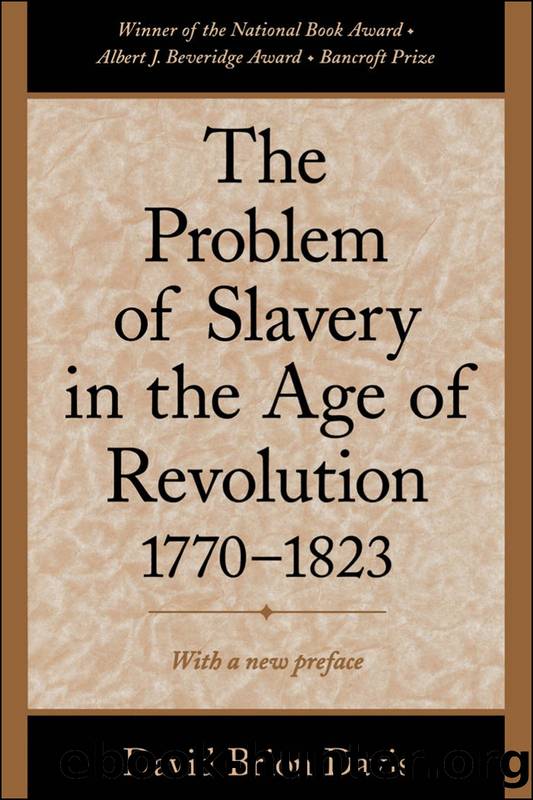
Author:Davis, David Brion;
Language: eng
Format: epub
Publisher: Oxford University Press USA - OSO
Published: 1999-09-14T16:00:00+00:00
The Perishability of Revolutionary Time
As later antislavery writers searched for a vocabulary that would resonate with the largest possible audience, they turned repeatedly to the examples and principles of the War of Independence. A petition of 1786 to the Virginia legislature, from Frederick and Hampshire counties, restated the central argument of inconsistency:
That the Glorious and ever memorable Revolution can be Justified on no other Principles but what doth plead with greater Force for the emancipation of our Slaves in proportion as the oppression exercised over them exceeds the oppression formerly exercised by Great Britain over these States.36
To illustrate the same point, David Cooper reminded his readers of the colonists’ outrage over General Howe’s atrocities in Boston, especially the separation of men from their families. Yet the American people had authorized similar and far worse crimes against the Africans. “In vain has the tyranny of kings been rejected,” said the delegates of the 1794 Convention of Abolition Societies, “while we permit in our country a domestic despotism, which involves, in its nature, most of the vices and miseries that we have endeavoured to avoid.” In the less temperate words of a writer in the American Museum, the inconsistency was “the most abandoned apostasy that ever took place, since the Almighty fiat spoke into existence this habitable world.”37
These arguments acquired new implications as they were repeated through the postwar decades. The “Glorious and ever memorable Revolution” kept receding into the past, secure now from any need for justification. There was, inevitably, a widening chasm of time between the transcendent moment of rebirth—when the “Word of Liberty” created a nation—and the recurring rediscoveries of America’s unredeemed sin. What was the meaning of this elongating interval? Did the persistence of slavery—and thus the growing permanence of America’s inconsistency—mean that the Revolution had been lost, in both senses of that word? Would post-Revolutionary America be simply an extension of pre-Revolutionary America, at least with respect to national sin and guilt? Or did institutionalized inconsistency mean that America would soon acquire all the infections and diseases of the Old World? The power of Revolutionary ideals depended on the sense of a continuing Revolutionary time—a time not simply of completion and rounding out, but a time of creation, marked by the same contingency, fears, and openness of the Revolution itself.
Such considerations make understandable the attempts by anti-slavery writers to find “signs of the times” that would reanimate the sense of collective peril generated by the Revolution. If God had rewarded the American people with military victory, He could be expected all the more to punish them for violating His covenant. In the 1780s His displeasure over slavery became manifest in the nation’s prolonged economic distress, in the dissension between states, and in Shays’s Rebellion. In the following decade slaveholding provoked even more ominous signs of divine wrath: yellow-fever epidemics; warfare with Barbary pirates and western Indians; the slave revolt in St. Domingue; the danger of being engulfed in a European war. The Barbary states, by their continuing
Download
This site does not store any files on its server. We only index and link to content provided by other sites. Please contact the content providers to delete copyright contents if any and email us, we'll remove relevant links or contents immediately.
| Africa | Americas |
| Arctic & Antarctica | Asia |
| Australia & Oceania | Europe |
| Middle East | Russia |
| United States | World |
| Ancient Civilizations | Military |
| Historical Study & Educational Resources |
The Dawn of Everything by David Graeber & David Wengrow(1691)
The Bomber Mafia by Malcolm Gladwell(1620)
Facing the Mountain by Daniel James Brown(1546)
Submerged Prehistory by Benjamin Jonathan; & Clive Bonsall & Catriona Pickard & Anders Fischer(1452)
Wandering in Strange Lands by Morgan Jerkins(1419)
Tip Top by Bill James(1409)
Driving While Brown: Sheriff Joe Arpaio Versus the Latino Resistance by Terry Greene Sterling & Jude Joffe-Block(1368)
Red Roulette : An Insider's Story of Wealth, Power, Corruption, and Vengeance in Today's China (9781982156176) by Shum Desmond(1350)
Evil Geniuses: The Unmaking of America: A Recent History by Kurt Andersen(1346)
The Way of Fire and Ice: The Living Tradition of Norse Paganism by Ryan Smith(1324)
American Kompromat by Craig Unger(1307)
It Was All a Lie by Stuart Stevens;(1295)
F*cking History by The Captain(1289)
American Dreams by Unknown(1277)
Treasure Islands: Tax Havens and the Men who Stole the World by Nicholas Shaxson(1266)
Evil Geniuses by Kurt Andersen(1249)
White House Inc. by Dan Alexander(1207)
The First Conspiracy by Brad Meltzer & Josh Mensch(1167)
The Fifteen Biggest Lies about the Economy: And Everything Else the Right Doesn't Want You to Know about Taxes, Jobs, and Corporate America by Joshua Holland(1115)
