The Plays of Margaret Drabble by Fernández José Francisco;
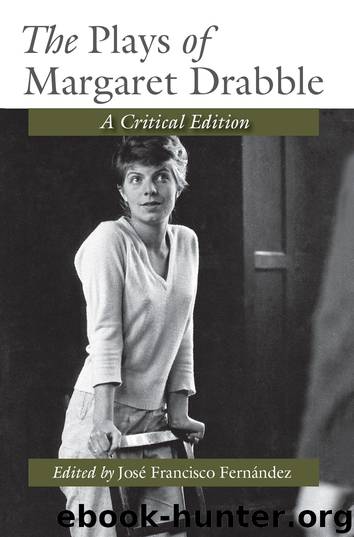
Author:Fernández, José Francisco;
Language: eng
Format: epub
Publisher: Syracuse University Press
Published: 2019-02-16T00:00:00+00:00
Bird of Paradise
Historical Context
BETSABÉ NAVARRO
“I was quite pleased with my own play but not very confident about it, not as confident as I felt about the novels.” Thus wrote Margaret Drabble about her only play for the stage, Bird of Paradise (1969). “I didn’t know how to stand up for myself, or didn’t want to try, and I had a feeling that nobody really knew what the play was about.”1 With the hindsight of time, Drabble’s words are all the more telling in that the play reveals itself to be an interesting experiment in theater in a period when all sorts of innovations in the arts were under way and were somehow a sign of the times. In what follows, I try to set out the complex picture behind Drabble’s only venture into the world of the theater.
What should be stressed, first of all, is that despite the author’s disparaging comments about what she wrote, the play moves swiftly, with a pervading sense of gliding effortlessly over the different topics of its day. It is as if the author assumed from the outset that because it was an anomalous project, she felt entitled to play with the form, thus avoiding, for instance, a thorough analysis of British society, something that would be more appropriate for a novel. Perhaps being relieved of this pressure allowed Drabble to tackle different issues in a straightforward manner, but not at all lightly (the seriousness and depth of Lady Garfield’s insight, for instance, is remarkable), yet without preambles or underlying themes. The points are made and followed by a rapid change of focus in a dynamic sense of theatrical sequencing, including the deployment of different settings on stage.
The play was written and performed during the period in which Harold Wilson’s governments (1964–69) were in full swing. Wilson was a Labour prime minister whose aim was to reverse the trend of the previous thirteen-year Tory rule. His priority during his terms in office was to modernize the country, to make a “new” Britain that was in tune with the contemporary world, and to move with “the white heat of technological change,” as he stated in his well-known speech of 1963. What he called the technological revolution was meant to illustrate the role that science and technology had in the new society as well as Labour’s progressive alternative to the traditional values that the Conservative Party represented: “The new prime minister claimed that his government would harness the ‘white heat’ of the technological revolution to transform the UK’s economy and society, halting the process of decline that the country had suffered in comparison with its European competitors” (Hughes 2015, 1). Wilson’s domestic agenda included liberal social policies on education, health, housing, pensions, and employment as well as on other controversial issues such as homosexuality, divorce, abortion, and immigration. Redistribution of wealth improved the standards of living for a great majority of the population and allowed working-class families to “catch up with middle-class incomes,” ending the “collectivist proletarian way of life” (Fielding 2003, 7).
Download
This site does not store any files on its server. We only index and link to content provided by other sites. Please contact the content providers to delete copyright contents if any and email us, we'll remove relevant links or contents immediately.
Cecilia; Or, Memoirs of an Heiress — Volume 2 by Fanny Burney(31962)
Cecilia; Or, Memoirs of an Heiress — Volume 3 by Fanny Burney(31945)
Dialogue by Robert McKee(4408)
The 101 Dalmatians by Dodie Smith(3515)
Bound by Hatred (The Singham Bloodlines Book 2) by MV Kasi(3087)
The Art of Dramatic Writing: Its Basis in the Creative Interpretation of Human Motives by Egri Lajos(3072)
Harry Potter and the Cursed Child - Parts One and Two by John Tiffany(3047)
The Beautiful Boys: A High School NA Reverse Harem Paranormal Bully Romance (Shadowlight Academy Book 1) by Gow Kailin(2873)
Angels in America by Tony Kushner(2665)
A Clockwork Orange by Anthony Burgess(2470)
Carrie's War by Nina Bawden(2470)
Unlaced by Jaci Burton & Jasmine Haynes & Joey W. Hill & Denise Rossetti(2377)
The Femme Playlist & I Cannot Lie to the Stars That Made Me by Catherine Hernandez(2294)
Open Book by Jessica Simpson(2269)
Drama by John Lithgow(2236)
Outside Woman (BWWM Amish Romance) by Stacy-Deanne(2124)
Terrorist Cop by Mordecai Dzikansky & ROBERT SLATER(2082)
Yerma by Federico García Lorca(2072)
Leo's Desire by Sundari Venkatraman(1935)
