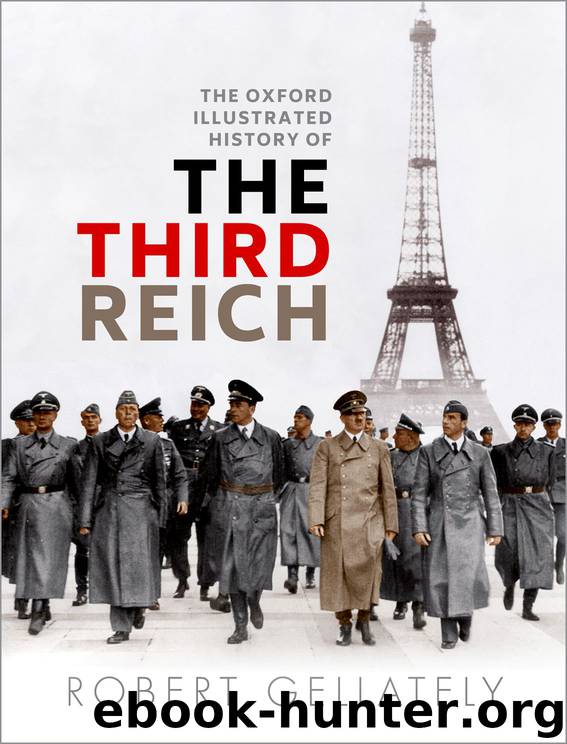
The Oxford Illustrated History of the Third Reich by Robert Gellately
Author:Robert Gellately
Language: eng
Format: epub
ISBN: 9780191044021
Publisher: OUP Oxford
Published: 2017-11-14T16:00:00+00:00
Conquest
Despite all the expenses and exertions of the pre-war years, and despite Hitler’ analysis that 1939 was a relatively favourable time for Germany to fight, the Third Reich entered World War II with considerable disadvantages. Only a portion of the army was mechanized; the British and French had more and sometimes better tanks and aircraft; stockpiles of ammunition, oil, and rubber were adequate to only a few months of combat; and the nation’ population and gross national product were much smaller than those of the empires it was fighting. Moreover, Germany already was so fully mobilized that getting more military output out of its economy seemed a daunting task. The labour force was particularly inelastic because a larger percentage of German women were already at work than was ever achieved in Britain and the US during the whole of World War II (more than half of all German women between the ages of fifteen and sixty were employed in 1939, and women already made up more than one-third of the German workforce). Increasing military production at a time when thousands of workers were being called to arms thus depended heavily on shifting labourers from low priority industries to high priority ones, a process that already had been going on for years.
Along with the inflow of food and minerals from the USSR, the dazzling military victories of 1939–40 masked these deficiencies and then partially alleviated them. Large numbers of Polish and French prisoners of war became available as labourers, especially in agriculture. Thousands of tons of fuel and other raw material in the Netherlands, Belgium, and France fell into German hands. Among these, the metal stocks, including nickel, copper, and steel, proved indispensable to the doubling of German arms production between January and July 1940. The territories that Germany annexed from Poland had a bumper harvest that autumn. Occupied Denmark’ dairy farms became essential providers of butter, milk, and cheese to the Home Front. And the massive occupation charges levied on Western Europe and later Serbia and Greece not only swelled the Reich Treasury but also enabled the Wehrmacht to pay the soldiers stationed there in local currencies. The troops used the money to pick shops clean of goods in short supply at home, which then went there via military post and softened the effects of rationing.
But the German occupied and allied states were also liabilities that exacerbated the Reich’ continuing problem of needing to spread resources in too many directions. A stagnant level of coal production now had to heat homes and power factories in Western Europe, as well as Germany. A certain amount of output for export had to continue in order to sustain trading ties to Finland, Italy, Croatia, Romania, and especially the Soviet Union, which demanded machinery, some of it vital to the Wehrmacht, and technological know-how in return for commodities. The army needed more men, but so did the coalmines, arms factories, and farms. Military actions depended heavily on horses, but so did agricultural output. Fertilizers and explosives required the same chemical inputs.
Download
This site does not store any files on its server. We only index and link to content provided by other sites. Please contact the content providers to delete copyright contents if any and email us, we'll remove relevant links or contents immediately.
| Africa | Americas |
| Arctic & Antarctica | Asia |
| Australia & Oceania | Europe |
| Middle East | Russia |
| United States | World |
| Ancient Civilizations | Military |
| Historical Study & Educational Resources |
The Radium Girls by Kate Moore(12036)
100 Deadly Skills by Clint Emerson(4932)
Rise and Kill First by Ronen Bergman(4797)
The Templars by Dan Jones(4695)
The Doomsday Machine by Daniel Ellsberg(4493)
The Rape of Nanking by Iris Chang(4224)
Killing England by Bill O'Reilly(4008)
Stalin by Stephen Kotkin(3973)
Hitler in Los Angeles by Steven J. Ross(3949)
12 Strong by Doug Stanton(3554)
Hitler's Monsters by Eric Kurlander(3352)
Blood and Sand by Alex Von Tunzelmann(3207)
The Code Book by Simon Singh(3197)
Darkest Hour by Anthony McCarten(3137)
The Art of War Visualized by Jessica Hagy(3014)
Hitler's Flying Saucers: A Guide to German Flying Discs of the Second World War by Stevens Henry(2759)
Babylon's Ark by Lawrence Anthony(2686)
The Second World Wars by Victor Davis Hanson(2529)
Tobruk by Peter Fitzsimons(2521)
