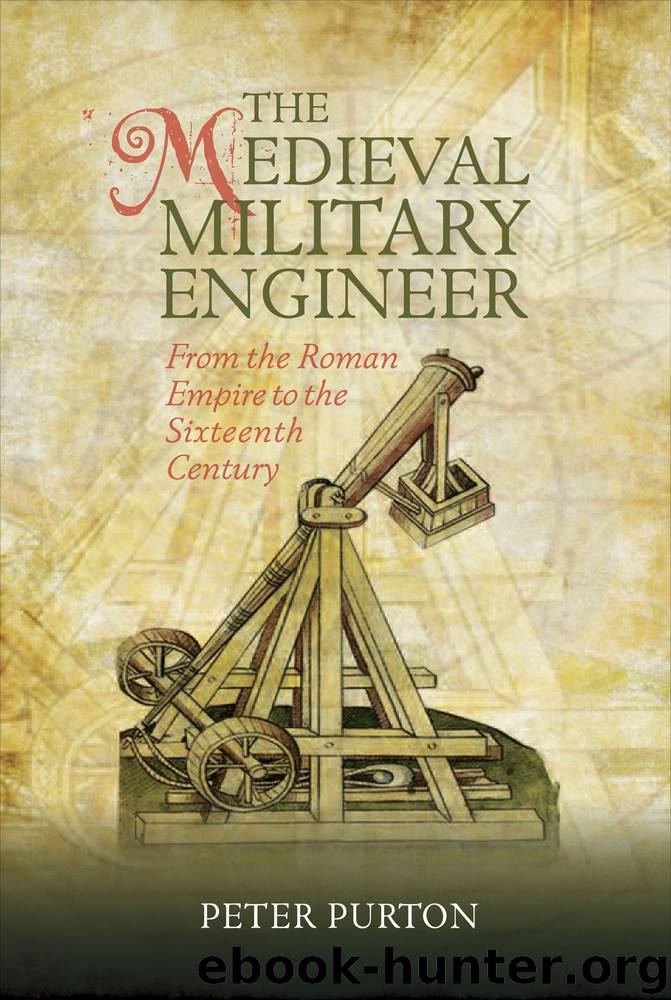
The Medieval Military Engineer by Peter Purton;
Author:Peter Purton;
Language: eng
Format: epub
Tags: Military History
Publisher: Boydell & Brewer
Published: 2018-03-16T16:00:00+00:00
THE MILITARY ENGINEER IN THE THIRTEENTH CENTURY:
RECOGNITION, STATUS, SKILLS AND SPECIALISMS
Thirteenth-century engineers were therefore faced with greater challenges to every area of their knowledge, skills and specialisms than ever, but they might now have had higher expectation of recognition and reward if they met them. It is these changes that make it reasonable to conclude that it is not just the chance survival of more records than in the twelfth century that accounts for this. Here I will look at evidence in particular from England, France, Sicily, Aragon and a number of smaller entities (in Italy and Savoy) where records permit analysis.
A striking feature was the length of service of a number of engineers. A few lost their lives in royal service but many were retained year after year. In France, the many successes of King Philip Augustus (1180–1223) necessarily involved reform of his army, and its engineering capacity was included within this. His work has been subjected to scholarly study for many years and the conclusions of this research agree on the main elements of his work in this sphere. The names of the engineers charged with the construction of his new castles, each dominated by their circular donjon, each of similar design and dimensions and now identified as tours philippiennes, were recorded, eleven of them identified as masters.65 The work extended over twenty years. The names include a few particularly associated with military engineering, for example Master Guérin who was responsible for the royal cabulus, a new term for a stone thrower that appeared at the end of the twelfth century. James the Conqueror, king of Aragon, relied on a corps of people to operate his siege equipment, but prominent amongst them was Master Nicoloso of Albenga who was involved in the capture of Mallorca in 1229 and was still serving at the siege of Burriana in 1238. He must have been of an advanced age when he was conveying the king’s engines and manufacturing 800 of the shot for the engines from ship to shore as late as 1275.66
English kings seem also to have been loyal to a number of their engineers, retaining them in service for many years. Prominent amongst these were Bertram, Gerard, Jordan and Richard. Jordan was the earliest, the man who “made the king’s trebuchet”, the first for an English king, who continued to receive wages for several years thereafter.67 Master Bertram, ingeniator regis, had a career lasting from at least 1253 to 1276. Sometimes he was recorded on his own, at other times with other engineers who appeared only once.68 Edward I regularly paid Richard of Chester for a wide range of engineering services, including organising the bridge of boats across to Anglesey in 1282 and, twenty years later, bridges across the river Forth in Scotland. But his service started with the building work at Rhuddlan and Flint castles in 1277 (presumably under the supervision of James of St George) and continued with his role in commanding royal trebuchets, referenced at the siege of Drsylwyn in 1287 and in Scotland in 1304.
Download
This site does not store any files on its server. We only index and link to content provided by other sites. Please contact the content providers to delete copyright contents if any and email us, we'll remove relevant links or contents immediately.
| Automotive | Engineering |
| Transportation |
Whiskies Galore by Ian Buxton(42102)
Introduction to Aircraft Design (Cambridge Aerospace Series) by John P. Fielding(33192)
Small Unmanned Fixed-wing Aircraft Design by Andrew J. Keane Andras Sobester James P. Scanlan & András Sóbester & James P. Scanlan(32844)
Craft Beer for the Homebrewer by Michael Agnew(18298)
Turbulence by E. J. Noyes(8143)
The Complete Stick Figure Physics Tutorials by Allen Sarah(7446)
The Thirst by Nesbo Jo(7030)
Kaplan MCAT General Chemistry Review by Kaplan(7006)
Bad Blood by John Carreyrou(6686)
Modelling of Convective Heat and Mass Transfer in Rotating Flows by Igor V. Shevchuk(6504)
Weapons of Math Destruction by Cathy O'Neil(6392)
Learning SQL by Alan Beaulieu(6365)
Man-made Catastrophes and Risk Information Concealment by Dmitry Chernov & Didier Sornette(6159)
Digital Minimalism by Cal Newport;(5853)
Life 3.0: Being Human in the Age of Artificial Intelligence by Tegmark Max(5636)
iGen by Jean M. Twenge(5475)
Secrets of Antigravity Propulsion: Tesla, UFOs, and Classified Aerospace Technology by Ph.D. Paul A. Laviolette(5424)
Design of Trajectory Optimization Approach for Space Maneuver Vehicle Skip Entry Problems by Runqi Chai & Al Savvaris & Antonios Tsourdos & Senchun Chai(5150)
Pale Blue Dot by Carl Sagan(5098)
