The Locust and the Bee by Mulgan Geoff; Mulgan Geoff;
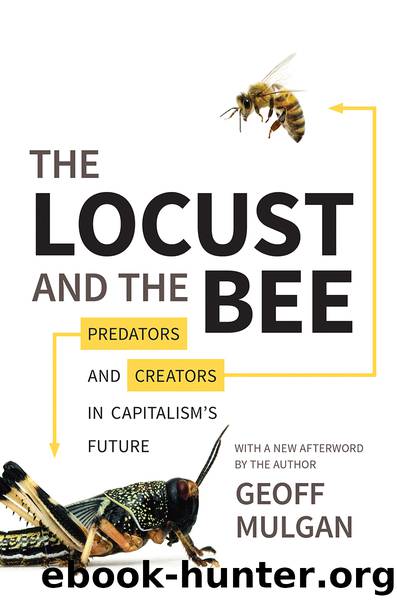
Author:Mulgan, Geoff; Mulgan, Geoff;
Language: eng
Format: epub
Publisher: Princeton University Press
Published: 2013-06-13T04:00:00+00:00
GREEN ECONOMY
Health and care share common features with the other great source of new jobs and wealth, the industries loosely labeled green. These too contain many advanced technologies, and the “Cleantech” field has excited venture capitalists and angel investors in very much the same way that biotechnology did twenty years ago. Energy-efficient light bulbs, hybrid cars, and biodegradable cleaning products are becoming mainstream alongside water-based paints, roof tiles that reflect the sun back only when it’s hot, and biodegradable pesticides. Biomimicry is being taken seriously in design, adapting methods from the natural world and applying them to materials and objects. Countries like South Korea have overhauled their economic strategies to prioritize the greening of industries such as cars and steel.
But it would be a mistake to see the green economy solely as a new wave of high-technology products pouring into the marketplace. A large proportion of activity in green industries involves rather more mundane technologies in repetitive tasks, and is often more akin to a service. The collection and processing of waste for recycling is one example. Large-scale off- and onshore wind farms are another. Retrofitting old homes, one of the keys to reducing carbon emissions in big cities, is technologically trivial, but remarkably hard to organize effectively (although the economic returns to the home owner may be substantial, people are generally reluctant to undergo the hassle). The same may be true of urban farming and the various movements to change the way we make food and consume it, replacing ever more exotic and distant imports with local production and seasonality. Most of these are labor-intensive, and all of them require continuous care and attention.
These shifts in the forms of production are mirrored in the evolution of consumption. One-off purchases of gadgets, clothes, and cars still dominate mass advertising. But wealthy societies have learned the disappointments of shopping: that more income and stuff are unreliable sources of well-being. And so we see constant innovation around the edges of consumption: products and services in which the consumer has to work harder (such as advanced cooking or dangerous sports); consumer goods that attempt to embed values of ecology or fair trade; and products that try to give their buyer the feeling of being a member of a club.
So far I’ve described discrete new models and ideas. But the brand new cities being built around the world have to rethink from scratch how to organize schools, libraries, parks, or healthcare. For some, technology is in the ascendant. South Korea’s New Song Do aims to be the first city with more soft architecture than hard, with cameras and ambient technologies woven into the physical fabric of street lights and walls, a step up from the cities like Shenzen with their millions of CCTV cameras. Its vision of the future is one in which people appear as an afterthought. Others are consciously green: like Harmaby Sjostad in Sweden, Vauban in Freiburg in Germany, Masdar in Abu Dhabi, or the eco-city being built in Tianjin in China.
Download
This site does not store any files on its server. We only index and link to content provided by other sites. Please contact the content providers to delete copyright contents if any and email us, we'll remove relevant links or contents immediately.
International Integration of the Brazilian Economy by Elias C. Grivoyannis(111469)
The Radium Girls by Kate Moore(12125)
Turbulence by E. J. Noyes(8153)
Nudge - Improving Decisions about Health, Wealth, and Happiness by Thaler Sunstein(7794)
The Black Swan by Nassim Nicholas Taleb(7229)
Rich Dad Poor Dad by Robert T. Kiyosaki(6784)
Pioneering Portfolio Management by David F. Swensen(6364)
Man-made Catastrophes and Risk Information Concealment by Dmitry Chernov & Didier Sornette(6169)
Zero to One by Peter Thiel(5897)
Secrecy World by Jake Bernstein(4825)
Millionaire: The Philanderer, Gambler, and Duelist Who Invented Modern Finance by Janet Gleeson(4556)
The Age of Surveillance Capitalism by Shoshana Zuboff(4378)
Skin in the Game by Nassim Nicholas Taleb(4335)
The Money Culture by Michael Lewis(4282)
Bullshit Jobs by David Graeber(4273)
Skin in the Game: Hidden Asymmetries in Daily Life by Nassim Nicholas Taleb(4075)
The Dhandho Investor by Mohnish Pabrai(3841)
The Wisdom of Finance by Mihir Desai(3814)
Blockchain Basics by Daniel Drescher(3656)
