The Last Shah by Ray Takeyh
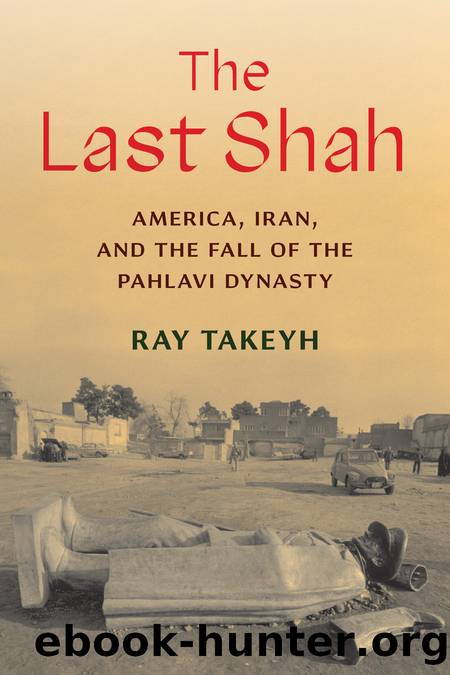
Author:Ray Takeyh
Language: eng
Format: epub
ISBN: 9780300217797
Publisher: Yale University Press
THE WHITE REVOLUTION AND ITS DISCONTENTS
Aminiâs dismissal allowed the shah to dominate Iranâs politics, a position he would not abandon until his final departure in 1979. This time, however, the shah came back to the scene as a revolutionary avenger on behalf of the masses. âIf there is to be a revolution in this country, I will be the one to lead it,â he insisted.57 This was to be a transformation guided by the shah on behalf of his peopleâa âWhite Revolution,â so called to differentiate the shahâs controlled rebellion from communist red or reactionary black. The old structures had to be dismantled and the old elite retired. The land-reform efforts were to be incorporated in a new set of initiatives that included female suffrage, establishment of health and literary corps, and rapid industrialization. The shah would be at the helm of a dynamic state, manned by a new technocratic elite pursuing his agenda of change.
The White Revolution signaled a transformation of Iranâs political order.58 Since his ascension to the throne, the shah had relied on a conservative coalition of landed gentry, clerical elders, and army officers to sustain his rule. This was essentially the partnership that had preserved the monarchy in 1953. He now signaled that he wanted not to be another feudal monarch but instead the ruler of a modernized country. He was dispensing with his old alliances to usher in a new coalition of the urban middle class and the peasantry. The army and the SAVAK were to be the sentries of this new order. But in Iranâs modern history, the peasantry rarely played a consequential political role, while the urban middle class wanted a representative government that the shah refused to deliver. In his moment of triumph, the shah and his American patrons failed to appreciate that the monarch was adrift, crafting a state without a reliable constituency.
The spirit of reform coming out of the Pahlavi state was bound to disturb the clerical community. The religious foundations, with their own tracts of land, subsidized the seminaries and provided upkeep for the mosques. While the land-reform law carved out some exceptions for the religious foundations, they were not entirely immune from its mandates. The shahâs reforms threatened not only the clericsâ purse but their overall influence. He wanted to expand state schools, establish more universities, and create a judicial system with secular civil codes. This would be a significant change: in rural areas, the courts were still largely clerical institutions that settled the disputes between the faithful, and religious schools were the main providers of elementary education.
The clergy were concerned about not just the governmentâs infringement on their prerogatives, but also the overall direction of national affairs. The mullahs were at ease with a Pahlavi regime that defended their concerns and was traditional in style. The emerging autocracy, with its concentration of power, distressed them as much as it distressed other sectors of society. Their opposition to land reform was not just about self-interest; it also had much to do with the Islamic canons protecting private property.
Download
This site does not store any files on its server. We only index and link to content provided by other sites. Please contact the content providers to delete copyright contents if any and email us, we'll remove relevant links or contents immediately.
| Africa | Americas |
| Arctic & Antarctica | Asia |
| Australia & Oceania | Europe |
| Middle East | Russia |
| United States | World |
| Ancient Civilizations | Military |
| Historical Study & Educational Resources |
The Dawn of Everything by David Graeber & David Wengrow(1776)
The Bomber Mafia by Malcolm Gladwell(1672)
Facing the Mountain by Daniel James Brown(1609)
Tip Top by Bill James(1502)
Submerged Prehistory by Benjamin Jonathan; & Clive Bonsall & Catriona Pickard & Anders Fischer(1499)
Wandering in Strange Lands by Morgan Jerkins(1493)
Driving While Brown: Sheriff Joe Arpaio Versus the Latino Resistance by Terry Greene Sterling & Jude Joffe-Block(1412)
Evil Geniuses: The Unmaking of America: A Recent History by Kurt Andersen(1401)
Red Roulette : An Insider's Story of Wealth, Power, Corruption, and Vengeance in Today's China (9781982156176) by Shum Desmond(1399)
The Way of Fire and Ice: The Living Tradition of Norse Paganism by Ryan Smith(1373)
American Kompromat by Craig Unger(1367)
F*cking History by The Captain(1357)
It Was All a Lie by Stuart Stevens;(1345)
American Dreams by Unknown(1326)
Treasure Islands: Tax Havens and the Men who Stole the World by Nicholas Shaxson(1310)
Evil Geniuses by Kurt Andersen(1304)
White House Inc. by Dan Alexander(1248)
The First Conspiracy by Brad Meltzer & Josh Mensch(1223)
The Fifteen Biggest Lies about the Economy: And Everything Else the Right Doesn't Want You to Know about Taxes, Jobs, and Corporate America by Joshua Holland(1159)
