The Last American Aristocrat by David S. Brown
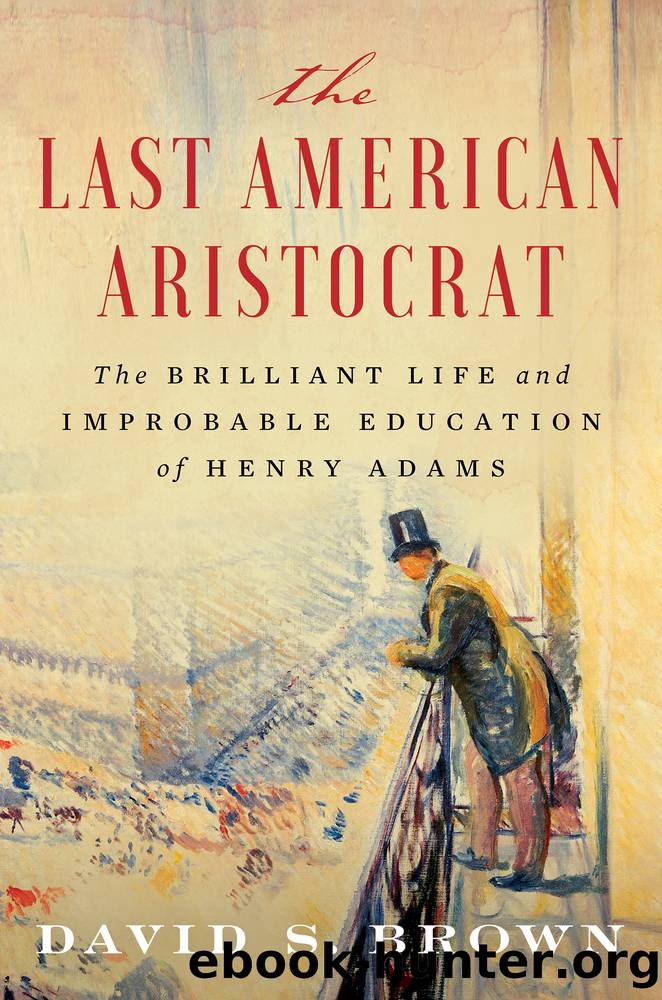
Author:David S. Brown
Language: eng
Format: epub
Publisher: Scribner
Published: 2020-11-24T00:00:00+00:00
* * *
As Henry sought Theodore Dwightâs company following Cloverâs death, so he now prevailed upon the traveling companionship of John La Farge, paying for his friendâs passage and various expenses. Of aristocratic French descent and raised Roman Catholic, the Manhattan-born La Farge, bald, bespectacled, and sporting a thick salt-and-pepper mustache, read widely and developed an interest in exotic cultures. A gifted muralist and maker of stained-glass windows, he had met Henry, three years his junior, in one of Bostonâs literary-artistic circles, perhaps at Harvard where he briefly taught art composition. He possessed, so Adams said, âthe neatest humor, the nicest observation, and the evenest temper you can imagine.â Though responsible for a wife and several children in Newport, Rhode Island, La Farge, committed to professional success, had lived independently in New York since the late 1870s. âHe was going to lead his own life,â remembered one relative. Talented, praised, and inundated with commissions, he established the La Farge Decorative Art Company in 1883, but the business soon dissolved following a bitter dispute with his partners over artistic control. Accused of taking designs belonging to the company, La Farge was arrested in May 1885. Though settled out of court with all charges dropped, the case made headlines; the New York World reported that the commotion caused âa decided scandal in both social and art circles and became the general topic of conversation whenever or wherever artists or connoisseurs met.â5 Now, a year later, with his name being gossiped about, a deeply embarrassed La Farge accepted Henryâs invitation to seek his own season of peace.
In early June the two voyagers embarked from Albany and began a âbrilliant runâ aboard the Union Pacific Railroad, whose director, Adamsâs brother Charles, kindly lent them his private company car. La Farge spent much of the trip sketching the spacious western landscape, while a more academic Henry read up on Buddhism. âOur journey,â he told one correspondent, âwas a glorious success.â Arriving in âdusty, wintry, and seedyâ San Francisco on the 10th, they briefly put up at the Palace Hotel before setting off on the Pacific Mail Steamship Company lineâs City of Sydney. Suffering through his usual mal de mer, Henry complained to Dwight that âthe Pacific Ocean is different from other oceans.⦠It contains nothing but head-winds, chopping seas, rains, cold and seasickness.â6 After three unpleasant weeks of fighting the elements and his stomach, Henry arrived in Yokohama on the second of July.
During the more than two centuries of national seclusion, in which foreigners were directed to Nagasaki (Japanâs âwindow on the worldâ), Yokohama remained a sleepy fishing village. The 1853 arrival of Commodore Matthew Perryâs small flotilla of U.S. Navy ships into Tokyo Bay, however, eventuated the opening of select Japanese ports to American vessels. This had the effect of turning Yokohama into a bustling metropolitan center of some seventy-five thousand, complete with gas-powered street lamps and a railway connection to Tokyo. Already an observer of âmodernityâsâ progress on two continents, Henry would now measure its advance in Asia.
Download
This site does not store any files on its server. We only index and link to content provided by other sites. Please contact the content providers to delete copyright contents if any and email us, we'll remove relevant links or contents immediately.
| Africa | Americas |
| Arctic & Antarctica | Asia |
| Australia & Oceania | Europe |
| Middle East | Russia |
| United States | World |
| Ancient Civilizations | Military |
| Historical Study & Educational Resources |
The Dawn of Everything by David Graeber & David Wengrow(1778)
The Bomber Mafia by Malcolm Gladwell(1673)
Facing the Mountain by Daniel James Brown(1609)
Tip Top by Bill James(1505)
Submerged Prehistory by Benjamin Jonathan; & Clive Bonsall & Catriona Pickard & Anders Fischer(1502)
Wandering in Strange Lands by Morgan Jerkins(1494)
Driving While Brown: Sheriff Joe Arpaio Versus the Latino Resistance by Terry Greene Sterling & Jude Joffe-Block(1413)
Evil Geniuses: The Unmaking of America: A Recent History by Kurt Andersen(1404)
Red Roulette : An Insider's Story of Wealth, Power, Corruption, and Vengeance in Today's China (9781982156176) by Shum Desmond(1400)
The Way of Fire and Ice: The Living Tradition of Norse Paganism by Ryan Smith(1374)
American Kompromat by Craig Unger(1369)
F*cking History by The Captain(1361)
It Was All a Lie by Stuart Stevens;(1345)
American Dreams by Unknown(1328)
Treasure Islands: Tax Havens and the Men who Stole the World by Nicholas Shaxson(1313)
Evil Geniuses by Kurt Andersen(1306)
White House Inc. by Dan Alexander(1250)
The First Conspiracy by Brad Meltzer & Josh Mensch(1225)
The Fifteen Biggest Lies about the Economy: And Everything Else the Right Doesn't Want You to Know about Taxes, Jobs, and Corporate America by Joshua Holland(1163)
