The Great Democracy by Ganesh Sitaraman
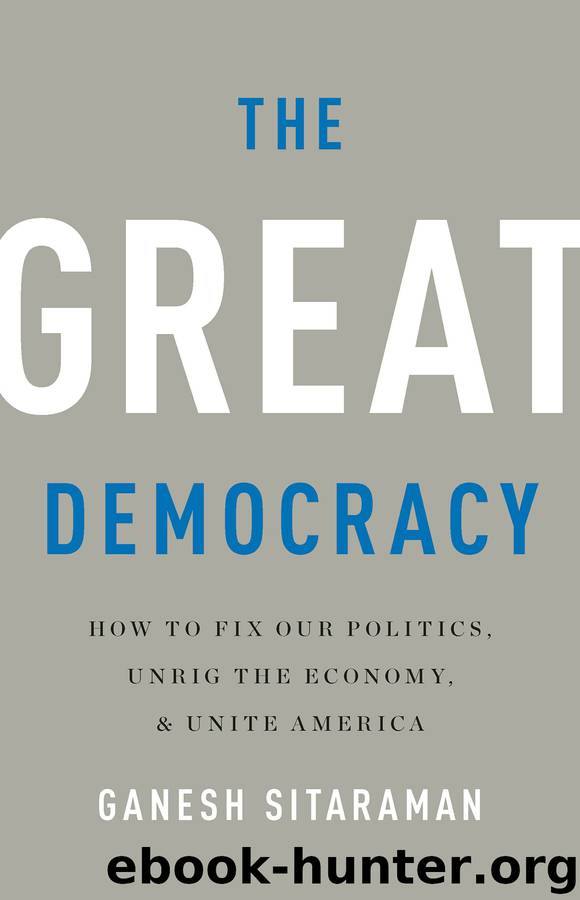
Author:Ganesh Sitaraman
Language: eng
Format: epub
Publisher: Basic Books
Published: 2019-12-09T16:00:00+00:00
7
ECONOMIC DEMOCRACY
When Theodore Roosevelt said that it wasn’t possible to have a political democracy without an economic democracy, he understood that democracy meant more than elections and voting. Roosevelt thought labor unions were indispensable and that they benefited workers and society as a whole. He condemned the conglomerates, monopolies, and trusts that aggregated power without responsibility. And he railed against corruption and special privileges.
The spirit of economic democracy gave life to his policies, and it has three components. The first is that society itself must be relatively equal economically. Political leaders and philosophers have long recognized that economic equality is connected to political democracy. The creator of the first American dictionary, Noah Webster, said that “an equality of property… is the very soul of a republic.” Statesman Daniel Webster and Supreme Court Justice Joseph Story both believed the equality of conditions in early America was the foundation for popular government. Alexis de Tocqueville wrote in the very first paragraph of Democracy in America that the “equality of conditions” in the country was the most remarkable fact about the young republic and that this equality undergirded American democracy.1
Note that these thinkers didn’t say equal opportunity or mobility, two things that neoliberal-era politicians champion. They instead emphasized the relative equality of conditions. They understood that, as we have seen, political power cannot be dissociated from economic power. This goes back to the “doom loop of oligarchy,” but the basics are worth repeating. When some people have more economic power, they can use their wealth to gain political power and influence. “When the rich govern alone, the interest of the poor is always in peril,” Tocqueville wrote. The result is not democracy, but oligarchy—rule by the wealthy few. At the same time, in an unequal society, the poor might rebel against the rich, leading to class warfare and revolution. Economic inequality brings with it political instability. Only in a country with relative economic equality is a stable democracy possible. Of course, for most of history, not everyone was considered part of the political community: women and minorities were systematically excluded. Today, we include people of all races and genders in the political community, and as a result, economic equality must extend to everyone.2
The second principle of economic democracy is that no entity should be so big or powerful that it evades democratic control. When any corporation has so much power that it can capture politics and defy regulation, it threatens democracy itself. Economic democracy therefore requires breaking up monopolies and conglomerates and instead fostering an economy of smaller businesses. Alternatively, if breaking up big businesses makes little sense, as is often the case with public utilities infrastructure and networked industries like telephones and railroads, economic democracy means regulating corporations or direct public provision of those goods and services. For there to be an economic democracy, economic power must be accountable to the people.3
The final principle of economic democracy is that the people themselves must have economic independence, freedom, and responsibility. In the age
Download
This site does not store any files on its server. We only index and link to content provided by other sites. Please contact the content providers to delete copyright contents if any and email us, we'll remove relevant links or contents immediately.
International Integration of the Brazilian Economy by Elias C. Grivoyannis(111064)
The Radium Girls by Kate Moore(12033)
Turbulence by E. J. Noyes(8055)
Nudge - Improving Decisions about Health, Wealth, and Happiness by Thaler Sunstein(7711)
The Black Swan by Nassim Nicholas Taleb(7136)
Rich Dad Poor Dad by Robert T. Kiyosaki(6642)
Pioneering Portfolio Management by David F. Swensen(6303)
Man-made Catastrophes and Risk Information Concealment by Dmitry Chernov & Didier Sornette(6022)
Zero to One by Peter Thiel(5805)
Secrecy World by Jake Bernstein(4755)
Millionaire: The Philanderer, Gambler, and Duelist Who Invented Modern Finance by Janet Gleeson(4481)
The Age of Surveillance Capitalism by Shoshana Zuboff(4303)
Skin in the Game by Nassim Nicholas Taleb(4253)
The Money Culture by Michael Lewis(4211)
Bullshit Jobs by David Graeber(4195)
Skin in the Game: Hidden Asymmetries in Daily Life by Nassim Nicholas Taleb(4009)
The Dhandho Investor by Mohnish Pabrai(3771)
The Wisdom of Finance by Mihir Desai(3751)
Blockchain Basics by Daniel Drescher(3585)
