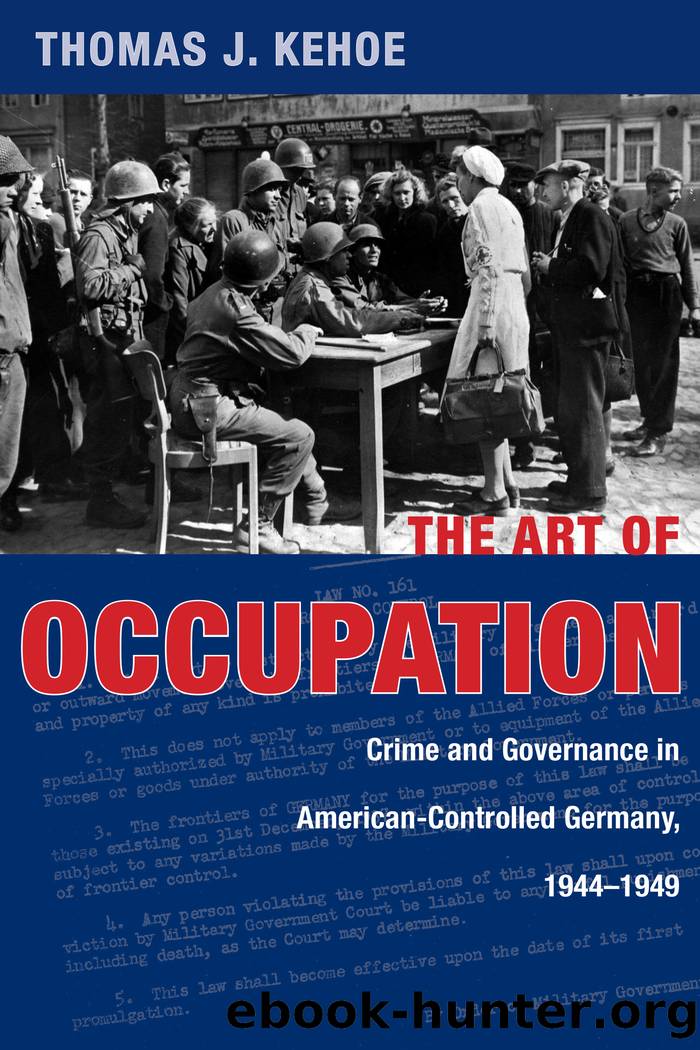
The Art of Occupation by Thomas J. Kehoe;
Author:Thomas J. Kehoe;
Language: eng
Format: epub
Publisher: Ohio University Press
Published: 2019-11-15T00:00:00+00:00
9 Winters of Discontent
Germany was on the verge of its third harsh winter after the end of the war when twenty-year-old Gerhard Winkler appeared before an MG court in Karlsruhe on 8 November 1948 charged with multiple offenses committed over the prior eighteen months. Transported to the court early that morning, he stood beside his defense attorney at 10:00 a.m. and listened as the prosecutor read through his fourteen charges, which included multiple burglaries and armed robberies, possession of illegal firearms, and dealing in stolen goods. In one instance, he robbed two American officers at gunpoint. In another, he broke into the home of the American field director of the Red Cross, held a gun to the man, and stole numerous personal items.1
Winklerâs trial came at the end of a year of dramatic changes in western Germany. The American, British, and French joint governors of the Western zones had attempted to prevent hyperinflation and combat a still-pervasive black market by reforming the currency. Although the deutsche mark replaced the reichsmark in June 1948, the effects were not felt by the end of the year. The initiative had, however, further stoked simmering tensions with the Soviet Union, which in response propagated a new currency for eastern Germany in July. It then sealed road and rail access to the Western zones of Berlin, forcing the Western Allies to supply their zones of the city by air. The resulting âBerlin blockadeâ lasted into the following year and clearly demonstrated that the Cold War had begun.2
Three American officers sat on the bench of the Karlsruhe court. After convicting Winkler, they explained in a unanimous decision that the ten-year prison sentence they imposed derived from three considerations: Winklerâs recidivism, the menacing nature of his offenses, and the broader economic and social implications of his crimes. âArmed burglary and armed robberyânext to murderâis the most serious crime a man can commit,â the chief justice told Winkler. âTo break into a manâs dwelling at night and endanger the lives of the people [is unacceptable]â¦. People on this continent and in every country have a right to sleep in their beds without being harassed by criminals.â3 These are perhaps unsurprising words from a judge passing sentence on a repeat offender, but they are telling of how social conditions in western Germany were understood by MG. Neither burglary nor robbery (even armed robbery) is often considered the next most serious offense after murder.
Winkler was also accused of âmishandlingâ two women, a housemaid and another young woman, in the houses he robbed. No charges for rape or sexual assault were laid in these cases, so it is unclear what police meant by âmishandle,â though the prosecutorsâ and judgesâ special mention of these victims is telling.4 For the court, however, the critical relationship was between the crimes and the broader social and economic context. The economy remained in dire condition, and the judges were cognizant of the domestic and geopolitical tribulations gripping occupied Germany at the time, which elevated their consideration of the severity of burglary and robbery.
Download
This site does not store any files on its server. We only index and link to content provided by other sites. Please contact the content providers to delete copyright contents if any and email us, we'll remove relevant links or contents immediately.
| Africa | Americas |
| Arctic & Antarctica | Asia |
| Australia & Oceania | Europe |
| Middle East | Russia |
| United States | World |
| Ancient Civilizations | Military |
| Historical Study & Educational Resources |
The Dawn of Everything by David Graeber & David Wengrow(1782)
The Bomber Mafia by Malcolm Gladwell(1676)
Facing the Mountain by Daniel James Brown(1614)
Tip Top by Bill James(1508)
Submerged Prehistory by Benjamin Jonathan; & Clive Bonsall & Catriona Pickard & Anders Fischer(1502)
Wandering in Strange Lands by Morgan Jerkins(1497)
Driving While Brown: Sheriff Joe Arpaio Versus the Latino Resistance by Terry Greene Sterling & Jude Joffe-Block(1414)
Evil Geniuses: The Unmaking of America: A Recent History by Kurt Andersen(1408)
Red Roulette : An Insider's Story of Wealth, Power, Corruption, and Vengeance in Today's China (9781982156176) by Shum Desmond(1404)
The Way of Fire and Ice: The Living Tradition of Norse Paganism by Ryan Smith(1375)
American Kompromat by Craig Unger(1373)
F*cking History by The Captain(1363)
It Was All a Lie by Stuart Stevens;(1347)
American Dreams by Unknown(1330)
Treasure Islands: Tax Havens and the Men who Stole the World by Nicholas Shaxson(1315)
Evil Geniuses by Kurt Andersen(1310)
White House Inc. by Dan Alexander(1253)
The First Conspiracy by Brad Meltzer & Josh Mensch(1227)
The Fifteen Biggest Lies about the Economy: And Everything Else the Right Doesn't Want You to Know about Taxes, Jobs, and Corporate America by Joshua Holland(1164)
