Surprised by Hope
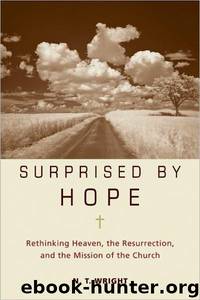
Author:N. T. Wright
Language: eng
Format: mobi
Tags: Spirituality, Non-Fiction, Religion
ISBN: 9780061551826
Publisher: HarperOne
Published: 2007-05-30T00:00:00+00:00
BEYOND HOPE, BEYOND PITY
Whenever I have spoken about these issues over the last decade or so, someone always asks, “What about hell?” This question really demands a book in itself, and I am torn between my lack of desire to write such a book and my recognition that one must at least say something.
Part of the difficulty of the topic, as with the others we have been studying, is that the word hell conjures up an image gained more from medieval imagery than from the earliest Christian writings. Just as many who were brought up to think of God as a bearded old gentleman sitting on a cloud decided that when they stopped believing in such a being they had therefore stopped believing in God, so many who were taught to think of hell as a literal underground location full of worms and fire, or for that matter as a kind of torture chamber at the center of God’s castle of heavenly delights, decided that when they stopped believing in that, so they stopped believing in hell. The first group decided that because they couldn’t believe in childish images of God, they must be atheists. The second decided that because they couldn’t believe in childish images of hell, they must be universalists.
There are of course better reasons for becoming an atheist and better reasons for becoming a universalist. Many who occupy one of those positions have gone by a much more sophisticated route than the ones I just described. But, at least at a popular level, it is not the serious early Christian doctrine of final judgment that has been rejected but rather one or other gross caricature.
The most common New Testament word sometimes translated by hell is Gehenna. Gehenna was a place, not just an idea: it was the rubbish heap outside the southwest corner of the old city of Jerusalem. There is to this day a valley at that point that bears the name Ge Hinnom. When I was in Jerusalem a few years ago, I was taken to a classy restaurant on the western slope of this famous valley, and we witnessed a spectacular fireworks display, organized no doubt without deliberate irony, on the site to which Jesus was referring to when he spoke about the smoldering fires of Gehenna. But, as with his language about heaven, so with his talk of Gehenna: once Christian readers had been sufficiently distanced from the original meaning of the words, alternative images would come to mind, generated not by Jesus or the New Testament but by the stock of images, some of them extremely lurid, supplied by ancient and medieval folklore and imagination.
The point is that when Jesus was warning his hearers about Gehenna, he was not, as a general rule, telling them that unless they repented in this life they would burn in the next one. As with God’s kingdom, so with its opposite: it is on earth that things matter, not somewhere else. His message to his contemporaries was stark and (as we would say today) political.
Download
This site does not store any files on its server. We only index and link to content provided by other sites. Please contact the content providers to delete copyright contents if any and email us, we'll remove relevant links or contents immediately.
The 5 Love Languages: The Secret to Love That Lasts by Gary Chapman(9900)
The Space Between by Michelle L. Teichman(6975)
Assassin’s Fate by Robin Hobb(6297)
Wiseguy by Nicholas Pileggi(5841)
Everything Happens for a Reason by Kate Bowler(4784)
Gerald's Game by Stephen King(4708)
Pillow Thoughts by Courtney Peppernell(4328)
A Simplified Life by Emily Ley(4215)
The Power of Positive Thinking by Norman Vincent Peale(4102)
The Secret Power of Speaking God's Word by Joyce Meyer(3404)
Harry Potter and the Prisoner of Azkaban (Book 3) by J. K. Rowling(3394)
Resisting Happiness by Matthew Kelly(3369)
Girl, Wash Your Face by Rachel Hollis(3315)
Being Aware of Being Aware by Rupert Spira(3297)
The Code Book by Simon Singh(3251)
Real Sex by Lauren F. Winner(3060)
More Language of Letting Go: 366 New Daily Meditations by Melody Beattie(3057)
Name Book, The: Over 10,000 Names--Their Meanings, Origins, and Spiritual Significance by Astoria Dorothy(3008)
The Holy Spirit by Billy Graham(2999)
