Striving for Better Jobs by Gatti Roberta; Angel-Urdinola Diego F.; Silva Joana
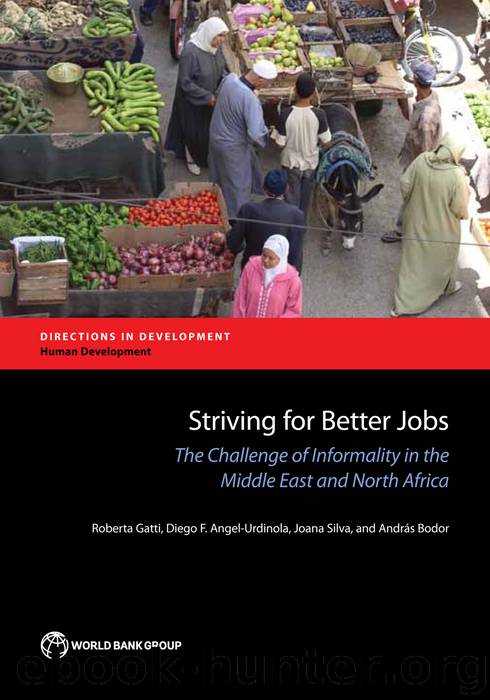
Author:Gatti, Roberta; Angel-Urdinola, Diego F.; Silva, Joana
Language: eng
Format: epub
Publisher: World Bank Publications
Published: 2014-03-21T16:00:00+00:00
References
Alami, R. M. 2008. “Comment définir l’informel?” La revue economia 2 (Feb.): 80.
Almeida, R., and P. Carneiro. 2009. “Enforcement of Regulation, Informal Employment, Firm Size and Firm Performance.” Journal of Comparative Economics 37 (1): 28–46.
Angel-Urdinola, D., and A. Kuddo. 2010. “Key Characteristics of Employment Regulation in the Middle East and North Africa.” SP Discussion Paper 1006. Washington, DC: World Bank.
Asiedu, E., and J. Freeman. 2008. “The Effect of Corruption on Investment Growth: Evidence from Firms in Latin America, Sub-Saharan Africa and Transition Countries.” Working Papers in Theoretical and Applied Economics 2008/02. Lawrence: University of Kansas, Department of Economics.
Botero, J. C., S. Djankov, R. La Porta, F. Lopez-de-Silanes, and A. Shleifer. 2004. “The Regulation of Labor.” Quarterly Journal of Economics 119 (4): 1339–1382.
Bruhn, M. 2011. “License to Sell: The Effect of Business Registration Reform on Entrepreneurial Activity in Mexico.” Review of Economics and Statistics 93 (1): 382–386.
Chong, A., and M. Gradstein. 2006. “Inequality and Informality.” Discussion Paper 5545. London: CEPR.
De Paula, A., and J. A. Scheinkman. 2007. “The Informal Sector.” Working paper 13486. Cambridge, MA: NBER.
De Soto, H. 1989. The Other Path: The Invisible Revolution in the Third World. New York: HarperCollins.
Direction de la Statistique. 2004. “L’enquête nationale sur le secteur informel non agricole.” Rabat, Morocco: Direction de la Statistique.
Djankov, S., R. F. Lopez-de-Silanes, and A. Shleifer. 2002. “The Regulation of Entry.” Quarterly Journal of Economics 117 (1): 1–37.
Djankov, S., C. McLiesh, and R. Ramalho. 2006. “Regulation and Growth.” Economics Letters 92 (3): 395–401.
Elbadawi, I., and N. Loayza. 2008. “Informality, Employment and Economic Development in the Arab World.” Journal of Development and Economic Policies 10 (2): 25–75.
Friedman, E., S. Johnson, D. Kaufmann, and P. Zoido-Lobaton. 2000. “Dodging the Grabbing Hand: The Determinants of Unofficial Activity in 69 Countries.” Journal of Public Economics 76 (3): 459–493.
Galal, A. 2005. “The Economics of Formalization: Potential Winners and Losers from Formalization in Egypt.” In Investment Climate, Growth, and Poverty, ed. G. Kochendorfer-Lucius and B. Pleskovic. Washington DC: World Bank.
Gatti, R., and M. Honorati. 2008. “Informality among Formal Firms: Firm-Level, Cross-Country Evidence on Tax Compliance and Access to Credit.” Policy Research Working Paper 4476. Washington, DC: World Bank.
ILO (International Labour Organization). 1993. “Resolutions Concerning International Classification of Status in Employment.” Adopted by the 15th International Conference of Labour Statisticians. Geneva: ILO.
________. 2002. “Decent Work and the Informal Economy: Sixth Item on the Agenda.” International Labour Conference 90th: 2002. Report VII (2A) Geneva: ILO. http://www.ilo.org/public/english/standards/relm/ilc/ilc90/pdf/rep-vi.pdf.
Ingram, M., V. Ramachandran, and V. Desai. 2007. “Why Do Firms Choose to be Informal? Evidence from the Africa Investment Climate Surveys.” Washington, DC: World Bank.
Ishengoma, E., and R. Kappel. 2006. “Economic Growth and Poverty: Does Formalization of Informal Enterprises Matter?” Working Paper Series 20. Hamburg: GIGA (German Institute of Global and Area Studies).
Johnson, S, D. Kaufmann, J. McMillan, and C. Woodruff. 2000. “Why Do Firms Hide? Bribes and Unofficial Activity after Communism.” Journal of Public Economics 76 (3): 495–520.
La Porta, R., and A. Shleifer. 2008. “The Unofficial Economy and Economic Development.” Brookings Papers on Economic Activity 2: 275–364.
Levenson, A., and W. Maloney. 1998.
Download
This site does not store any files on its server. We only index and link to content provided by other sites. Please contact the content providers to delete copyright contents if any and email us, we'll remove relevant links or contents immediately.
International Integration of the Brazilian Economy by Elias C. Grivoyannis(111470)
The Radium Girls by Kate Moore(12126)
Turbulence by E. J. Noyes(8153)
Nudge - Improving Decisions about Health, Wealth, and Happiness by Thaler Sunstein(7794)
The Black Swan by Nassim Nicholas Taleb(7229)
Rich Dad Poor Dad by Robert T. Kiyosaki(6784)
Pioneering Portfolio Management by David F. Swensen(6364)
Man-made Catastrophes and Risk Information Concealment by Dmitry Chernov & Didier Sornette(6169)
Zero to One by Peter Thiel(5898)
Secrecy World by Jake Bernstein(4825)
Millionaire: The Philanderer, Gambler, and Duelist Who Invented Modern Finance by Janet Gleeson(4556)
The Age of Surveillance Capitalism by Shoshana Zuboff(4385)
Skin in the Game by Nassim Nicholas Taleb(4336)
The Money Culture by Michael Lewis(4282)
Bullshit Jobs by David Graeber(4274)
Skin in the Game: Hidden Asymmetries in Daily Life by Nassim Nicholas Taleb(4077)
The Dhandho Investor by Mohnish Pabrai(3843)
The Wisdom of Finance by Mihir Desai(3814)
Blockchain Basics by Daniel Drescher(3657)
