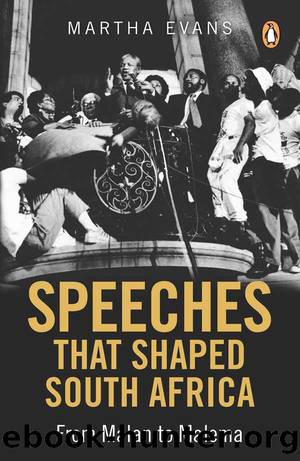
Speeches that Shaped South Africa by Martha Evans
Author:Martha Evans [Evans, Martha]
Language: eng
Format: epub
Publisher: Penguin Random House South Africa
Published: 2017-10-23T00:00:00+00:00
Despite the high stakes, Botha made no attempt to placate black anger or court the foreign media, and the speech is a perplexing mix of pompous boast, veiled threat and defiant declaration. After praising the government for its leadership, and chastising the media for putting words in his mouth, the president, famous for didactic finger-wagging, warned the world against pressuring the South African state: ‘Don’t push us too far in your own interests,’ Botha fumed, and ‘I am not prepared to make [a statement of intent], not now and not tomorrow’. At the same time, the president’s remarks suggest that he is in fact about to initiate historic changes: ‘I believe that we are today crossing the Rubicon,’ he says towards the end, and ‘There can be no turning back.’ But the more analysts examined his words, the harder it was to understand what he was talking about.
The president, dressed in a blue suit and described as being in a ‘jaunty mood’,13 clung to several divisive apartheid creations, continuing to speak of the homelands as ‘national states’ and dismissing the idea of a fourth African chamber of Parliament, which would extend the power-sharing deal to black South Africans. Despite the backlash over the Mandela release offer, and the speculation about whether the speech would announce a new offer, he dredges up twenty-year-old court verdicts, making it clear that Mandela’s release was not on the cards.
The only real suggestion of significant reform came in the vague assertion that any ‘national states’ (homelands) wishing to remain a part of South Africa would not be forced into accepting independence and that a solution must be found to address the permanence of blacks in urban areas. At another time, these might have seemed progressive, but couched as they were between bombast and lambast, they did not sound like anything momentous – certainly not to the Western world.
The economic and diplomatic fallout was catastrophic. The rand tumbled to a record low, and despite Botha’s brags of ‘favourable’ ‘economic fundamentals’, the economy was hit hard. While Chase Manhattan had decided some time before that it would no longer roll over loans,14 it announced its decision immediately after the speech and various banks followed suit, forcing South Africa to declare a unilateral moratorium on the repayment of foreign debt.15
France withdrew its ambassador from the country and banned new investment in its economy; Australia announced its intention to formally endorse sanctions; and the leader of the Labour Party in the UK quipped that ‘the Bothas, like the Bourbons, forget nothing and learn nothing’,16 in reference to the long-standing French dynasty.
The media was also disenchanted. The Times of London said that the speech was not merely an anticlimax but ‘marked a crossing of the wrong Rubicon before a perilous land’.17 The Natal Witness described the speech as a ‘damp squib’,18 and Port Elizabeth’s Evening Post expressed the nation’s disappointment, saying that the address ‘offered little cause for hope that the South African crisis is anywhere nearer resolution’.19 More forgivingly,
Download
This site does not store any files on its server. We only index and link to content provided by other sites. Please contact the content providers to delete copyright contents if any and email us, we'll remove relevant links or contents immediately.
| Africa | Americas |
| Arctic & Antarctica | Asia |
| Australia & Oceania | Europe |
| Middle East | Russia |
| United States | World |
| Ancient Civilizations | Military |
| Historical Study & Educational Resources |
The Dawn of Everything by David Graeber & David Wengrow(1707)
The Bomber Mafia by Malcolm Gladwell(1625)
Facing the Mountain by Daniel James Brown(1553)
Submerged Prehistory by Benjamin Jonathan; & Clive Bonsall & Catriona Pickard & Anders Fischer(1455)
Wandering in Strange Lands by Morgan Jerkins(1430)
Tip Top by Bill James(1416)
Driving While Brown: Sheriff Joe Arpaio Versus the Latino Resistance by Terry Greene Sterling & Jude Joffe-Block(1376)
Red Roulette : An Insider's Story of Wealth, Power, Corruption, and Vengeance in Today's China (9781982156176) by Shum Desmond(1359)
Evil Geniuses: The Unmaking of America: A Recent History by Kurt Andersen(1354)
The Way of Fire and Ice: The Living Tradition of Norse Paganism by Ryan Smith(1336)
American Kompromat by Craig Unger(1315)
F*cking History by The Captain(1304)
It Was All a Lie by Stuart Stevens;(1300)
American Dreams by Unknown(1286)
Treasure Islands: Tax Havens and the Men who Stole the World by Nicholas Shaxson(1274)
Evil Geniuses by Kurt Andersen(1257)
White House Inc. by Dan Alexander(1212)
The First Conspiracy by Brad Meltzer & Josh Mensch(1174)
The Fifteen Biggest Lies about the Economy: And Everything Else the Right Doesn't Want You to Know about Taxes, Jobs, and Corporate America by Joshua Holland(1126)
