Soldiers to the Last Day by Denis Havel
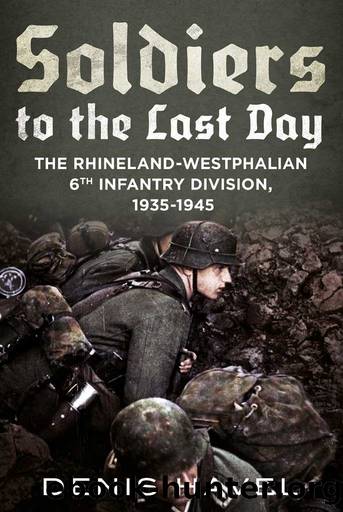
Author:Denis Havel [Havel, Denis]
Language: eng
Format: epub
ISBN: 978-1-78155-744-0
Publisher: Fonthill Media
Published: 2019-06-14T16:00:00+00:00
10
Operation Büffel
The 6th Grenadier Division rang in the New Year in a lively fashion, one that would become tradition for the remainder of the war. At daybreak on January 1, every carbine, machine gun, mortar, and even 2-cm Flak gun fired away at the Russian positions in front of them. Ivan did not return the New Year’s greeting, hunkering down instead in bunkers and trenches fully expecting a major attack. Then the guns fell silent and the smoke drifted away. After all, it had all been in good fun.
The Führer and the German General Staff were in a far less celebratory mood that New Year’s Day. The Rzhev Front may have withstood the Soviet winter onslaught, but far to the south on the Stalingrad and Caucasus Fronts, a disaster was staring them in the face. In mid-November, Zhukov’s other offensive, Operation Uranus, had smashed through the Romanian armies, entrapped von Paulus’ 6th Army in Stalingrad, and was pushing southwest to the Sea of Azov, threatening to cut off the other two German armies in the Caucasus. Von Paulus had requested permission to attempt to break out of the encirclement, but the Führer had denied the request. The 6th Army would fight where it stood. Hitler had given assurances that he would somehow rescue the 6th Army. He did not. Two months later, von Paulus and the remnants of the 6th Army surrendered. A total 91,000 freezing and starving skeletons shuffled off to Siberia; a scant 5,000 of them would ever see Germany again.
Although short of catastrophic, the German defeat at Stalingrad was a severe blow to the Wehrmacht. Depending on the sources, dates, and extent of the campaign considered, Axis losses in killed, wounded, or taken prisoner range from a quarter to over a half million men. Whatever the number, after three and a half years of war these were losses that Germany would be hard put to replace.
History likes its drama and the Battle of Stalingrad has often been called the “turning point” of the war. Accurate or not, the defeat was certainly indicative that Germany had reached, if not overreached, the limit of its power. Hitler might still have been determined to win the war, but more sober minds at the Führer’s Headquarters and in the field were now thinking more in terms of how not to lose the war. The defeat and heavy losses at Stalingrad were soon to directly affect the defenders of Rzhev.
Early in January, the “prodigal sons” of Regiment 18 returned from their “Winterreise.” For the past month as part of 9th Army’s mobile reserve, they had been flung about the battlefield to wherever a crisis had arisen. At Ossuga and in the Lutschessatal, they had suffered heavy casualties. Thirteen officers and 407 men had been killed, wounded, or were missing (40 percent). As Becker’s grenadiers trudged northwards through the snow, they caught sight of a road marker, “Rshew 27 km,” and despite the memories of the horrific summer battles, many a Landser strangely experienced the feeling of returning home.
Download
This site does not store any files on its server. We only index and link to content provided by other sites. Please contact the content providers to delete copyright contents if any and email us, we'll remove relevant links or contents immediately.
| Africa | Americas |
| Arctic & Antarctica | Asia |
| Australia & Oceania | Europe |
| Middle East | Russia |
| United States | World |
| Ancient Civilizations | Military |
| Historical Study & Educational Resources |
The Radium Girls by Kate Moore(12030)
100 Deadly Skills by Clint Emerson(4927)
Rise and Kill First by Ronen Bergman(4790)
The Templars by Dan Jones(4689)
The Doomsday Machine by Daniel Ellsberg(4490)
The Rape of Nanking by Iris Chang(4215)
Killing England by Bill O'Reilly(4005)
Stalin by Stephen Kotkin(3969)
Hitler in Los Angeles by Steven J. Ross(3946)
12 Strong by Doug Stanton(3551)
Hitler's Monsters by Eric Kurlander(3343)
Blood and Sand by Alex Von Tunzelmann(3205)
The Code Book by Simon Singh(3189)
Darkest Hour by Anthony McCarten(3133)
The Art of War Visualized by Jessica Hagy(3009)
Hitler's Flying Saucers: A Guide to German Flying Discs of the Second World War by Stevens Henry(2756)
Babylon's Ark by Lawrence Anthony(2682)
The Second World Wars by Victor Davis Hanson(2526)
Tobruk by Peter Fitzsimons(2518)
