Small Wars and Skirmishes: 1902-1918 by Edwin Herbert
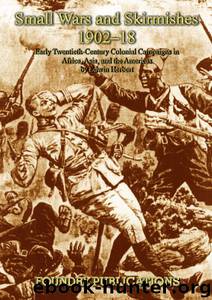
Author:Edwin Herbert [Herbert, Edwin]
Language: eng
Format: epub
Tags: HISTORY / Military / World War I
ISBN: 9781901543346
Publisher: Casemate Publishers
Published: 2003-07-18T21:00:00+00:00
Meanwhile, in the south, the Witbooi Nama, led by Captain Hendrik Witbooi, had belatedly responded to the Herero call to arms, in response to a leadership challenge from Jakob Morenga, who had joined the Bondelswarts uprising in 1903 and who had not accepted the peace treaty in 1904 (causing the Germans to place a price of 1,000 marks on his head). As Morenga had a Nama father and an Herero mother, he was able to call on support from both tribal groupings. Initially, Witbooi had sided with the Germans, as he had done in all previous conflicts for the last ten years, and had actually provided an 80-strong contingent to fight the Herero at Waterberg. Now, Morenga’s challenge spurred him into action against the Germans.
It was not a wise decision. It was too late to save the Herero dying in the desert and it was too little to have any chance against the increasing might of the Germans. Even with help from three neighbouring tribes — the Franzmannschen Nama from the Gochas area (120 men under Simon Kopper), the Khauben or Red Nation (so-called because of the reddish tint to their skin) from the Hoachanas region (190 men under Manesse Noreseb), and the Veldskoendragers or the Wearers of Veld Shoes from the area to the east of the Karras Hills (200 men under Hans Hendrik) — the total number of warriors in Witbooi’s army at no time exceeded 1,500 men, less than half of whom were armed with modern rifles. Captain Christian Goliath of Bersheba and Paul Frederiks, Captain of the Bethanie people, as well as the Keetmanshoop tribe, refused to join the rebellion. German troopships had been pouring reinforcements into Swapokmund since spring 1904 and there were already 10,000 fully-equipped regulars in the colony.
In July 1904 Morenga set up a fortified camp in the Sambock hills with a band of 11 men, and from this base he attacked German farms in order to capture the weapons, ammunition, and food he needed to wage war against his former masters. A 30-strong German detachment under Lieutenant von Stempel was sent to capture him, leading to an encounter on 30 August at a farm owned by a Boer called Freyer, near Kouchanas. In a short firefight, Stempel and two other Germans were killed and the rest put to flight. After this success, both Nama and Herero flocked to Morenga’s side and by September he commanded over 400 armed men at a new base in the Karras hills. At dawn on 5 October, Morenga’s band struck at Wasserfal, where the Eighth Field Company was bivouacked, taking the troopers by surprise and driving off all their horses.
The rebellion became general in October when Hendrik Witbooi added his weight to Morenga’s predations and 40 German soldiers and civilians were killed in a massacre similar to the one heralding the start of the Herero revolt. The dead included Bezirksamtmann von Burgsdorff, the highest German official in Namaland.
The German response was soon forthcoming. On 22 November the
Download
This site does not store any files on its server. We only index and link to content provided by other sites. Please contact the content providers to delete copyright contents if any and email us, we'll remove relevant links or contents immediately.
| Automotive | Engineering |
| Transportation |
Whiskies Galore by Ian Buxton(42022)
Introduction to Aircraft Design (Cambridge Aerospace Series) by John P. Fielding(33134)
Small Unmanned Fixed-wing Aircraft Design by Andrew J. Keane Andras Sobester James P. Scanlan & András Sóbester & James P. Scanlan(32807)
Craft Beer for the Homebrewer by Michael Agnew(18249)
Turbulence by E. J. Noyes(8057)
The Complete Stick Figure Physics Tutorials by Allen Sarah(7378)
The Thirst by Nesbo Jo(6950)
Kaplan MCAT General Chemistry Review by Kaplan(6939)
Bad Blood by John Carreyrou(6626)
Modelling of Convective Heat and Mass Transfer in Rotating Flows by Igor V. Shevchuk(6448)
Learning SQL by Alan Beaulieu(6293)
Weapons of Math Destruction by Cathy O'Neil(6285)
Man-made Catastrophes and Risk Information Concealment by Dmitry Chernov & Didier Sornette(6029)
Digital Minimalism by Cal Newport;(5769)
Life 3.0: Being Human in the Age of Artificial Intelligence by Tegmark Max(5561)
iGen by Jean M. Twenge(5419)
Secrets of Antigravity Propulsion: Tesla, UFOs, and Classified Aerospace Technology by Ph.D. Paul A. Laviolette(5374)
Design of Trajectory Optimization Approach for Space Maneuver Vehicle Skip Entry Problems by Runqi Chai & Al Savvaris & Antonios Tsourdos & Senchun Chai(5071)
Pale Blue Dot by Carl Sagan(5013)
