Searching for Black Confederates by Levin Kevin M.;
Author:Levin, Kevin M.;
Language: eng
Format: epub
Publisher: University of North Carolina Press
Published: 2019-11-15T00:00:00+00:00
Chapter Five
TURNING CAMP SLAVES INTO BLACK CONFEDERATE SOLDIERS
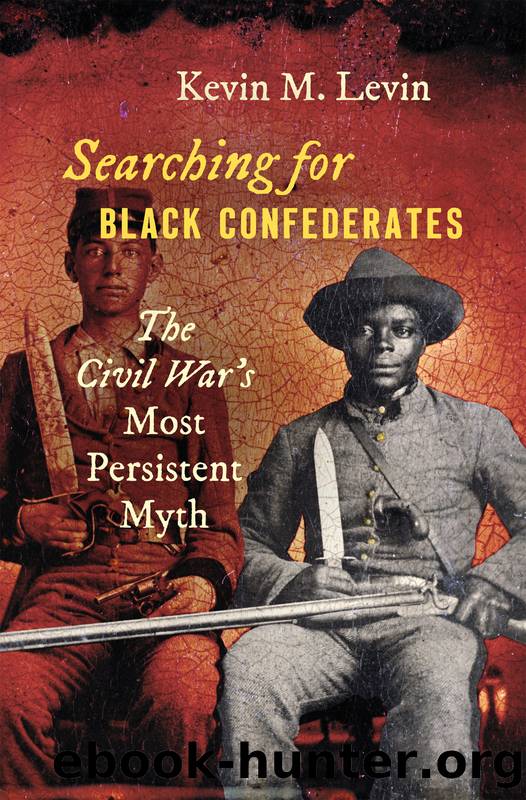
On September 17, 1994, the General William Barksdale Camp 1220, Sons of Confederate Veterans, and John M. Stone Chapter 380, United Daughters of the Confederacy (UDC), placed a Southern Cross of Honor on the grave of Silas Chandler in Greenwood Cemetery in West Point, Mississippi.1 By honoring him, the SCV transformed an unknown story about an obscure slave into a full-blown legend. Films, art prints, T-shirts, and the spread of the photograph of Silas and Andrew Chandler on the Internet soon followed, all promoting Silas as a loyal son of the South who became a Confederate soldier, heroically battling Yankees alongside his white owner. The Cross of Honor, introduced in 1900 by the UDC, was intended for Confederate soldiers who performed acts of valor on the battlefield. It was about this time that Myra Chandler Sampson, the great-granddaughter of Silas, discovered the marker. For Sampson, it represented nothing less than the SCVâs and UDCâs goal to âperpetuate myths in attempt to rewrite and sugar-coat the shameful truth about parts of our American history for political and financial gain.â2
The Confederate heritage community relied on a wide range of accounts of former camp slaves that became popularized by the turn of the twentieth century rather than on Lost Cause narratives from the immediate postwar period. By the 1990s, photographs of uniformed black men as well as pension applications in which the distinction between slave and soldier was sometimes clouded became evidence that the Confederacy recruited large numbers of blacks into the army as soldiers. Interpreting black men in the army as soldiers echoed the Lost Causeâs insistence that African Americans were loyal but also constituted a break with the claim that they did so as slaves.
The reinterpretation of Silas Chandler and others as soldiers, serving in an equal capacity to white men, was part of a much broader counternarrative that was first introduced by the SCV in the late 1970s in response to a growing interest among academic historians and the general public in the history of slavery, the role of African Americans in the Union army during the Civil War, and the importance of emancipation. This resurgence of interest picked up speed during the civil rights era as historians and black Americans challenged the central tenets of the Lost Cause, especially the unassailable belief in the loyalty of the slave population. They emphasized the central role that slavery played in causing the war and emancipation as its most important outcome. At the center of this new narrative were stories of black Union soldiers and accounts of their role in helping to destroy the Confederacy and end slavery. Popular magazines such as Jet and Ebony, literature published by civil rights organizations, and public speeches of civil rights activists embraced the black Union soldier as a reminder of emancipation, freedom, and the âunfinished workâ of achieving equal rights. New scholarship focused attention at historic sites and museums on the history of slavery, and popular television shows
Download
This site does not store any files on its server. We only index and link to content provided by other sites. Please contact the content providers to delete copyright contents if any and email us, we'll remove relevant links or contents immediately.
| Africa | Americas |
| Arctic & Antarctica | Asia |
| Australia & Oceania | Europe |
| Middle East | Russia |
| United States | World |
| Ancient Civilizations | Military |
| Historical Study & Educational Resources |
The Dawn of Everything by David Graeber & David Wengrow(1776)
The Bomber Mafia by Malcolm Gladwell(1673)
Facing the Mountain by Daniel James Brown(1609)
Tip Top by Bill James(1505)
Submerged Prehistory by Benjamin Jonathan; & Clive Bonsall & Catriona Pickard & Anders Fischer(1502)
Wandering in Strange Lands by Morgan Jerkins(1494)
Driving While Brown: Sheriff Joe Arpaio Versus the Latino Resistance by Terry Greene Sterling & Jude Joffe-Block(1413)
Evil Geniuses: The Unmaking of America: A Recent History by Kurt Andersen(1404)
Red Roulette : An Insider's Story of Wealth, Power, Corruption, and Vengeance in Today's China (9781982156176) by Shum Desmond(1400)
The Way of Fire and Ice: The Living Tradition of Norse Paganism by Ryan Smith(1374)
American Kompromat by Craig Unger(1369)
F*cking History by The Captain(1361)
It Was All a Lie by Stuart Stevens;(1345)
American Dreams by Unknown(1328)
Treasure Islands: Tax Havens and the Men who Stole the World by Nicholas Shaxson(1312)
Evil Geniuses by Kurt Andersen(1306)
White House Inc. by Dan Alexander(1250)
The First Conspiracy by Brad Meltzer & Josh Mensch(1224)
The Fifteen Biggest Lies about the Economy: And Everything Else the Right Doesn't Want You to Know about Taxes, Jobs, and Corporate America by Joshua Holland(1163)
