Rethinking America by Murrin John M.; Shankman Andrew;
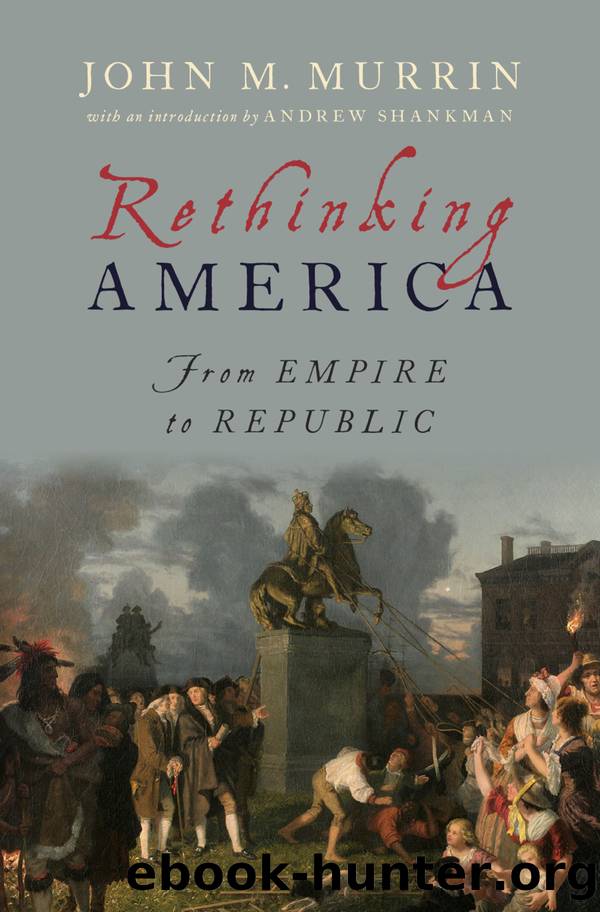
Author:Murrin, John M.; Shankman, Andrew;
Language: eng
Format: epub
Publisher: Oxford University Press, Incorporated
Published: 2018-11-15T00:00:00+00:00
7
Fundamental Values, the Founding Fathers, and the Constitution
âWE FORMED OUR Constitution without any acknowledgement of God,â President Timothy Dwight told his Yale audience as the War of 1812 loomed threateningly over the community. âThe Convention, by which it was formed, never asked, even once, his direction, or his blessing upon their labours. Thus we commenced our national existence under the present system, without God.â Dwight traveled a great deal and knew personally some of the delegates to the Philadelphia Convention. Very likely one of them told him about the day on which the Fathers of the Constitution refused to invoke God in any form.1
During one of the stormiest moments of the Constitutional Convention, Benjamin Franklin tried to break the impasse between large-state and small-state advocates that threatened to paralyze the proceedings. Why, he asked on June 28, 1787, had the members ânot hitherto once thought of humbly applying to the Father of lights to illuminate our understandings?â During the prolonged crisis with Great Britain that had led to Independence, the First and Second Continental Congresses had routinely opened their proceedings with public prayers, be noted. He did not point out that the Rev. Jacob Duché, the principal chaplain to Congress in those years, had somewhat spoiled the overall effect by becoming a loyalist. Instead, Franklin insisted that the United States had already benefited from âfrequent instances of a Superintending providence in our favor.â âGod governs in the affairs of men,â he proclaimed emphatically. He therefore moved âthat henceforth prayers imploring the assistance of Heaven, and its blessings on our deliberations, be held in this Assembly every morning before we proceed to business, and that one or more of the Clergy of this City be requested to officiate in that service.â2
The motion drew a second from Roger Sherman of Connecticut, one of two born-again Christians at the Convention, although his modern biographer, Christopher Collier, considers him a âpoliticalâ New Lightâsomeone, that is, who knew that joining the New Light coalition could be a prerequisite to a successful public career and who probably persuaded his neighbors (this point remains unclear) that he had experienced the conversion required of a full church member.3
What happened after Franklin and Sherman urged the Founding Fathers to invoke God? Alexander Hamilton, we know, opposed the motion. However proper such a gesture might have been at the outset of the Convention, he argued, it was imprudent âat this late dayâ because it might indicate to the broader public: âthat the embarrassments and dissentions within the convention, had suggested this measure.â So James Madison recorded at the time.4 According to the much later and highly problematic recollections of the youngest delegate at the gathering, Jonathan Dayton of New Jersey, Hamilton accompanied his objections with a highly irreverent speech. We shall probably never know whether Hamilton said anything of the kind at that particular moment, but the sentiments attributed to him by Dayton are quite compatible with the convictions of an admirer of David Hume, the skeptical Scottish philosopher whose writings Hamilton had devoured early in his military career.
Download
This site does not store any files on its server. We only index and link to content provided by other sites. Please contact the content providers to delete copyright contents if any and email us, we'll remove relevant links or contents immediately.
| Africa | Americas |
| Arctic & Antarctica | Asia |
| Australia & Oceania | Europe |
| Middle East | Russia |
| United States | World |
| Ancient Civilizations | Military |
| Historical Study & Educational Resources |
The Dawn of Everything by David Graeber & David Wengrow(1707)
The Bomber Mafia by Malcolm Gladwell(1625)
Facing the Mountain by Daniel James Brown(1553)
Submerged Prehistory by Benjamin Jonathan; & Clive Bonsall & Catriona Pickard & Anders Fischer(1455)
Wandering in Strange Lands by Morgan Jerkins(1430)
Tip Top by Bill James(1416)
Driving While Brown: Sheriff Joe Arpaio Versus the Latino Resistance by Terry Greene Sterling & Jude Joffe-Block(1376)
Red Roulette : An Insider's Story of Wealth, Power, Corruption, and Vengeance in Today's China (9781982156176) by Shum Desmond(1359)
Evil Geniuses: The Unmaking of America: A Recent History by Kurt Andersen(1354)
The Way of Fire and Ice: The Living Tradition of Norse Paganism by Ryan Smith(1336)
American Kompromat by Craig Unger(1315)
F*cking History by The Captain(1304)
It Was All a Lie by Stuart Stevens;(1300)
American Dreams by Unknown(1286)
Treasure Islands: Tax Havens and the Men who Stole the World by Nicholas Shaxson(1274)
Evil Geniuses by Kurt Andersen(1257)
White House Inc. by Dan Alexander(1212)
The First Conspiracy by Brad Meltzer & Josh Mensch(1174)
The Fifteen Biggest Lies about the Economy: And Everything Else the Right Doesn't Want You to Know about Taxes, Jobs, and Corporate America by Joshua Holland(1126)
