Race & Economics by Walter E. Williams
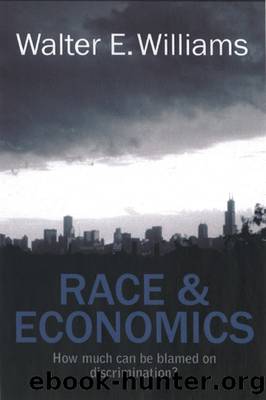
Author:Walter E. Williams
Language: eng
Format: epub
Tags: African-Americans, blacks, slavery, family structure, race, whites, welfare, racial discrimination, laws, competition, labor market, minimum wage, skilled labor, unskilled labor, licensing, regulation, deregulation, racial segregation
Publisher: Hoover Institution Press
Published: 2011-08-15T00:00:00+00:00
Black and White Labor Violence
Labor violence in Chicago was a classic instance of racial competition in the labor market, and in 1919, it culminated in one of the nationâs deadliest race riots.[30] When the riot was over, twenty-three blacks lay dead along with fifteen whites; well over 500 people of both races were injured. The history of Chicagoâs racial antagonism goes back to the Pullman strike of 1894, when packing and slaughterhouse workers struck in sympathy with Eugene V. Debsâs American Railway Union. This strike marked the first time in the history of the packing industry that blacks were used as strikebreakers, and the action ended in defeat for the white workers.
In 1904, the packers once again went out on strike. This time the strike was over the skilled butchersâ demand for a minimum wage of 20 cents an hour for their unskilled brethren, complaining that large packinghouses âbegan a system to crowd out the expert butchers and replace them by cheaper men in every way.â They were displaced by âcheap Polackers and Hungarians. . . .â[31] As our earlier analysis of the economic effects of minimum wages would predict, âThe skilled worker realized that this specialization enabled unskilled workers with âmuscleâ to replace him; it appeared inevitable that unless a minimum wage were obtained for the unskilled, cut-throat job competition would drive all the wages down.â[32]
Once again, the packersâ strike was broken by blacks, who were hired as replacements by the thousands. And once again, they were subjected to extensive violence. Out of desperation as well as miscalculation, union leaders wired Booker T. Washington asking him to come to Chicago to lecture blacks on the subject: âShould Negroes Become Strikebreakers?â Washington turned the invitation down. South Carolinaâs Senator âPitchfork Benâ Tillman, a rabid segregationist, came instead to tell the union workers, âIt was the niggers that whipped you in line. . . . They were the club with which your brains were beaten out.â[33]
In 1905, during a Chicago teamstersâ strike, trainloads of black workers were brought in to deliver milk, coal, and other merchandise. They were set upon by angry strikers, and riots ensued. Chicagoâs city council enacted an order requesting that the cityâs corporation counsel file an opinion as to âwhether the importation of hundreds of Negro workers is not a menace to the community and should be restricted.â The employersâ association responded by indicating a willingness not to import any more blacks, but refused to fire those already employed. The teamstersâ president replied, âYou have the Negroes in here to fight us and we answer that we have the right to attack them wherever found.â
Indicative of white solidarity over strikebreaking was the sympathy strike conducted by hundreds of grade school students. They stoned black drivers delivering coal to their schools. Teachers and principals encouraged the students, in one case saying, âI invite the students to strike, if the dirty niggers deliver coal at this school.â
Despite union and political pressure, employers continued to hire blacksâas more than temporary.
Download
This site does not store any files on its server. We only index and link to content provided by other sites. Please contact the content providers to delete copyright contents if any and email us, we'll remove relevant links or contents immediately.
International Integration of the Brazilian Economy by Elias C. Grivoyannis(111078)
The Radium Girls by Kate Moore(12036)
Turbulence by E. J. Noyes(8057)
Nudge - Improving Decisions about Health, Wealth, and Happiness by Thaler Sunstein(7712)
The Black Swan by Nassim Nicholas Taleb(7137)
Rich Dad Poor Dad by Robert T. Kiyosaki(6646)
Pioneering Portfolio Management by David F. Swensen(6305)
Man-made Catastrophes and Risk Information Concealment by Dmitry Chernov & Didier Sornette(6029)
Zero to One by Peter Thiel(5808)
Secrecy World by Jake Bernstein(4756)
Millionaire: The Philanderer, Gambler, and Duelist Who Invented Modern Finance by Janet Gleeson(4483)
The Age of Surveillance Capitalism by Shoshana Zuboff(4310)
Skin in the Game by Nassim Nicholas Taleb(4257)
The Money Culture by Michael Lewis(4212)
Bullshit Jobs by David Graeber(4197)
Skin in the Game: Hidden Asymmetries in Daily Life by Nassim Nicholas Taleb(4012)
The Dhandho Investor by Mohnish Pabrai(3775)
The Wisdom of Finance by Mihir Desai(3754)
Blockchain Basics by Daniel Drescher(3586)
