Out of Context: How to Avoid Misinterpreting the Bible by Richard Schultz
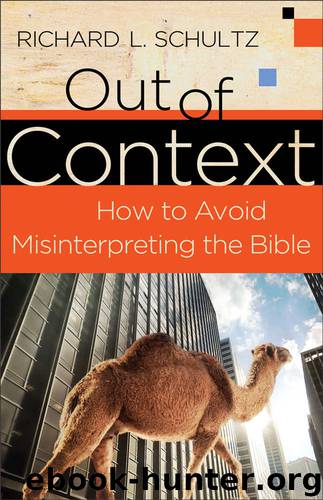
Author:Richard Schultz [Schultz, Richard]
Language: eng
Format: azw3, epub
Tags: REL006000, REL012000, Bible—Hermeneutics
ISBN: 9781441238887
Publisher: Baker Publishing Group
Published: 2012-11-01T04:00:00+00:00
Historical Narrative
One of the most appealing biblical genres is historical narrative. It is found in more than half of the Old Testament books, as well as in the four Gospels and Acts in the New Testament. Biblical narratives are artistic literary compositions that are more like short stories than archival reports. They present the challenges of the life of faith in a multifaceted portrait, which often mirrors our own struggles and triumphs. This can lead to a number of problems in interpretation and application. We already discussed in chapter 3 the tendency to read a specific narrative in isolation from its larger context. There is also a temptation to derive a moral from each individual story, much like an Aesop fable, or to suppose that even minor details have spiritual importance. Another major problem arises when we assume that what is described in the narrative is prescribed by God by virtue of being a part of inspired Scripture. Or, in other words, we may wrongly believe that we should aspire to do whatever the biblical characters did. The examples below illustrate these issues.
Confusing the Descriptive for the Prescriptive
Gary Smalley and John Trent’s book The Blessing encourages parents to make it a priority to bless their children, based on the model of the patriarchal blessing in Genesis 27 and 48–49. The authors correctly acknowledge that the patriarchal blessing played a unique role in salvation history. It was reserved for one special occasion, it was irrevocable and prophetic, and it was based on God’s sovereign choice of the biological line of divine blessing. Smalley and Trent are convinced, however, that these passages not only portray the actions of Isaac and Jacob but also teach the permanent importance of parental blessing. They even identify in Genesis five elements that every parental blessing should include: giving a meaningful touch, delivering a spoken message, attaching high value to the person being blessed, picturing a special future for that person, and being actively committed to helping to fulfill that blessing.[105]
Smalley and Trent’s approach reflects a basic misunderstanding of how biblical narratives communicate spiritual truth. To move properly from what the narrative describes the biblical characters doing to what is prescribed for us to do, it is important, first of all, to identify the narrative’s place within the larger biblical story of redemption. As we do that, we should keep the focus on God and his involvement in history, not on the deeds of biblical heroes and heroines (or villains). We should be cautious about deriving theology or practices directly from narrative description because the narrative does not always make it clear which of the biblical characters’ beliefs and practices we should follow. Should we also follow the patriarchs in practicing polygamy (Gen. 16:1–4; 29:15–30) and lying to get ourselves out of tight spots (Gen. 12:10–20; 20:1–18; 26:1–11)? Since narratives “illustrate what is taught explicitly and categorically elsewhere,”[106] we are better off basing our theology and practices on the explicit teachings of Scripture. When reading narratives, we should pay attention to how the details were selected and ordered.
Download
Out of Context: How to Avoid Misinterpreting the Bible by Richard Schultz.epub
This site does not store any files on its server. We only index and link to content provided by other sites. Please contact the content providers to delete copyright contents if any and email us, we'll remove relevant links or contents immediately.
The 5 Love Languages: The Secret to Love That Lasts by Gary Chapman(9782)
The Space Between by Michelle L. Teichman(6927)
Assassin’s Fate by Robin Hobb(6197)
Wiseguy by Nicholas Pileggi(5767)
Everything Happens for a Reason by Kate Bowler(4729)
Gerald's Game by Stephen King(4639)
Pillow Thoughts by Courtney Peppernell(4271)
A Simplified Life by Emily Ley(4156)
The Power of Positive Thinking by Norman Vincent Peale(4054)
Harry Potter and the Prisoner of Azkaban (Book 3) by J. K. Rowling(3346)
Resisting Happiness by Matthew Kelly(3336)
Girl, Wash Your Face by Rachel Hollis(3275)
Being Aware of Being Aware by Rupert Spira(3272)
The Code Book by Simon Singh(3175)
The Secret Power of Speaking God's Word by Joyce Meyer(3167)
More Language of Letting Go: 366 New Daily Meditations by Melody Beattie(3017)
Real Sex by Lauren F. Winner(3006)
Name Book, The: Over 10,000 Names--Their Meanings, Origins, and Spiritual Significance by Astoria Dorothy(2977)
The Holy Spirit by Billy Graham(2942)
