Mass Murder in California's Empty Quarter by Ray A. March
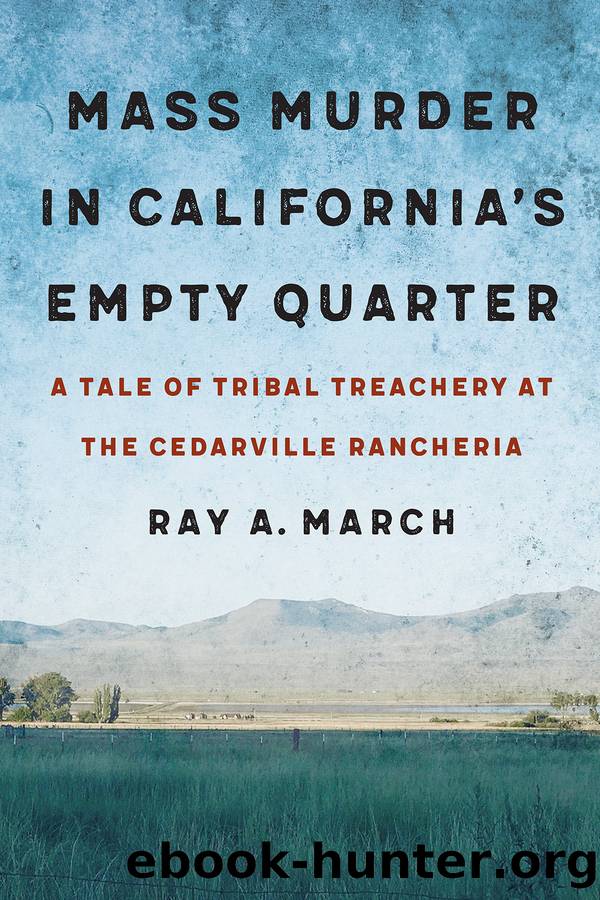
Author:Ray A. March [March, Ray A.]
Language: eng
Format: epub
Tags: SOC021000 Social Science / Ethnic Studies / Native American Studies, TRU002000 True Crime / Murder / General
Publisher: Bison Books
27
âTheyâre just Indians, who cares if they kill each other. Itâs certainly not worth the cost of a death penalty trial.â
There was a familiar ring to these complaints. They were echoes of complaints Kandi heard from her students at Modoc High. âWhy are we reading about other races if this is American Lit?â âWhy arenât we reading about Americans if this is American Lit?â âWhy are we wasting time reading about Indians?â
The grumbling was loud enough to reach the district attorney. For nearly a year before Cherieâs case went to trialâand well in advance of the change of venue that Funk eventually agreed toâhe was aware of the antipathy between the Native and white populations in Modoc County.
âIn the course of the case a few people said to me, âWhy are we spending the money to prosecute an Indian who killed other Indians?ââ Funk said. He heard that people were hearing the same complaint from others they knew. The message was clear to Funk: âIf she wants to plead to multiple life terms, thatâs good enough.â Why waste white taxpayersâ money to execute an Indian? Indians werenât worth it. After the trial, he admitted he had encountered a âfair bit of virulent racism as push-back against seeking the death penalty for Cherie Rhoades.â
âI heard the argument. I understood the argument. But the bottom line was it was a cold-blooded, premediated mass shooting perpetrated by ambush. The crime deserved the death penalty if a jury would render it. It was that simple,â Funk said. It wasnât that the grumblers were opposed to the death penalty. Most of them, according to Modoc County voting statistics, favored lethal injection.
Funk knew some of the victims and their families because he had either prosecuted them as district attorney or defended several when he was in private practice. However, their brushes with the law didnât mean they werenât entitled to his pursuing the death penalty, which was what they wanted.
There were two reasons for imposing the death penalty. One was the severity of the crime. The other was that surviving members of the tribe wanted Cherie executed no matter the cost to taxpayers. Tribal dynamics could not be ignored. As Funk later explained, Cherieâs crime was a cold-blooded, premeditated killing. At the same time there was a lot of passion behind it. She hated her brother and the tribal government for their treatment of her. What didnât help in preparing his caseâin Funkâs opinionâwas that the tribe was tragically dysfunctional.
While Funk was deciding whether he would accept Cherieâs offer of a plea deal or seek death, California and the nation were debating the moral, legal, and economic merits of legally killing someone. On July 16, 2014, U.S. District Judge Cormack J. Carney ruled Californiaâs death penalty unconstitutional. His decision pivoted on a petition by death row inmate Ernest Dewayne Jones, who had been sentenced to die nearly twenty years earlier for the rape and killing of his girlfriendâs mother. Jonesâs attorneys argued that Californiaâs dysfunctional death penalty system caused delays in carrying out a backlog of executions.
Download
This site does not store any files on its server. We only index and link to content provided by other sites. Please contact the content providers to delete copyright contents if any and email us, we'll remove relevant links or contents immediately.
| Africa | Americas |
| Arctic & Antarctica | Asia |
| Australia & Oceania | Europe |
| Middle East | Russia |
| United States | World |
| Ancient Civilizations | Military |
| Historical Study & Educational Resources |
The Dawn of Everything by David Graeber & David Wengrow(1707)
The Bomber Mafia by Malcolm Gladwell(1625)
Facing the Mountain by Daniel James Brown(1553)
Submerged Prehistory by Benjamin Jonathan; & Clive Bonsall & Catriona Pickard & Anders Fischer(1455)
Wandering in Strange Lands by Morgan Jerkins(1430)
Tip Top by Bill James(1416)
Driving While Brown: Sheriff Joe Arpaio Versus the Latino Resistance by Terry Greene Sterling & Jude Joffe-Block(1376)
Red Roulette : An Insider's Story of Wealth, Power, Corruption, and Vengeance in Today's China (9781982156176) by Shum Desmond(1359)
Evil Geniuses: The Unmaking of America: A Recent History by Kurt Andersen(1354)
The Way of Fire and Ice: The Living Tradition of Norse Paganism by Ryan Smith(1336)
American Kompromat by Craig Unger(1315)
F*cking History by The Captain(1304)
It Was All a Lie by Stuart Stevens;(1300)
American Dreams by Unknown(1286)
Treasure Islands: Tax Havens and the Men who Stole the World by Nicholas Shaxson(1274)
Evil Geniuses by Kurt Andersen(1257)
White House Inc. by Dan Alexander(1212)
The First Conspiracy by Brad Meltzer & Josh Mensch(1174)
The Fifteen Biggest Lies about the Economy: And Everything Else the Right Doesn't Want You to Know about Taxes, Jobs, and Corporate America by Joshua Holland(1126)
