Mary Shelley and the Rights of the Child by Botting Eileen Hunt;
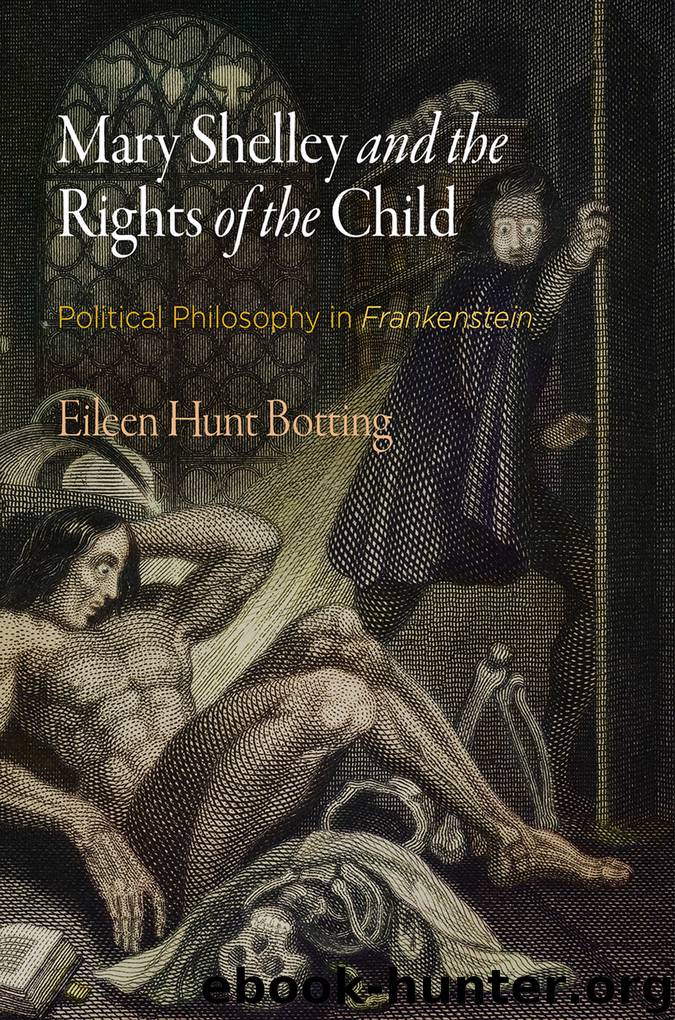
Author:Botting, Eileen Hunt;
Language: eng
Format: epub
Publisher: University of Pennsylvania Press
Published: 2017-03-16T04:00:00+00:00
Thought Experiment 2: Lovelessness
What if the child was totally abandoned because the lone parent (and other people) did not love him due to fear and disgust of his hideous form?
Frankenstein’s second thought experiment picks up right where the first one left off. Thought Experiment 1 rendered the Creature motherless twice over—due to being made (a) by a father-scientist without a woman and (b) with “un-human features” so horrifying and disgusting that all people, including his lone parent, appear to lack sufficient affective motivation to intensively care for, let alone love, him. As a result, the Creature suffers immediate abandonment by his father only to endure living alone without much human contact for the remainder of his documented five to six years. Thought Experiment 2 begins with this worst-case scenario of child abandonment but trains the reader’s eye on the variables of infant features and parental emotions in order to focus attention on an aspect of the novel’s first set of moral questions: to what extent must the feeling of love attend the proper and complete performance of the duty of parental care?
Adoration of the beauty—indeed, perfection—of newborns and infants is typically expected of Western parents, as well as their relatives and friends and even strangers who pass them on the street. Going one step further, it is often said that parents will think their own baby beautiful even if the child seems ugly to others. In this modern Western familial ideal, a powerful parental affection arises from parental reverence for the infant’s beauty, regardless of the child’s appearance to others.
Ethologists and psychiatrists have tested these folk ideas about the affective impact of infant cuteness on potential parents or caregivers. The ethologist Konrad Lorenz proposed the concept of a “baby schema” or set of cross-species animal infant features (“large head, round face, and big eyes”) that is “perceived as cute” and “motivates caretaking behavior in other individuals.”69 Psychiatrists have since shown that human babies who are rated highly for their cute features are more likely to elicit the affective motivation for caretaking than those who are rated lower on a scale of cuteness.70
Psychologists have furthermore demonstrated that human caretaking motivation toward cute babies does not depend upon the baby sharing the same species or ethnicity as the potential caregiver.71 The sex of the potential care-giver does not matter much either, except that women expressed greater caretaking motivation in response to pictures of cute babies than men. From an evolutionary perspective, women may have developed a stronger caregiving motivation in response to infant cuteness as an adaptation to their expectation of a far greater share of caregiving for children. Since women—across cultures and epochs—have been more likely to act as mothers of infants, they have needed more affective motivation than men to carry out this intensive practice of mothering.72 Nevertheless, men and women share a similar affective response to infant cuteness, which supplies a cross-cultural motivation to act as parents to those infants who are dependent on their care and love for surviving and thriving.
Download
This site does not store any files on its server. We only index and link to content provided by other sites. Please contact the content providers to delete copyright contents if any and email us, we'll remove relevant links or contents immediately.
The Thirst by Nesbo Jo(7035)
Permanent Record by Edward Snowden(5923)
The Myth of the Strong Leader by Archie Brown(5586)
Spare by Prince Harry The Duke of Sussex(5292)
A Higher Loyalty: Truth, Lies, and Leadership by James Comey(5043)
Secrecy World by Jake Bernstein(4825)
Adulting by Kelly Williams Brown(4649)
The Borden Murders by Sarah Miller(4410)
Machine Learning at Scale with H2O by Gregory Keys | David Whiting(4400)
Killers of the Flower Moon by David Grann(4139)
American Kingpin by Nick Bilton(3957)
The Secret Barrister by The Secret Barrister(3775)
Fear by Bob Woodward(3734)
Future Crimes by Marc Goodman(3655)
The Last Girl by Nadia Murad(3562)
The House on Mango Street by Sandra Cisneros(3539)
Liar's Poker by Michael Lewis(3530)
Oathbringer (The Stormlight Archive, Book 3) by Brandon Sanderson(3349)
The Social Psychology of Inequality by Unknown(3120)
