Leaving the body : a complete guide to astral projection by Rogo D. Scott
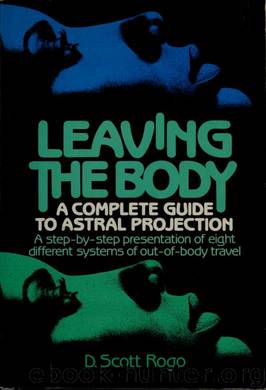
Author:Rogo, D. Scott
Language: eng
Format: epub
Tags: Astral projection
Publisher: New York : Prentice Hall Press
Published: 1983-09-05T16:00:00+00:00
use a relatively simple one. When you lie down to sleep, hold a single mental image in your mind as long as you can. When other images start popping spontaneously into your mind, you have entered the hypnagogic state.
Learn to observe these images and passively study them. This process of observation will actually keep you awake, since the mind will be kept minimally stimulated but not actually aroused. I have used this technique for years and have even trained myself to observe these images, rouse myself, write them down, and then almost immediately return to the hypnagogic state. It is, indeed, all a matter of practice. Another old method of prolonging the hypnagogic state is to rest with your arm bent at the elbow and elevated. When you are just about to fall asleep, your arm will begin to fall and alert you to the fact. Again, with practice, you will eventually be able to hold that state right between waking and sleeping for a considerable period of time. The key is simply to become aware of it.
Monroe does not call this state by its formal psychological name; he simply calls it "Condition A."
Step three: Deepen the state. Monroe advises the student to learn how to deepen the hypnagogic state as a prerequisite to leaving the body. The first exercise is to learn how to clear the mind while remaining near sleep. "Do not think of anything, but remain posed between wakefulness and sleep," he advises. "Simply look through your closed eyelids at the blackness ahead of you. Do nothing more. After a number of these exercises, you may hallucinate 'mind pictures' or light patterns. These seem to have no great significance and may merely be forms of neural discharge."* When these images cease, one has entered what Monroe calls Condition B. From here one must learn to enter even deeper into Condition C—a state of such relaxation that one loses all awareness of the body and sensory stimulation. You are almost in a void in which your only source of stimulation will be your own thoughts.
The ideal state for leaving the body, however, is Condition D. This is the same as Condition C when it is voluntarily induced from a rested and refreshed condition and is not the result of the normal fatigue that brings on sleep. To achieve Condition D, Monroe suggests that you practice
*The "light patterns" one sees while entering sleep are technically called phos-phenes and result when any stimulus other than light reaches the retina. They are not neural discharges, but purely optical effects.
Download
This site does not store any files on its server. We only index and link to content provided by other sites. Please contact the content providers to delete copyright contents if any and email us, we'll remove relevant links or contents immediately.
Animal Frequency by Melissa Alvarez(4478)
Sigil Witchery by Laura Tempest Zakroff(4250)
Real Magic by Dean Radin PhD(4134)
Fingerprints of the Gods by Graham Hancock(4009)
Aleister Crowley: The Biography by Tobias Churton(3647)
Journeys Out of the Body by Robert Monroe(3630)
Alchemy and Alchemists by C. J. S. Thompson(3526)
The Rosicrucians by Christopher McIntosh(3523)
Mysteries by Colin Wilson(3460)
The Hatha Yoga Pradipika (Translated) by Svatmarama(3353)
Hitler's Monsters by Eric Kurlander(3352)
Wicca: a guide for the solitary practitioner by Scott Cunningham(3182)
John Dee and the Empire of Angels by Jason Louv(3170)
Infinite Energy Technologies by Finley Eversole(2989)
Book of Life by Deborah Harkness(2943)
Dark Star Rising by Gary Lachman(2872)
The Book of Lies by Aleister Crowley(2849)
Aliens by Jim Al-Khalili(2837)
To Light a Sacred Flame by Silver RavenWolf(2828)
