July Crisis: The World's Descent into War, Summer 1914 by T. G. Otte
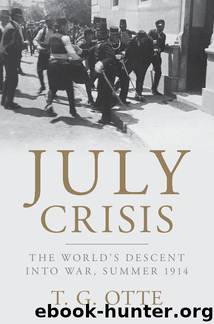
Author:T. G. Otte [Otte, T. G.]
Language: eng
Format: epub
Publisher: Cambridge University Press
Published: 2014-06-04T21:00:00+00:00
Baron Giesl leaves Belgrade
While the chancelleries of Europe moved in anticipation of Belgrade’s reply to the Habsburg démarche, the Serbian capital itself resembled a ‘beehive’, as Baron Giesl, the Austro-Hungarian minister there, later recalled. According to the recollections of his German colleague, Griesinger, the mood in the streets of Belgrade was ‘uneasy, and yet unquestionably depressed’.156
Following the presentation of Vienna’s démarche and in Pašić’s absence from the capital, during the night of 23–4 July Dušan Stefanović, the war minister, ordered the first tentative military measures in preparation for full mobilization. The military flour mill and provisions were dispatched to Niš; the railways were placed under military control, and military trains left Belgrade station; explosive devices were fitted underneath the Sava bridge to blow it up on the outbreak of conflict; medical columns were heading out of Belgrade towards the south; secret government files and the gold reserves of Serbia’s National Bank were transported to a secure location near Stalać, some thirty-eight miles north-west of Niš. Further preparations were made to evacuate the government to Niš. Later on 24 July, Field Marshal Putnik arrived at Orsova (now Orșova) from his sojourn at the Gleichenberg spa. He had been briefly detained by Austro-Hungarian police, but was then released on the orders of the Emperor himself.157
These were sensible military precautions, and were not in themselves an indication that the civilian authorities at Belgrade were coming under the influence of the military. They underlined the acute concerns about Serbia’s lack of military preparedness, fuelled by rumours of Habsburg forces massing around Semlin (now Zemun) in readiness for a strike immediately on the expiry of the ultimatum. Certainly, however, the influence of the military party had been strengthened. Drum rolls in the squares of the capital and outside its many cafés called up reservists. It was this, presumably, that persuaded the Austro-Hungarian and German ministers that mobilization was already in full swing.158 Having twice met on 24 July to discuss Vienna’s note, on the following day the Serbian cabinet was sitting almost without interruption, its meetings presided over by the Regent, Prince Alexandar. By mid-afternoon, Serbia’s official response to the Habsburg démarche was complete.159
Belgrade’s reaction to the note was, in part, conditioned by the attitude of the Powers. There was little direct support for Serbia – too objectionable had been the assassination of the Archduke, and too great appeared the risks of escalation. Even R. W. Seton-Watson, the historian and political commentator who as ‘Scotus Viator’ had acquired a reputation as a Balkans expert, was appalled by the murder of the Archduke. Although no supporter of Greater Serbian ideas, he was nevertheless sympathetic to the ambitions of the Balkan nations. Even so, he advised high-powered friends at Belgrade that ‘Servia’s duty today is to say as little as possible, to offer what little reparation it is possible to offer, without waiting to be asked to do so, and to do everything in her power to prove to the outside world that nobody in responsible positions had anything to do with the conspiracy.
Download
This site does not store any files on its server. We only index and link to content provided by other sites. Please contact the content providers to delete copyright contents if any and email us, we'll remove relevant links or contents immediately.
| Africa | Americas |
| Arctic & Antarctica | Asia |
| Australia & Oceania | Europe |
| Middle East | Russia |
| United States | World |
| Ancient Civilizations | Military |
| Historical Study & Educational Resources |
The Radium Girls by Kate Moore(12030)
100 Deadly Skills by Clint Emerson(4927)
Rise and Kill First by Ronen Bergman(4790)
The Templars by Dan Jones(4689)
The Doomsday Machine by Daniel Ellsberg(4490)
The Rape of Nanking by Iris Chang(4214)
Killing England by Bill O'Reilly(4005)
Stalin by Stephen Kotkin(3969)
Hitler in Los Angeles by Steven J. Ross(3946)
12 Strong by Doug Stanton(3551)
Hitler's Monsters by Eric Kurlander(3343)
Blood and Sand by Alex Von Tunzelmann(3205)
The Code Book by Simon Singh(3189)
Darkest Hour by Anthony McCarten(3133)
The Art of War Visualized by Jessica Hagy(3009)
Hitler's Flying Saucers: A Guide to German Flying Discs of the Second World War by Stevens Henry(2756)
Babylon's Ark by Lawrence Anthony(2682)
The Second World Wars by Victor Davis Hanson(2526)
Tobruk by Peter Fitzsimons(2518)
