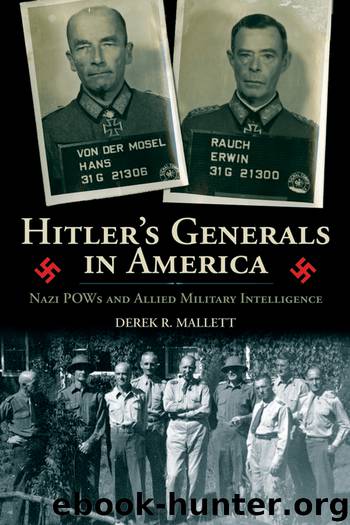
Hitler's Generals in America by Derek R. Mallett
Author:Derek R. Mallett
Language: eng
Format: epub
Publisher: The University Press of Kentucky
Published: 2018-06-28T16:00:00+00:00
5
Cold War Allies
On April 15, 1945, a German U-Boat embarked from Kristiansand on the southern tip of Norway. U-234 carried Lieutenant General Ulrich Kessler, the German air attaché and head of the German Air Force liaison staff to Tokyo. Kessler led a “mission of specialists for the purpose of acquainting the Japanese with the latest developments in German radio, radar, V and other weapons, and aircraft and assisting them in reproducing such equipment, weapons, and aircraft for Japanese use.”1
En route to Japan, U-234 received word of Germany’s unconditional surrender. Following a great deal of discussion about the best course of action, and after receiving a message from German grand admiral Karl Dönitz urging all U-boat captains to surrender, U-234’s captain, Lieutenant Commander Johann Heinrich Fehler, radioed his position to the U.S. Navy and unconditionally surrendered. The U-boat also carried two Japanese passengers, Lieutenant Commander Tomonaga Hideo and Lieutenant Shoji Genzo, serving as part of the Japanese liaison staff. The German officers allowed these men to destroy their documents and then buried them at sea after the two Japanese men entered the stateroom of U-234 and committed hara-kiri. Arriving shortly thereafter, the U.S. Navy then escorted the submarine and its distinguished passenger to Portsmouth, New Hampshire, where Kessler was officially taken into American custody as a prisoner of war.2
Kessler later claimed that he had never intended to fulfill his mission to Tokyo. Rather, he planned to go ashore on the coast of Florida and contact American officials about the possibility of collaborating. This appears to have been a distortion of the truth. In fact, Lieutenant Commander Fehler later stated that Kessler argued adamantly against surrendering to the Allies, contending that the U-boat should be sailed to South America instead.3
Regardless, Kessler’s capture marked a notable point in the American relationship with Wehrmacht generals. Rather than placing the general with his colleagues in either Clinton, Mississippi, or Dermott, Arkansas, American authorities sent him to Fort Hunt, Virginia, the secret U.S. military intelligence facility near Washington, D.C. Here the American staff interrogated and eavesdropped on Kessler in a manner that reflected British practices at Trent Park. The U.S. War Department’s Military Intelligence Service had been engaged in this type of activity throughout the war, but this was one of the few instances when its operation focused on a German general officer. In fact, Kessler was the first German general to be targeted by this kind of activity on American soil since the departure of von Vaerst, Köchy, Borowietz, Bülowius, and von Quast from the other secret U.S. military intelligence facility at Byron Hot Springs in July 1943. Why, with the war in Europe over, would Washington now find it important to initiate interrogations and eavesdrop on high-ranking Wehrmacht officers when it had shown so little interest in the dozens of German generals and admirals who had been in its immediate custody for months?
With the war against Germany concluded, the United States could now turn its full attention to the war against imperial Japan. Kessler had maintained contact with Japanese navy pilots during the war.
Download
This site does not store any files on its server. We only index and link to content provided by other sites. Please contact the content providers to delete copyright contents if any and email us, we'll remove relevant links or contents immediately.
| Africa | Americas |
| Arctic & Antarctica | Asia |
| Australia & Oceania | Europe |
| Middle East | Russia |
| United States | World |
| Ancient Civilizations | Military |
| Historical Study & Educational Resources |
The Radium Girls by Kate Moore(12030)
100 Deadly Skills by Clint Emerson(4927)
Rise and Kill First by Ronen Bergman(4790)
The Templars by Dan Jones(4689)
The Doomsday Machine by Daniel Ellsberg(4490)
The Rape of Nanking by Iris Chang(4214)
Killing England by Bill O'Reilly(4005)
Stalin by Stephen Kotkin(3969)
Hitler in Los Angeles by Steven J. Ross(3946)
12 Strong by Doug Stanton(3551)
Hitler's Monsters by Eric Kurlander(3343)
Blood and Sand by Alex Von Tunzelmann(3205)
The Code Book by Simon Singh(3189)
Darkest Hour by Anthony McCarten(3133)
The Art of War Visualized by Jessica Hagy(3009)
Hitler's Flying Saucers: A Guide to German Flying Discs of the Second World War by Stevens Henry(2756)
Babylon's Ark by Lawrence Anthony(2682)
The Second World Wars by Victor Davis Hanson(2526)
Tobruk by Peter Fitzsimons(2518)
