General Erich Hoepner by W. Chales de Beaulieu Linden Lyons
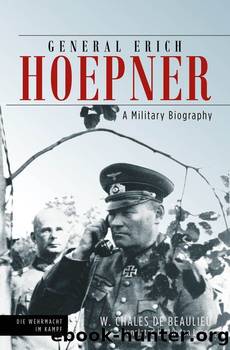
Author:W. Chales de Beaulieu, Linden Lyons [W. Chales de Beaulieu, Linden Lyons]
Language: eng
Format: epub
ISBN: 9781612009766
Barnesnoble:
Publisher: Casemate Publishers
Published: 2021-03-08T00:00:00+00:00
CHAPTER 4
The Assault on Moscow in 1941
(a)Plans for the operation
From the middle of September 1941, the bulk of the German Army in the East made preparations to launch a powerful strike that would annihilate the enemy forces under the command of Marshal Semyon Timoshenko and would subsequently lead to the capture of Moscow â the military, economic, and political centre of power of Russia. Approximately 70 divisions, all of which had already advanced far into Russian territory, would be committed to this assault. The formations at the disposal of Army Group Centre (Field-Marshal Fedor von Bock) were, from south to north, the Second Panzer Army (Colonel-General Heinz Guderian), the Second Army (Colonel-General Maximilian Freiherr von Weichs), the Fourth Army (Field-Marshal Günther von Kluge), and the Ninth Army (Colonel-General Adolf StrauÃ). Accompanying the Fourth Army was Panzer Group 4 (Colonel-General Erich Hoepner), and accompanying the Ninth Army was Panzer Group 3 (General of Panzer Troops Georg Hans Reinhardt). These formations stood along a line which followed, from the area south of Bryansk, the upper course of the Desna and then ran through the terrain on the eastern side of Smolensk, Velizh, and Velikiye Luki. It was already autumn, so the weather was bound to deteriorate soon. This would negatively impact the movement of our units, especially the motorised troops. But there was no choice. The attack had to be carried out. It was imperative that most of the enemyâs forces be destroyed before the onset of winter; otherwise, the Russian leadership would possess sufficient strength to make it more difficult for the German formations to take up a defensive position. The OKH was convinced that it would be possible to reach Moscow and thereby bring about a decisive outcome to the war. Even Colonel-General Hoepner was of the view that a final attempt should be made to achieve victory. If the risk had been taken to venture into Russia in the first place, any opportunity to defeat the enemy should be ruthlessly exploited. This did not mean that he was not apprehensive. The experience on the Volkhov front seemed to suggest that Russian reserves were inexhaustible. German strength, on the other hand, was limited. We were lacking in reserves, and most of our divisions were at half strength. The combat troops of Panzer Group 4 had been given little or no chance to rest, for they had been required to make the tiring journey to their new assembly area right away. Excessive demands had been placed on the matériel of the panzer group, and there was also a shortage of replacement parts. But if it was true that the enemy was running out of reserve forces, as believed by Hitler and many in the OKH, the attempt to take Moscow had to be made.
The planned operation would involve a double envelopment across a front approximately 200 kilometres in width. Mobile forces were to encircle and eliminate the bulk of the Russian formations to the east of Smolensk so as to create the conditions for a thrust on Moscow.
Download
This site does not store any files on its server. We only index and link to content provided by other sites. Please contact the content providers to delete copyright contents if any and email us, we'll remove relevant links or contents immediately.
| Africa | Americas |
| Arctic & Antarctica | Asia |
| Australia & Oceania | Europe |
| Middle East | Russia |
| United States | World |
| Ancient Civilizations | Military |
| Historical Study & Educational Resources |
The Radium Girls by Kate Moore(12208)
100 Deadly Skills by Clint Emerson(5034)
Rise and Kill First by Ronen Bergman(4911)
The Templars by Dan Jones(4810)
The Doomsday Machine by Daniel Ellsberg(4633)
The Rape of Nanking by Iris Chang(4338)
Killing England by Bill O'Reilly(4117)
Stalin by Stephen Kotkin(4080)
Hitler in Los Angeles by Steven J. Ross(4018)
12 Strong by Doug Stanton(3635)
Hitler's Monsters by Eric Kurlander(3479)
The Code Book by Simon Singh(3329)
Blood and Sand by Alex Von Tunzelmann(3316)
Darkest Hour by Anthony McCarten(3237)
The Art of War Visualized by Jessica Hagy(3113)
Hitler's Flying Saucers: A Guide to German Flying Discs of the Second World War by Stevens Henry(2816)
Babylon's Ark by Lawrence Anthony(2801)
Tobruk by Peter Fitzsimons(2625)
The Second World Wars by Victor Davis Hanson(2592)
