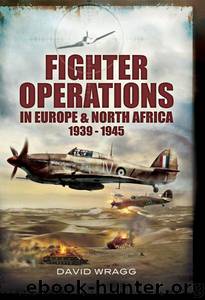
Fighter Operations in Europe and North Africa 1939-1945 by David Wragg
Author:David Wragg [Wragg, David]
Language: eng
Format: epub
Tags: HISTORY / Military / World War II
Publisher: Casemate Publishers
Published: 2012-08-23T21:00:00+00:00
He was soon to discover that his aircraft’s radio wasn’t working as he attempted to return to Furious, and this was followed by the realisation that the pneumatic system had also failed. He flew past the ship, signalling that he would have to land without flaps, meaning a faster than usual approach onto the elderly carrier’s short flight deck. Fortunately, his undercarriage worked. On landing, he found that he was the centre of attention for a large number of aircrew and naval ratings who surrounded his aircraft. It was not until he climbed down from the cockpit that he discovered why – there was a large hole about 2 feet in diameter on the port side immediately behind his seat and inside he could see that the fuselage was full of acid as a result of the accumulator blowing up. His radio was in pieces. Potentially most serious of all, only one of the control wires to the rudder had not been severed, and this had got him back safely, otherwise he would have been in trouble, losing control at just 1,000 feet. Indeed, he could see that his Seafire had looked after him very well, as the armour plate behind his seat had been peppered with shrapnel and yet he escaped unscathed.
Baldwin’s squadron commanding officer was the only person shot down from the squadrons aboard Furious, and was taken prisoner by the Vichy French. He sat in a French general’s office while they decided what to do with him, and, when they eventually surrendered, he was returned, going aboard the carrier just two days after being shot down and one of the shortest spells as a prisoner of war on record!
Vichy resistance in North Africa ended on 9 November in Oran.
MEDITERRANEAN AIR COMMAND
After the invasion of North Africa and the subsequent defeat of German forces, the Allies created a new organisation, the Mediterranean Air Command, on 18 February 1943, under the overall command of ACM Sir Arthur Tedder. This was a reversal of the earlier structure as RAF Middle East Command, led by ACM Sir Sholto Douglas, became one of MAC’s subordinate commands, as did Air HQ Malta, under AVM Sir Keith Park, and the Northwest African Air Forces (NAAF) led by Major General Carl Spaatz of the USAAF.
The decision to implement this reorganisation was taken at the Casablanca Conference the previous month, attended by Winston Churchill and the US President, Franklin Roosevelt.
Further down, the structure became more complicated. NAAF was the major sub-command and it in turn was divided into three. Major General Jimmy Doolittle commanded the North West African Strategic Air Force (NASAF) while the North West African Coastal Air Force (NACAF) was initially led by Group Captain G.G. Barrett, although he was soon relieved by AVM Sir Hugh Lloyd, and the North West African Tactical Air Force (NATAF) was commanded by Acting Air Marshal Sir Arthur Coningham. It was this latter command that took over the Western Desert Air Force, commanded by AVM Harry Broadhurst. There was also a tactical bomber sub-command within NATAF.
Download
This site does not store any files on its server. We only index and link to content provided by other sites. Please contact the content providers to delete copyright contents if any and email us, we'll remove relevant links or contents immediately.
| Africa | Americas |
| Arctic & Antarctica | Asia |
| Australia & Oceania | Europe |
| Middle East | Russia |
| United States | World |
| Ancient Civilizations | Military |
| Historical Study & Educational Resources |
The Radium Girls by Kate Moore(12036)
100 Deadly Skills by Clint Emerson(4932)
Rise and Kill First by Ronen Bergman(4797)
The Templars by Dan Jones(4695)
The Doomsday Machine by Daniel Ellsberg(4493)
The Rape of Nanking by Iris Chang(4224)
Killing England by Bill O'Reilly(4008)
Stalin by Stephen Kotkin(3973)
Hitler in Los Angeles by Steven J. Ross(3949)
12 Strong by Doug Stanton(3554)
Hitler's Monsters by Eric Kurlander(3349)
Blood and Sand by Alex Von Tunzelmann(3207)
The Code Book by Simon Singh(3197)
Darkest Hour by Anthony McCarten(3136)
The Art of War Visualized by Jessica Hagy(3014)
Hitler's Flying Saucers: A Guide to German Flying Discs of the Second World War by Stevens Henry(2759)
Babylon's Ark by Lawrence Anthony(2686)
The Second World Wars by Victor Davis Hanson(2529)
Tobruk by Peter Fitzsimons(2521)
