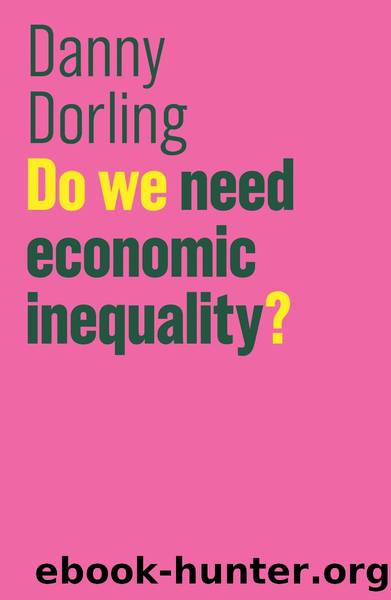
Do We Need Economic Inequality? by Danny Dorling
Author:Danny Dorling [Dorling, Danny]
Language: eng
Format: epub
ISBN: 9781509516582
Publisher: Wiley
Published: 2017-11-29T00:00:00+00:00
Having more money than others does not make you happier. You might end up buying 210 £50 bottles of wine a year just to get through the play-dates. All the key factors affecting health and happiness are relative. Recently economists from the LSE showed that: ‘People adapt to higher levels of income over time, but, much more importantly, they also compare their own income to that of their peers. Analysing data from the British Household Panel Survey, we find that life satisfaction is predicted mainly by an individual’s income relative to that of others in their peer group as defined by age, gender and region. The same is true in Australia and Germany.’49
What is often not said is that in affluent countries with narrower income inequalities, public services tend to be better funded and that appears to improve people’s mental health: people are better housed and better cared for by the state, getting around is less stressful, and they are treated better by their neighbours.
There are a huge number of different social costs that come with tolerating high inequality, many of which may initially sound surprising. One example is adoption, which is far more common in more economically unequal countries than more equal countries. In the year ending 31 March 2016 some 4,690 children were adopted in the UK whereas in the Netherlands with a population roughly four times lower, it is 28 children annually.50 That is an enormous difference in the numbers of mothers having to give up their children.
So why do you not hear more about the costs of inequality? This could be because of the political cost. Newspapers and television stations in unequal countries are bought up by tycoons, their media then begin to spread their views. These frequently include the view that it is good to have wide inequalities. National broadcasters such as the BBC are afraid to report the consequences of inequality too much for fear that they will be privatized.51
Think tanks can often only do work they are funded to do. In unequal countries they increasingly become mouthpieces for the very rich. Universities are influenced, especially ‘since “the monied interests” are able to exercise undue influence over university appointments in economics’, where appointees agree with the views of the funder.52 Political parties are bought by donation and promises of political and media support. However, because the costs of rising inequality are so high and escalate so much, the truth eventually tumbles out in fact after fact after fact. We are all losers when inequalities rise and all winners when they fall.
Download
This site does not store any files on its server. We only index and link to content provided by other sites. Please contact the content providers to delete copyright contents if any and email us, we'll remove relevant links or contents immediately.
International Integration of the Brazilian Economy by Elias C. Grivoyannis(111602)
The Radium Girls by Kate Moore(12182)
Turbulence by E. J. Noyes(8214)
Nudge - Improving Decisions about Health, Wealth, and Happiness by Thaler Sunstein(7854)
The Black Swan by Nassim Nicholas Taleb(7275)
Rich Dad Poor Dad by Robert T. Kiyosaki(6855)
Pioneering Portfolio Management by David F. Swensen(6403)
Man-made Catastrophes and Risk Information Concealment by Dmitry Chernov & Didier Sornette(6219)
Zero to One by Peter Thiel(5952)
Secrecy World by Jake Bernstein(4885)
Millionaire: The Philanderer, Gambler, and Duelist Who Invented Modern Finance by Janet Gleeson(4602)
The Age of Surveillance Capitalism by Shoshana Zuboff(4435)
Skin in the Game by Nassim Nicholas Taleb(4382)
The Money Culture by Michael Lewis(4336)
Bullshit Jobs by David Graeber(4334)
Skin in the Game: Hidden Asymmetries in Daily Life by Nassim Nicholas Taleb(4126)
The Dhandho Investor by Mohnish Pabrai(3886)
The Wisdom of Finance by Mihir Desai(3862)
Bull by the Horns: Fighting to Save Main Street From Wall Street and Wall Street From Itself by Sheila Bair(3720)
