Daron Acemoglu & James Robinson by Why Nations Fail: The Origins of Power Prosperity;Poverty
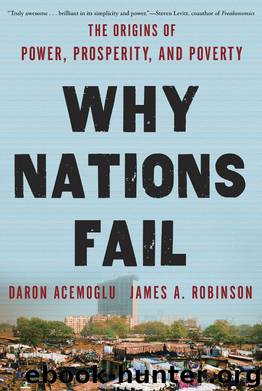
Author:Why Nations Fail: The Origins of Power, Prosperity;Poverty
Language: eng
Format: mobi
ISBN: 0307719219
Publisher: Crown Business
Published: 2012-03-20T05:00:00+00:00
All this warfare and conflict not only caused major loss of life and human suffering but also put in motion a particular path of institutional development in Africa. Before the early modern era, African societies were less centralized politically than those of Eurasia. Most polities were small scale, with tribal chiefs and perhaps kings controlling land and resources. Many, as we showed with Somalia, had no structure of hierarchical political authority at all. The slave trade initiated two adverse political processes. First, many polities initially became more absolutist, organized around a single objective: to enslave and sell others to European slavers. Second, as a consequence but, paradoxically, in opposition to the first process, warring and slaving ultimately destroyed whatever order and legitimate state authority existed in sub-Saharan Africa. Apart from warfare, slaves were also kidnapped and captured by small-scale raiding. The law also became a tool of enslavement. No matter what crime you committed, the penalty was slavery. The English merchant Francis Moore observed the consequences of this along the Senegambia coast of West Africa in the 1730s:
Since this slave trade has been us’d, all punishments are changed into slavery; there being an advantage on such condemnations, they strain for crimes very hard, in order to get the benefit of selling the criminal. Not only murder, theft and adultery, are punished by selling the criminal for slave, but every trifling case is punished in the same manner.
Institutions, even religious ones, became perverted by the desire to capture and sell slaves. One example is the famous oracle at Arochukwa, in eastern Nigeria. The oracle was widely believed to speak for a prominent deity in the region respected by the major local ethnic groups, the Ijaw, the Ibibio, and the Igbo. The oracle was approached to settle disputes and adjudicate on disagreements. Plaintiffs who traveled to Arochukwa to face the oracle had to descend from the town into a gorge of the Cross River, where the oracle was housed in a tall cave, the front of which was lined with human skulls. The priests of the oracle, in league with the Aro slavers and merchants, would dispense the decision of the oracle. Often this involved people being “swallowed” by the oracle, which actually meant that once they had passed through the cave, they were led away down the Cross River and to the waiting ships of the Europeans. This process in which all laws and customs were distorted and broken to capture slaves and more slaves had devastating effects on political centralization, though in some places it did lead to the rise of powerful states whose main raison d’être was raiding and slaving. The Kingdom of Kongo itself was probably the first African state to experience a metamorphosis into a slaving state, until it was destroyed by civil war. Other slaving states arose most prominently in West Africa and included Oyo in Nigeria, Dahomey in Benin, and subsequently Asante in Ghana.
The expansion of the state of Oyo in the middle of the seventeenth century, for example, is directly related to the increase of slave exports on the coast.
Download
This site does not store any files on its server. We only index and link to content provided by other sites. Please contact the content providers to delete copyright contents if any and email us, we'll remove relevant links or contents immediately.
International Integration of the Brazilian Economy by Elias C. Grivoyannis(111078)
The Radium Girls by Kate Moore(12036)
Turbulence by E. J. Noyes(8057)
Nudge - Improving Decisions about Health, Wealth, and Happiness by Thaler Sunstein(7712)
The Black Swan by Nassim Nicholas Taleb(7137)
Rich Dad Poor Dad by Robert T. Kiyosaki(6646)
Pioneering Portfolio Management by David F. Swensen(6305)
Man-made Catastrophes and Risk Information Concealment by Dmitry Chernov & Didier Sornette(6029)
Zero to One by Peter Thiel(5808)
Secrecy World by Jake Bernstein(4756)
Millionaire: The Philanderer, Gambler, and Duelist Who Invented Modern Finance by Janet Gleeson(4483)
The Age of Surveillance Capitalism by Shoshana Zuboff(4310)
Skin in the Game by Nassim Nicholas Taleb(4257)
The Money Culture by Michael Lewis(4212)
Bullshit Jobs by David Graeber(4197)
Skin in the Game: Hidden Asymmetries in Daily Life by Nassim Nicholas Taleb(4012)
The Dhandho Investor by Mohnish Pabrai(3776)
The Wisdom of Finance by Mihir Desai(3754)
Blockchain Basics by Daniel Drescher(3586)
