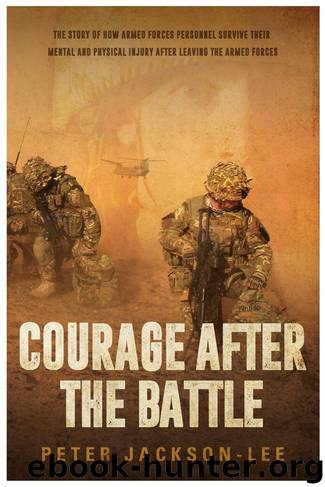
Courage After the Battle by Peter Jackson-Lee
Author:Peter Jackson-Lee
Language: eng
Format: epub
Publisher: Brown Dog Books
As conflicts change and weapons get even more powerful, the soldier in the battlefield has to cope with this, as does his body. Bearing in mind that a large percentage of the body (up to 60%) is water, this is quite a fragile piece of kit or equipment, whichever way you look at it. There is an even more fragile item, the grey matter or brain which sits quite happily in the top section of the body and is open to all manner of outside forces. In Iraq and Afghanistan, soldiers had protective armour to keep their body and vital organs safe, but that does not protect a brain or other exposed body part from a closed blast injury.
Notwithstanding the close battle situations, IEDs and low flying fighter aircraft and helicopters, soldiers will now also have to contend with the threat of so-called less lethal weapons. These are designed to target people’s sight and hearing.
This adds to the problems of the battlefield when soldiers prefer not to use hearing protection as it reduces or makes it very difficult to hear orders during the battle. These orders can be other soldiers communicating and letting you know their intentions as the battle moves forward, they are changing magazines or have a stoppage (weapon jammed), requests for covering fire to other troops in the area. The list is endless, but the need to communicate is vital during a battle and fast moving situations, as decisions are made in an instant and these have to be successfully communicated to everyone.
This is not a modern problem and veterans from all conflicts and wars have come across the same problem, with the results being hearing or other damage.
The following personal stories were taken from a Sense.Org article of deafblind service personnel by Sarah Butler, with interviews by Megan Mann.
https://www.sense.org.uk/content/talking-sense-deafblind-war-veterans
Bob Miller, born in 1915
Bob was 25 and the Manager of a greengrocer’s shop when he was called up in 1940. In the army, he was responsible for maintaining gun batteries.
“I didn’t know anything about vehicles, and I had to be able to ride a motorbike, I went in to the battery commander and told him I didn’t know how to ride one. He said ‘Well, you’ve got a week to learn!’”
Bob’s first active service was on D-Day, when he landed in France at the end of the first day of the invasion. He stated:
“If anybody said they weren’t afraid I think they’d be telling lies. The worst part was landing on the beach, being shelled and mortared and everything coming at us.”
A German bomb landed close to Bob and exploded, leaving shrapnel in the back of his right ear. He was treated in a field hospital, only the most serious cases were evacuated, and carried on fighting, sporting a large bandage round his head. Despite this, and the incredible noise of gunfire all around him during the invasion, Bob’s hearing was fine when he was demobbed.
Bob’s hearing loss developed in the 1980s:
“I applied for a pension and they put it in writing that it was through the fault of the war.
Download
This site does not store any files on its server. We only index and link to content provided by other sites. Please contact the content providers to delete copyright contents if any and email us, we'll remove relevant links or contents immediately.
| Automotive | Engineering |
| Transportation |
Whiskies Galore by Ian Buxton(42088)
Introduction to Aircraft Design (Cambridge Aerospace Series) by John P. Fielding(33180)
Small Unmanned Fixed-wing Aircraft Design by Andrew J. Keane Andras Sobester James P. Scanlan & András Sóbester & James P. Scanlan(32836)
Craft Beer for the Homebrewer by Michael Agnew(18289)
Turbulence by E. J. Noyes(8130)
The Complete Stick Figure Physics Tutorials by Allen Sarah(7427)
The Thirst by Nesbo Jo(7012)
Kaplan MCAT General Chemistry Review by Kaplan(6991)
Bad Blood by John Carreyrou(6675)
Modelling of Convective Heat and Mass Transfer in Rotating Flows by Igor V. Shevchuk(6496)
Weapons of Math Destruction by Cathy O'Neil(6371)
Learning SQL by Alan Beaulieu(6349)
Man-made Catastrophes and Risk Information Concealment by Dmitry Chernov & Didier Sornette(6144)
Digital Minimalism by Cal Newport;(5842)
Life 3.0: Being Human in the Age of Artificial Intelligence by Tegmark Max(5621)
iGen by Jean M. Twenge(5467)
Secrets of Antigravity Propulsion: Tesla, UFOs, and Classified Aerospace Technology by Ph.D. Paul A. Laviolette(5417)
Design of Trajectory Optimization Approach for Space Maneuver Vehicle Skip Entry Problems by Runqi Chai & Al Savvaris & Antonios Tsourdos & Senchun Chai(5143)
Pale Blue Dot by Carl Sagan(5083)
